
The Alto Knights
The Alto Knights is a late-career gift from two of the most important figures in American crime cinema. Barry Levinson directing, Nicholas Pileggi writing, Robert De Niro starring: this is the lineage that gave us GoodFellas and Casino, and The Alto Knights wears that heritage without apology.…
Full analysis below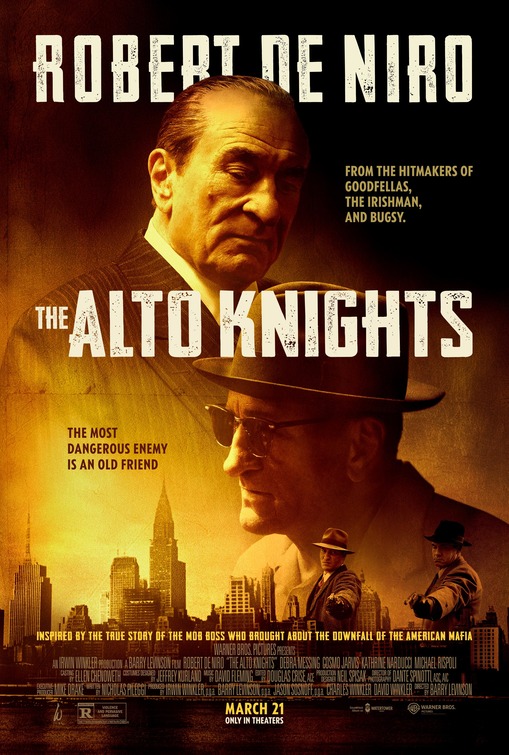
NOT A WOKE TRAP. The Alto Knights is a traditional mob film with no ideological agenda beyond telling a compelling story about loyalty, betrayal, and the costs of a life in organized crime. Any mature content is front-loaded and consistent throughout. There is no bait-and-switch. Conservative viewers who enjoy the Goodfellas lineage of crime drama will know exactly what they are getting.
The Alto Knights is a late-career gift from two of the most important figures in American crime cinema. Barry Levinson directing, Nicholas Pileggi writing, Robert De Niro starring: this is the lineage that gave us GoodFellas and Casino, and The Alto Knights wears that heritage without apology. It is not quite at that level. But it is serious, well-crafted adult filmmaking in a genre that Hollywood rarely makes anymore, and De Niro's dual performance as both Frank Costello and Vito Genovese is the best work he has done in at least a decade.
The historical premise is compelling. Frank Costello was the most powerful mob boss in America through the 1940s and early 50s, a man who wielded political influence, cultivated legitimacy, and preferred to rule through leverage rather than bloodshed. Vito Genovese was his old friend and rival who spent years in exile and returned to find Costello occupying the throne he believed was his. Their collision - and Genovese's 1957 assassination attempt against Costello, which Costello survived - is the kind of real story that needs no invention to be dramatic.
Pileggi brings his journalist's instinct for accumulating telling detail. You feel the texture of the world: the Copacabana, the backroom negotiations, the coded language of men who cannot say what they actually mean in public. Levinson directs with the unhurried confidence of someone who trusts his material. The film does not rush. It lets scenes breathe. In an era of relentlessly kinetic filmmaking, this is almost radical.
The De Niro dual performance is the main event. Playing Costello, he is weary and regal, a man who has won everything and knows the cost. Playing Genovese, he is coiled and dangerous, all suppressed grievance and entitlement. The prosthetics differentiate them physically, but the real distinction is in the body language and the rhythm of speech. When both men share scenes through intercutting, the performance never loses coherence. This is craft at the highest level.
Debra Messing as Loretta Costello is the casting surprise that pays off. She plays a woman who made her choice with open eyes and lives with it completely. The scene where she reckons with what her husband's world has cost them both is the film's most honest moment.
From a traditional values lens, The Alto Knights is complicated in the way all serious mob films are. It depicts a world built on loyalty, hierarchy, and masculine codes of conduct that are, simultaneously, real virtues corrupted by criminal purpose. The Mafia's structures of loyalty and hierarchy are parodies of traditional order: the values are real, the application is monstrous. Pileggi and Levinson understand this and do not pretend otherwise. The film shows the consequence of a life organized around violent power. It does not sentimentalize.
What it does not do is smuggle in progressive politics. There is no racial subtext, no institutional evil framing beyond the criminal institutions on screen, no girl boss retrofitting, no diversity casting engineering. The film is about two old Italian-American men who built something together and then tried to destroy each other. It respects its audience's intelligence. That alone puts it above most of what Hollywood currently produces.
Formula: Weighted Score = Severity × Authenticity Multiplier × Centrality Multiplier
🔴 Woke Tropes
| Trope | Severity | Authenticity | Centrality | Score |
|---|---|---|---|---|
| Institutional/Systemic Corruption | 3 | High | Moderate | 2.1 |
| TOTAL WOKE | 2.1 | |||
🟢 Traditional Tropes
| Trope | Severity | Authenticity | Centrality | Score |
|---|---|---|---|---|
| Masculine Codes of Loyalty and Consequence | 4 | High | High | 5.04 |
| Consequence for Transgression | 4 | High | High | 5.04 |
| Marriage as Committed Partnership | 3 | High | Moderate | 2.1 |
| Earned Status Through Performance | 2 | High | Low | 0.7 |
| Aging with Dignity | 2 | High | Low | 0.7 |
| TOTAL TRADITIONAL | 13.6 | |||
Score Margin: +11 TRAD
Director: Barry Levinson
CENTRIST LIBERAL. Levinson is an old-school Hollywood filmmaker whose work (Rain Man, Bugsy, Wag the Dog, Avalon) reflects a liberal sensibility but one rooted in character, craft, and story rather than ideology. He is not a progressive activist. He makes films about complicated men doing bad things in morally interesting ways. The Alto Knights is firmly in that tradition.Barry Levinson is 81 years old and one of the last working directors from the generation that built the New Hollywood. His credits span Rain Man (1988, Best Picture Oscar), Good Morning Vietnam (1987), Bugsy (1991), Wag the Dog (1997), and Diner (1982). He is a Baltimore native whose best work draws on personal geography and the rhythms of working-class life. The Alto Knights reunites him with Robert De Niro - who starred in Wag the Dog - for a film about the real-life fallout between mob bosses Frank Costello and Vito Genovese. Levinson brings the steady, character-first approach of a filmmaker who has nothing left to prove and no interest in chasing trends.
Writer: Nicholas Pileggi
Nicholas Pileggi is the most important writer in American mob cinema. He wrote the books and screenplays for GoodFellas (with Scorsese) and Casino (with Scorsese). At 86, he returns for The Alto Knights with the same obsessive factual grounding that made those films landmark documents of organized crime in America. Pileggi's scripts are notable for their specificity, their refusal to romanticize without also acknowledging horror, and their deep respect for historical record. He draws on his decades of reporting on the New York mob to tell the story of Costello and Genovese's collision course.
Adult Viewer Insight
Conservative adults who enjoy serious crime drama will find The Alto Knights worth their time. It is not a morality play and it does not pretend to be. It shows men who lived by a code that produced tremendous violence and mutual betrayal, and it tells that story with the craft of filmmakers who have been doing this at the highest level for fifty years. De Niro's dual performance is worth the ticket price alone. The film earns its TRADITIONAL LEAN score because it treats loyalty, hierarchy, consequence, and masculine duty as real things with real weight, even as it shows what those things look like when applied to criminal ends. There is no progressive agenda here. Just a very good crime film.
Parental Guidance
Rated R for violence, language, and adult content throughout. This is emphatically not a family film. The violence is significant - multiple shootings including an assassination attempt - and the language includes period-appropriate ethnic slurs and strong profanity throughout. Adult viewers only. If you are a fan of GoodFellas or Casino, you know what you are signing up for. If those films were too much for you, The Alto Knights will be as well.
Find The Alto Knights on Amazon Prime Video, rent, or buy:
▶ Stream or Buy on AmazonAs an Amazon Associate, VirtueVigil earns from qualifying purchases.
Community Discussion 0
Subscribe to comment.
Join the VirtueVigil community to share your perspective on this review.