Am I Racist?
Am I Racist? is Matt Walsh doing his best Borat impression, and it works more often than it doesn't.
Full analysis below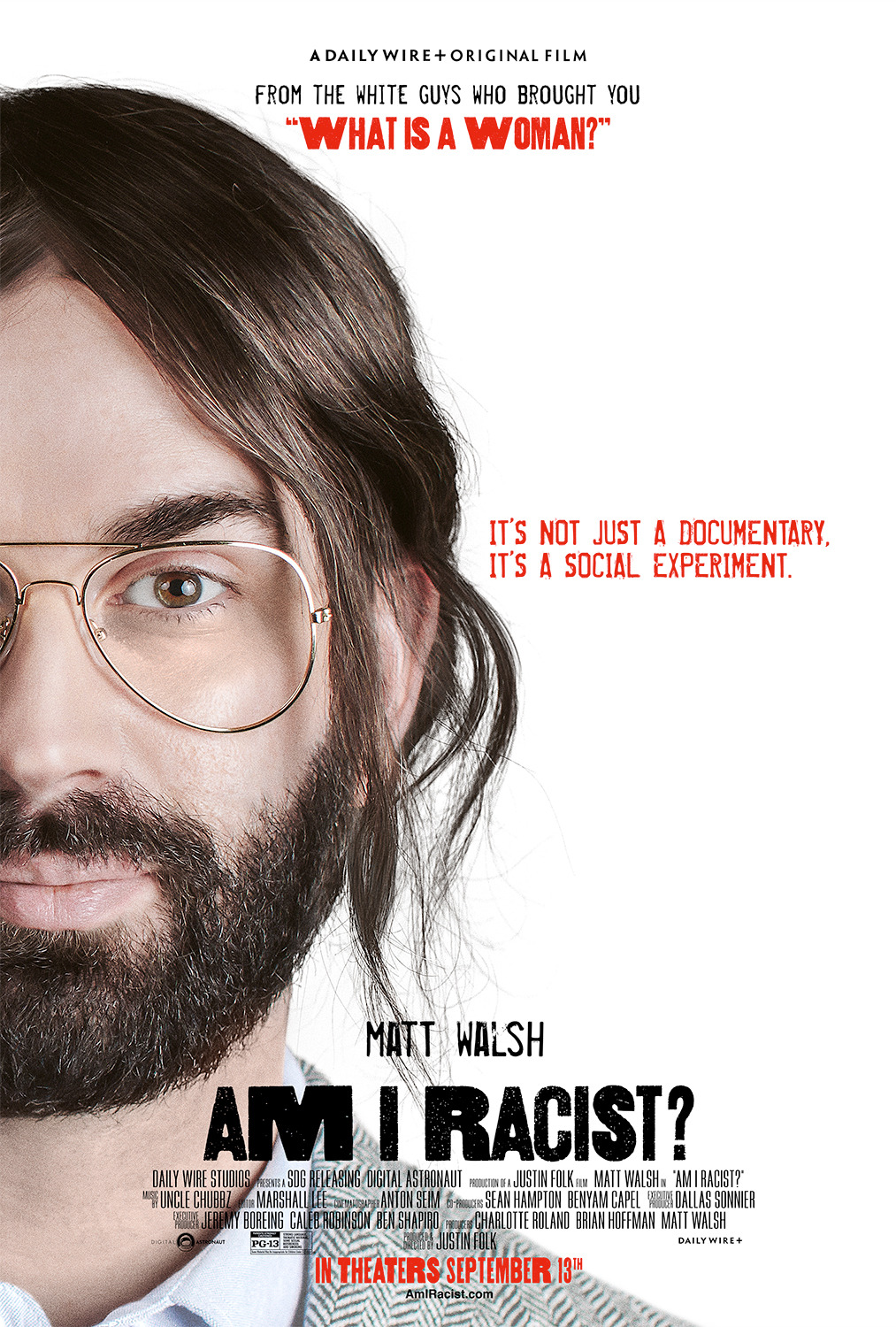
NOT A WOKE TRAP. Am I Racist? is a satirical documentary produced by The Daily Wire, hosted by Matt Walsh, and marketed explicitly as a conservative takedown of the DEI industry. The film's ideological position is announced from the first frame and never wavers. There is no bait-and-switch. Conservative viewers know exactly what they're getting. The only people surprised by this film's perspective are the DEI practitioners who didn't realize Walsh was undercover.
Am I Racist? is Matt Walsh doing his best Borat impression, and it works more often than it doesn't.
The premise is simple. Walsh, a Daily Wire podcast host and professional conservative provocateur, goes undercover as a bumbling white man named 'Steven' who desperately wants to confront his own racism. He gets a DEI certification online, prints himself a laminated card, and starts paying real money for access to the biggest names in the anti-racism industry. The result is a satirical documentary that became the highest-grossing documentary of 2024, earned $12.3 million against a $3 million budget, and delivered the biggest opening weekend for a political documentary since Fahrenheit 9/11 in 2004.
The film's structure follows Walsh through escalating encounters. Early scenes establish the premise: he attends a white guilt support group, gets kicked out, and decides to go deeper. He interviews Kate Slater, inventor of the Anti-Racist Roadmap, who tells him to 'do the work' without ever clearly defining what 'the work' actually is. This becomes the film's running joke and its most effective satirical weapon. Every DEI expert Walsh encounters uses the same vague, unfalsifiable language. The work is always more work. The racism is always deeper than you think. And the solution always seems to involve paying the person talking.
The film's best sequence is Walsh's infiltration of a Race2Dinner event, where co-founders Saira Rao and Regina Jackson charge white women $5,000 per dinner to be told that America is irredeemably racist and that 'the entire system has to burn.' Walsh, disguised as a waiter, drops plates and spills water while interjecting his own exaggerated white guilt platitudes. The scene is genuinely funny because it lets Rao and Jackson make themselves look absurd without Walsh needing to do much. When Rao declares that Republicans are Nazis and that the country should be burned to the ground, the audience doesn't need Walsh's commentary. The material speaks for itself.
The Robin DiAngelo interview is the film's marquee moment. Walsh paid $15,000 for the privilege of sitting across from the author of White Fragility, the book that became the Bible of the corporate anti-racism movement. The meeting starts cordially. Then Walsh asks DiAngelo about reparations. She says she supports them. Walsh brings his Black producer, Ben, on camera and hands him $30. Then he pressures DiAngelo to do the same. She resists. He persists. Eventually, she goes to her purse and gives Ben cash of her own. The moment is devastating because it exposes the gap between ideology and practice. DiAngelo has made millions telling white people they are complicit in racism. When asked to put her own money where her mouth is, in the most literal way possible, she squirms. Ben, for his part, simply says he'll never say no to someone who wants to give him money.
Walsh also does street-level interviews that serve as the film's emotional counterweight. He visits a biker bar in the South, expecting to find racism. Instead, he finds working-class men who dismiss the entire DEI framework with blunt common sense. 'We all bleed the same, man,' one heavily tattooed biker tells him. An older Black mechanic from British Guiana laughs off Walsh's offer of a DEI book and says the only book he reads is the Bible. 'Love one another,' the mechanic says. These scenes work because they suggest that the people furthest from the DEI industry have already arrived at the conclusion the industry claims to be working toward.
The film's climax is Walsh's own fake DEI workshop, the 'Do the Work Workshop,' where he brings in real participants via a Craigslist ad. He confesses his uncle Frank's racist joke from twenty years ago, berates the man in front of the group, and eventually distributes self-flagellation devices as a metaphor for white guilt. Some participants leave. Some stay. Walsh then breaks character, tells the room the entire thing is a scam, and walks out. The sequence runs a bit long and doesn't land as sharply as the DiAngelo interview or the Race2Dinner scene, but the central point hits: how far will people go along with something they know is absurd if the social pressure is strong enough?
The Thomas Sowell quote that closes the film is the intellectual thesis statement Walsh has been circling for 101 minutes: the anti-racism industry has become a self-perpetuating racket where the solution to racism is always more anti-racism training, more money, more guilt, and more division.
Is it fair? Not entirely. Walsh is dealing from a stacked deck. He selects the most extreme voices, edits for maximum embarrassment, and never engages with the strongest versions of the arguments he's mocking. The film never interviews a measured, credible voice who supports diversity initiatives from a non-grifter perspective. It treats the entire DEI industry as a monolith of charlatans, which is rhetorically effective but intellectually dishonest. The deception required to make the film also raises ethical questions. Walsh lied to get these interviews. DiAngelo's complaint that she 'had been played' is factually accurate, whatever you think of her work.
But as a piece of political comedy, it works. Walsh's deadpan is strong enough to sustain the premise, even if he lacks the manic genius of Sacha Baron Cohen at his peak. The box office proves there's a massive audience hungry for this kind of cultural pushback. And the film's most effective moments, the ones where DEI practitioners damn themselves with their own words, require no editorial spin.
Am I Racist? is not a documentary in any traditional sense. It's a satirical weapon designed to ridicule a specific cultural movement. It does that well. Whether you find it hilarious or mean-spirited depends entirely on what you think of the movement it targets.
Formula: Weighted Score = Severity × Authenticity Multiplier × Centrality Multiplier
🔴 Woke Tropes
| Trope | Severity | Authenticity | Centrality | Score |
|---|---|---|---|---|
| Deceptive Filmmaking Ethics | 2 | 1 | 0.5 | 1 |
| Selective Targeting / Strawman Construction | 2 | 1 | 1 | 2 |
| N-word Discussion Without Resolution | 1 | 1.4 | 0.5 | 0.7 |
| TOTAL WOKE | 3.7 | |||
🟢 Traditional Tropes
| Trope | Severity | Authenticity | Centrality | Score |
|---|---|---|---|---|
| Exposing Institutional Grift | 5 | 0.7 | 1.8 | 6.3 |
| Colorblind Common Sense as Moral Ideal | 4 | 0.7 | 1.8 | 5.04 |
| Personal Responsibility Over Systemic Analysis | 4 | 0.7 | 1 | 2.8 |
| Anti-Elitism / Common People Know Best | 4 | 0.7 | 1 | 2.8 |
| Free Speech and Satire as Corrective Force | 3 | 0.7 | 1.8 | 3.78 |
| Faith and Scripture as Moral Foundation | 3 | 0.7 | 0.5 | 1.05 |
| Defense of Western Heritage | 3 | 0.7 | 1 | 2.1 |
| Rejection of Collective Guilt | 4 | 0.7 | 1.8 | 5.04 |
| Hypocrisy Exposed Through Actions | 4 | 0.7 | 1 | 2.8 |
| Mockery of Social Conformity | 3 | 0.7 | 1 | 2.1 |
| TOTAL TRADITIONAL | 33.8 | |||
Score Margin: +30 TRAD
Director: Justin Folk
CONSERVATIVE. Folk is The Daily Wire's in-house director, responsible for both of Walsh's documentary films. His previous credits include What Is a Woman? (2022) and a VFX background on studio films like The Matrix Reloaded. He left mainstream Hollywood for The Daily Wire and has no ambiguity about his ideological alignment.Justin Folk is an American filmmaker who transitioned from VFX work on major studio productions (The Matrix Reloaded, The Matrix Revolutions, The Incredible Hulk) to directing documentaries for The Daily Wire. His first feature as director was What Is a Woman? (2022), which became a viral cultural flashpoint about gender ideology. Am I Racist? is his second feature and marks The Daily Wire's first theatrically released film. Folk also co-wrote the screenplay with Walsh, Brian Hoffman, and Dallas Sonnier. His directorial approach borrows heavily from the Borat playbook: hidden cameras, undercover personas, and letting subjects reveal themselves through their own words. The result is more guerrilla journalism than traditional documentary filmmaking.
Writer: Justin Folk, Brian Hoffman, Matt Walsh, Dallas Sonnier
A four-writer team with overlapping producer credits. Walsh is the on-screen talent and driving creative force. Brian Hoffman produced both of Walsh's documentaries. Dallas Sonnier is a veteran producer who previously ran Cinestate (Bone Tomahawk, Brawl in Cell Block 99, Dragged Across Concrete) and managed the early careers of Greta Gerwig and Leslye Headland before leaving mainstream Hollywood over what he described as its 'politicized nature.' Sonnier rebranded his company as Bonfire Legend and partnered exclusively with The Daily Wire. The writing credits are somewhat nominal for a documentary. The 'script' consists primarily of Walsh's undercover scenarios, interview setups, and the structural arc of the film.
Adult Viewer Insight
Conservative adults will love this film. It confirms every suspicion they've had about the DEI industry: that it's a money-making scheme, that its practitioners can't clearly define their own terms, and that the anti-racism framework creates more racial division than it solves. The Robin DiAngelo reparations scene alone is worth the ticket price for anyone who's been forced to sit through corporate diversity training. The film's weaknesses are real but won't bother the target audience. Walsh never engages with the strongest case for diversity work. He cherry-picks the most extreme examples. The deception is ethically dubious. But the target audience isn't watching for balanced journalism. They're watching for catharsis, and the film delivers it in spades. Liberal or progressive adults will find the film infuriating, dishonest, and mean-spirited. Moderates will laugh at some of it and wince at the rest.
Parental Guidance
Rated PG-13 for strong language, thematic material, some sexual references and smoking. Seven bleeped but recognizable f-words and moderate profanity throughout. One crude sexual reference on a character's t-shirt. Comedic recreation of a hate crime hoax including a noose. No violence, nudity, or drug content beyond bar scenes with alcohol. The real concern is comprehension: children under 12 won't understand the cultural context. This is best suited for teens 13+ and adults. Conservative families will find it a useful entry point for discussing DEI, anti-racism, and media criticism with older teenagers.
Find Am I Racist? on Amazon Prime Video, rent, or buy:
▶ Stream or Buy on AmazonAs an Amazon Associate, VirtueVigil earns from qualifying purchases.
Community Discussion 0
Subscribe to comment.
Join the VirtueVigil community to share your perspective on this review.