
Beetlejuice Beetlejuice (2024)
Tim Burton made a sequel to Beetlejuice 36 years after the original, and the result is exactly what you'd expect from a director who has been coasting on his own aesthetic for at least a decade: a film that looks like a Tim Burton movie, sounds like a Tim Burton movie, and delivers about 60% of the …
Full analysis below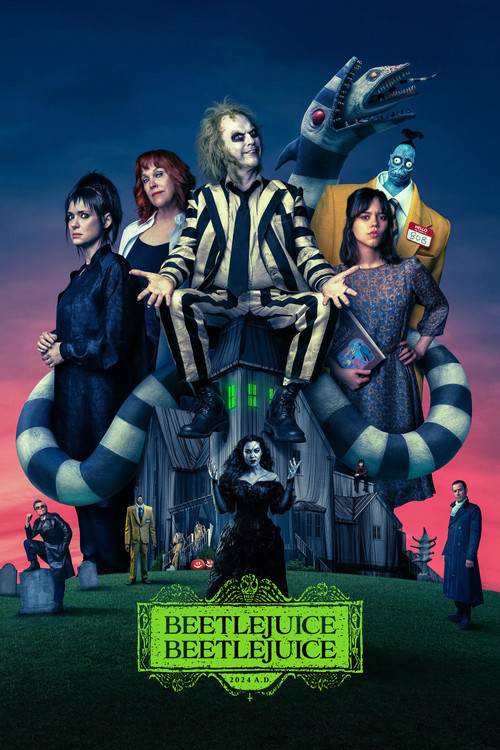
This film draws you in for a significant portion of its runtime with traditional or neutral content before springing its woke agenda. Know before you go!
MILD WOKE TRAP. The marketing leans hard on 1988 nostalgia: Beetlejuice is back, Michael Keaton is back, the sandworms are back, the practical effects are back. What the marketing downplays is that the film's emotional center is a mother-daughter conflict about Lydia's new-age TV career, a Gen Z daughter (Astrid) who resents her mother's entire worldview, and a progressive reframing of the Deetz family dynamic where Charles Deetz is killed off-screen and Delia's feminist art career is played for laughs that are also endorsements. The Beetlejuice nostalgia is genuine, but it's wrapped around a 2024 family structure that conservative viewers may not have signed up for.
Tim Burton made a sequel to Beetlejuice 36 years after the original, and the result is exactly what you'd expect from a director who has been coasting on his own aesthetic for at least a decade: a film that looks like a Tim Burton movie, sounds like a Tim Burton movie, and delivers about 60% of the joy of a Tim Burton movie. The Beetlejuice scenes work. Everything around them is a mixed bag of nostalgia, generational comedy, and progressive family dynamics that never quite gel.
Charles Deetz has died off-screen in a plane crash (the film gives him an absurd shark-related send-off in the afterlife). Lydia Deetz (Winona Ryder) has become the host of a ghost-hunting TV show called "Ghost House," a clear parody of paranormal reality television. She's dating Rory (Justin Theroux), her producer and manager, who is transparently a con man. Her daughter Astrid (Jenna Ortega) is a cynical, science-minded teenager who resents her mother's belief in the supernatural and her grandmother Delia's (Catherine O'Hara) avant-garde art nonsense.
The Deetz family returns to Winter River, Connecticut for Charles's memorial. Astrid meets Jeremy (also a ghost, though she doesn't know it yet), and through a series of events, gets pulled into the afterlife. Lydia is forced to summon Beetlejuice (Michael Keaton) for help. Beetlejuice, still obsessed with marrying Lydia, agrees to rescue Astrid in exchange for Lydia's hand. Meanwhile, Beetlejuice's ex-wife Delores (Monica Bellucci), a soul-consuming entity, is stalking him through the afterlife for revenge.
The afterlife sequences are the film's strongest material. Burton's imagination fires on all cylinders in the bureaucratic underworld. The practical effects are genuinely impressive in an era of CGI saturation. Michael Keaton's performance is as manic and funny as it was in 1988. Willem Dafoe as Wolf Jackson, a dead action-movie star who now plays an afterlife detective, is an inspired comic creation.
The living-world material is weaker. The Rory con-man subplot is predictable and wastes Justin Theroux. Astrid's romance with Jeremy has a genuine emotional beat but is undercooked. The generational conflict between Lydia and Astrid, which should be the film's heart, never achieves the depth it needs because the script keeps cutting away to afterlife slapstick.
Trope Analysis -- VVWS Weighted Scoring
Woke Tropes
| Trope | Severity (1-5) | Authenticity | Centrality | Weighted Score |
|---|---|---|---|---|
| Patriarch eliminated, Charles Deetz killed off to center female family dynamic | 3 | Low, feels like a writing convenience | Central | 4.2 |
| Male romantic interest (Rory) as fraud and predator, coded as a critique of patriarchal exploitation | 3 | Moderate | Moderate | 3.0 |
| Gen Z daughter as the rational corrective to her mother's beliefs, generational superiority coding | 2 | Moderate | Moderate | 2.0 |
| Delia's feminist art treated as both joke and valid self-expression | 2 | High, consistent with her character | Supporting | 1.4 |
| All-female family unit as emotional center with no positive male figures among the living | 2 | Moderate | Central | 2.5 |
| Soul Drain subplot, Delores framed as wronged ex-wife seeking justified revenge | 2 | Moderate | Supporting | 2.0 |
| WOKE TOTAL | 15.1 |
Traditional Tropes
| Trope | Severity (1-5) | Authenticity | Centrality | Weighted Score |
|---|---|---|---|---|
| Mother-daughter reconciliation, Lydia and Astrid finding common ground | 3 | High | Central | 3.8 |
| Practical craftsmanship, Burton's commitment to practical effects over CGI | 3 | High | Supporting | 2.1 |
| Con man exposed and punished, Rory gets his comeuppance | 2 | High | Supporting | 1.4 |
| Nostalgia as genuine cultural value, the original's spirit honored | 2 | Moderate | Supporting | 1.4 |
| Afterlife has rules and consequences, moral universe with structure | 2 | High | Supporting | 1.4 |
| Marriage as binding contract, even in the afterlife (played for comedy but taken seriously by the plot) | 2 | Moderate | Supporting | 1.4 |
| TRAD TOTAL | 11.5 |
Director Ideological Track Record
Tim Burton's career is a case study in how aesthetic identity maps onto ideological sympathy. His films consistently side with outcasts, misfits, and weirdos against conformist society. This is a progressive instinct, but Burton's execution has historically been more personal than political:
- Edward Scissorhands (1990): Outsider vs. suburbia. The suburbs are conformist and cruel. This reads progressive, but Burton's target is human cruelty in general, not a specific political system.
- Ed Wood (1994): A celebration of passion over competence. Ed Wood is terrible at filmmaking and magnificent at caring about it. No political content.
- Sweeney Todd (2007): Class-based revenge fantasy set in Victorian London. Mildly progressive in its sympathy for the dispossessed.
- Big Eyes (2014): Based on a true story of a woman whose husband stole credit for her art. Straightforward feminist narrative, but grounded in historical fact.
- Wednesday (2022, TV): Gothic outsider girl vs. prep school conformity. Moderate progressive elements in institutional critique, balanced by genuine love of classic horror tropes.
- Beetlejuice Beetlejuice (2024): The subject of this review.
Burton is not a political filmmaker. He's a temperamental one. His films side with weirdness against normalcy. In the 1980s and 1990s, that was countercultural. In 2024, it's practically mainstream Hollywood orthodoxy, which is perhaps why Burton's recent work feels less distinctive than it once did.
Adult Viewer Insight
Michael Keaton is the reason to see this film, and he is a very good reason. At 73, he delivers Beetlejuice with the same unhinged energy he brought to the role at 37. The performance is not nostalgic. It's vital. Every scene he's in crackles with anarchic joy. Willem Dafoe matches him beat for beat as Wolf Jackson. Catherine O'Hara's Delia remains the franchise's great unsung comic creation: a woman so committed to her own pretentiousness that she becomes genuinely lovable.
The problem is everything around Beetlejuice. The Rory subplot is a waste of Justin Theroux's considerable talent. The Monica Bellucci villain barely speaks and exists primarily as a visual. The Astrid-Jeremy romance needed another draft. And the elimination of Charles Deetz, while understandable given Jeffrey Jones's real-world legal issues, leaves a father-shaped hole in the family dynamic that the film never fills with anything equally substantial.
Conservative viewers should calibrate expectations. This is a nostalgia sequel that delivers the nostalgia but wraps it in a 2024 family dynamic where the patriarch is dead, the men are villains or ghosts, and three generations of women figure things out on their own. That's not offensive. It's just noticeably, unmistakably current. If you can enjoy Beetlejuice's scenes (and you will, they're excellent) and tolerate the contemporary framing, the film is a fun ride. If the framing bothers you, you still have the 1988 original.
Director: Tim Burton
Outsider-sympathetic auteur, moderate progressive leanTim Burton has spent four decades making films about misunderstood outsiders. His sympathies have always been with the freaks, the goths, the misfits. This is an inherently progressive disposition, but Burton expresses it through visual imagination rather than political messaging. His films rarely lecture. They invite you into a world where the weird kids are right.
Writer: Alfred Gough & Miles Millar
Best known for creating Smallville and writing the screenplay for Spider-Man 2. Journeyman screenwriters who serve the director's vision. Their Wednesday (2022) for Burton on Netflix had moderate progressive elements (outsider empowerment, institutional critique) balanced by genuine gothic atmosphere.
Adult Viewer Insight
Michael Keaton is the reason to see this film, and he's a very good reason. At 73, he delivers Beetlejuice with the same unhinged energy he brought at 37. Willem Dafoe and Catherine O'Hara are equally excellent. The problem is everything around Beetlejuice: a predictable con-man subplot, an underdeveloped romance, and the elimination of Charles Deetz leaving a father-shaped hole in the family dynamic. Conservative viewers should calibrate expectations. This is nostalgia wrapped in a 2024 family structure where three generations of women figure things out alone. Enjoy the Beetlejuice scenes (they're excellent) and tolerate the framing.
Parental Guidance
Ages 10+ -- PG-13: - Macabre humor throughout (consistent with the original): shrunken heads, afterlife bureaucracy, soul consumption - A character is eaten by a shark (played for absurd comedy, not graphic) - Mild language - No sexual content beyond a brief kiss - The afterlife is presented as a real place with rules, not as a religious concept. Parents who want to discuss spiritual themes will find entry points but the film doesn't invite that conversation itself - Jump scares are mild and comedic rather than genuinely frightening Appropriate for the same age range as the original. Children who loved the 1988 film will enjoy this. The afterlife sequences are the highlight. The family drama is more for adults. A perfectly fine Halloween-season family watch, though it lacks the original's strange magic. VirtueVigil Editorial Team Review Date: February 2026
Find Beetlejuice Beetlejuice (2024) on Amazon Prime Video, rent, or buy:
▶ Stream or Buy on AmazonAs an Amazon Associate, VirtueVigil earns from qualifying purchases.




Community Discussion 0
Subscribe to comment.
Join the VirtueVigil community to share your perspective on this review.