Black Adam
Black Adam is a movie that has everything it needs to be a great comic book film and makes almost none of it work.
Full analysis below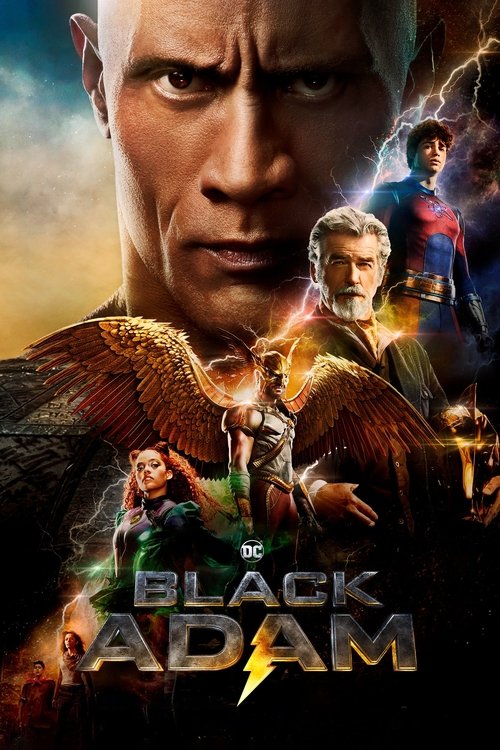
Not a woke trap. Black Adam's anti-colonial framing is present from the premise: an ancient warrior awakened to free an oppressed nation from foreign criminal occupation. Trailers established Dwayne Johnson as a brutal, morally ambiguous antihero operating outside American institutional authority. The diverse cast and Middle Eastern setting are consistent with the marketing. No hidden progressive agenda. The film is what it advertises: a Dwayne Johnson vehicle with nationalist liberation themes wrapped in DC mythology.
Black Adam is a movie that has everything it needs to be a great comic book film and makes almost none of it work.
Dwayne Johnson as an ancient Egyptian champion wrongly imprisoned for five thousand years, released into a modern nation under criminal occupation, with no moral framework other than his own judgment and zero patience for due process? That is a genuinely interesting premise. A power fantasy about the kind of justice that does not wait for institutions. A character who represents the frustration of a people abandoned by legitimate authority. That premise should sing.
Instead it lumber along for 125 minutes, occasionally spectacular, mostly inert.
The film's most honest scene is early. Teth-Adam is released, immediately begins killing Intergang soldiers, and Adrianna Tomaz, who called him up from his tomb, watches in horror. She did not want a killer. She wanted a liberator. Adam does not understand the distinction. He was a champion of Kahndaq in an age when champions killed people who oppressed Kahndaq. The film is at its best when it sits with this dissonance.
The Justice Society arrives to stop him, and this is where the film should really begin: the argument between Hawkman's rule-of-law morality and Black Adam's results-based justice. That argument has weight. Aldis Hodge plays Hawkman with genuine conviction, and Johnson's Adam is, at his best, a man who has watched idealism fail so many times he no longer believes it is available to him. These two should be the film's spine.
Instead, the film pivots to a third-act villain (Sabbac, the demonic warlord) who is so generic he makes Hawkman's institutional concerns look like moral philosophy by comparison. The real antagonism drains away in favor of CGI escalation.
Pierce Brosnan's Doctor Fate is the film's saving grace. He is an old man who has seen too much of the future, and his acceptance of what is coming for him is the only characterization in the film that achieves genuine weight. His final scene is the only moment in the movie that lands as intended.
From a traditional values perspective, Black Adam is a better score than its reputation suggests. The film's liberation narrative is nationalist in the traditional sense: Kahndaq for the Khandaqis. There is no universal human rights framing, no progressive internationalism. Adam does not free Kahndaq because all people deserve freedom. He frees Kahndaq because it is his people and his land. The film treats this as a complete moral justification. That framing is closer to conservative nationalism than to left-wing anti-colonialism.
The masculine power fantasy is unapologetic. Adam is not asked to become more empathetic or emotionally intelligent. He is asked to apply his power correctly, not to reconsider whether power is appropriate at all. The film ultimately endorses his approach: the bad guys are stopped, Kahndaq is freed, and institutional authorities who tried to contain him are proved wrong. This is not a film about the limits of individual power.
The anti-colonialism scoring reflects the fact that Kahndaq's occupation by Intergang is framed with direct parallels to colonial occupation narratives. The US government's response (send the Justice Society to contain the local champion who is upsetting regional stability) maps onto historical patterns of imperial power managing local uprisings. The film draws this parallel intentionally, and it carries some woke freight even if Adam's solution is deeply traditional.
Bottom line: Black Adam is a frustrating film because it glimpses the movie it could have been in every third scene, then retreats to safety. Johnson's charisma and the Adam premise deserve better material. The DC franchise's decision not to pursue a sequel is comprehensible from a box office perspective, but the character still has potential that was never properly tapped.
Formula: Weighted Score = Severity × Authenticity Multiplier × Centrality Multiplier
🔴 Woke Tropes
| Trope | Severity | Authenticity | Centrality | Score |
|---|---|---|---|---|
| Anti-Colonial / National Liberation Framing | 3 | 0.7 | 1.8 | 3.78 |
| Female Catalyst / Lead Supporting Character | 2 | 1 | 1 | 2 |
| Institutional / US Government as Obstacle to Justice | 2 | 0.7 | 1 | 1.4 |
| Diverse Ensemble Cast | 1 | 1 | 0.5 | 0.5 |
| TOTAL WOKE | 7.7 | |||
🟢 Traditional Tropes
| Trope | Severity | Authenticity | Centrality | Score |
|---|---|---|---|---|
| Masculine Power Fantasy (Unqualified) | 4 | 0.7 | 1.8 | 5.04 |
| Justice Outside Institutional Law | 3 | 0.7 | 1.8 | 3.78 |
| Protector / Champion Archetype | 3 | 0.7 | 1 | 2.1 |
| Nationalist Pride / Sovereignty of a People | 2 | 0.7 | 1 | 1.4 |
| Divine Authority / Ancient Sacred Covenant | 2 | 0.7 | 0.5 | 0.7 |
| TOTAL TRADITIONAL | 13.0 | |||
Score Margin: +5 TRAD
Director: Jaume Collet-Serra
CENTER. Spanish-born director with no known political agenda. His prior work includes Orphan (2009), Non-Stop (2014), and The Shallows (2016). He is a genre craftsman who works from scripts rather than personal ideology. His action sensibility favors kinetic editing and visceral spectacle over thematic depth.Jaume Collet-Serra has spent much of his career making efficient, well-crafted genre films with Liam Neeson and Gerard Butler. Black Adam is his largest production by a significant margin. His direction here is competent but not auteurist — the action sequences have visual energy, and he handles the scale without embarrassing himself, but there is little stylistic distinctiveness. The film's tone is erratic in ways that seem scripted rather than directed.
Writer:
Adam Sztykiel (Made in Italy, Rampage) developed the original script. Rory Haines and Sohrab Noshirvani, the team behind Good Behavior and The Informer, rewrote it. The script is the film's primary weakness: its tone ranges from family-friendly adventure to gruesome violence without finding a register that serves both. The liberation narrative has genuine weight in individual scenes but never achieves the thematic coherence needed to anchor the character study Johnson intended.
Adult Viewer Insight
Conservative adults will find more in Black Adam than the mixed reviews suggested. The film's liberation narrative is nationalist rather than progressive — Adam fights for his people, not for universal principles, and the film treats this as sufficient moral justification. The masculine power fantasy is unqualified. Hawkman's rule-of-law morality is taken seriously as a counterpoint but ultimately loses to results-based justice. The US government (Amanda Waller) is the institutional villain trying to contain a legitimate champion of his people. That framing plays differently depending on your politics, but its bones are traditional. The film is a mess, but an ideologically interesting mess.
Parental Guidance
PG-13. Appropriate for ages 12 and up. Frequent action violence including a protagonist who kills enemies. Demonic villain imagery in the third act. Brief ancient slavery flashback. No sexual content, no nudity, mild language. Standard PG-13 fare with slightly higher body count than typical superhero films.
Find Black Adam on Amazon Prime Video, rent, or buy:
▶ Stream or Buy on AmazonAs an Amazon Associate, VirtueVigil earns from qualifying purchases.
Community Discussion 0
Subscribe to comment.
Join the VirtueVigil community to share your perspective on this review.