
Blitz
Steve McQueen's "Blitz" arrives dressed in the clothing of a wartime survival story, the kind of tale that should celebrate British resilience, familial devotion, and the quiet heroism of ordinary people under extraordinary duress.…
Full analysis below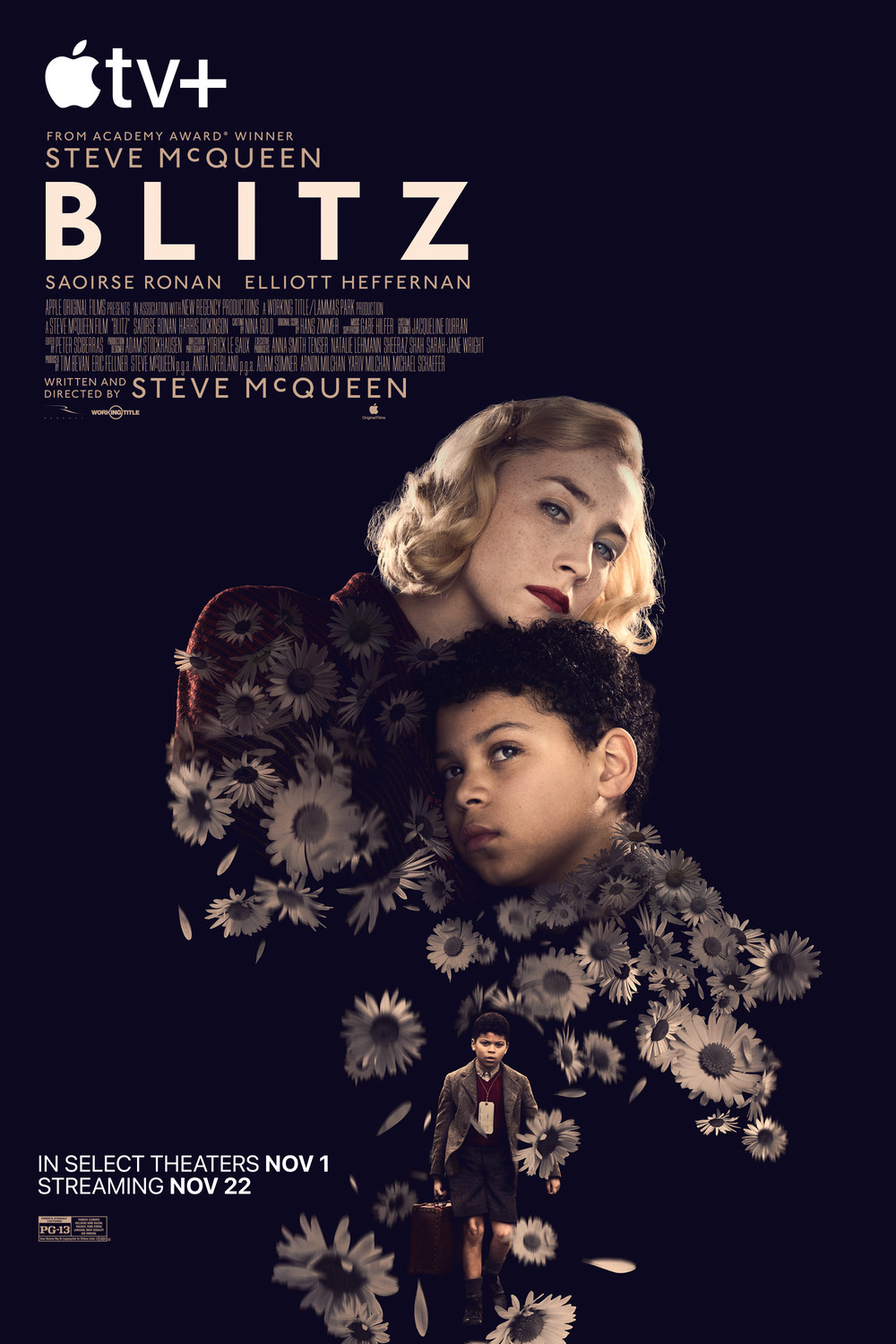
This film draws you in for a significant portion of its runtime with traditional or neutral content before springing its woke agenda. Know before you go!
The racial and colonial themes are visible from the first act and maintain consistent presence throughout. McQueen does not disguise his intentions. Conservative viewers will know what they are watching within the first 15 minutes.
Steve McQueen's "Blitz" arrives dressed in the clothing of a wartime survival story, the kind of tale that should celebrate British resilience, familial devotion, and the quiet heroism of ordinary people under extraordinary duress. And to be fair, those elements genuinely exist here, more than a first viewing might suggest. Saoirse Ronan delivers a deeply committed performance as Rita, a mother whose entire being is organized around recovering her evacuated son. Young Elliott Heffernan carries real emotional weight as nine-year-old George navigating a bombed-out London. The Blitz itself is rendered with impressive craft. But McQueen is not content to tell a straightforward story about survival and love. He is interested in using the Second World War as a backdrop for a modern lecture on race, colonialism, and institutional bigotry. The war is not the subject; it is the set dressing.
The film's central conceit, that George is mixed-race in 1940s London, is historically plausible and could have been handled with subtlety. Instead, McQueen layers racial incident upon racial incident until the cumulative effect feels less like honest storytelling and more like a prosecutorial brief against Britain itself. George is bullied on the evacuation train for his hair. He is called a slur by a neighborhood boy. His father Marcus is beaten by racist thugs and then arrested by the very police who should have protected him, after which he is deported to Grenada and never seen again. Rita is shamed at a pub for having a mixed-race child. A colonial sugar display features grotesque caricature statues of Black men. Each scene, taken individually, reflects genuine historical reality; McQueen is curating and emphasizing real history, not fabricating it. The East End was multiethnic. The shelter campaign was real. Colonial displays did exist. But the editorial emphasis is relentless, and the cumulative rhythm transforms documentation into argument.
The character of Ife, a Nigerian ARP warden, functions almost entirely as a mouthpiece for contemporary diversity rhetoric. When a family in a shelter puts up a sheet to separate themselves from their Sikh neighbor, Ife delivers a unity speech that would sound perfectly at home in a 2024 corporate DEI seminar. That he is subsequently killed feels less like a tragic consequence of war and more like a calculated martyrdom designed to amplify his message. The shelter scene, with its parade of multiethnic East Enders, is staged as a corrective to what McQueen apparently considers an overly white popular memory of the Blitz. The demographics are historically defensible; the framing as a moral lesson is the modern imposition. George is also captured by a gang of thieves whose criminality the film contextualizes as wartime desperation, a systemic explanation rather than a moral one, further reinforcing the pattern of excusing individual failings through structural grievance.
Where the film genuinely succeeds, and where our initial review did not give sufficient credit, is on traditional terms. The mother-son bond is the emotional engine of the film, and it operates on entirely traditional terms. Rita is not coded as a modern activist; she is coded as a devoted mother. Her singing, her emotional vulnerability, her entire arc is maternal to its core. This is traditional femininity presented without irony. The entire plot is fundamentally a homecoming narrative: George's desperate odyssey across London, Rita's relentless search, and the bittersweet reunion that restores the family unit. Grandfather Gerald functions as the family's elder anchor, a quiet patriarch whose death carries weight precisely because he fills the role of the wise elder who stayed behind so the young could be sent to safety. Rita's factory work celebrates industry and perseverance. The thread of faith running through the family's endurance, while underdeveloped, is genuine. These are not incidental elements; they are the emotional core that makes the film work despite its ideological freight.
Conservative viewers should be aware that this film uses a beloved period of British history primarily as a vehicle for racial grievance, but they should also know that the traditional bones of the story are stronger than the woke dressing suggests. The institutional evil trope is pervasive. The anti-Western revisionism is unmistakable. But the homecoming, the maternal devotion, the elder's sacrifice, these elements connect to something real and timeless. This is not a woke trap; the racial themes are present from the opening minutes and never pretend to be anything else. McQueen is forthright about his intentions. The result is a film at war with itself: technically accomplished, emotionally powerful in its traditional elements, and ideologically heavy-handed in its progressive ones.
For conservative viewers who choose to engage, this film is worth understanding as a representative example of how prestige historical filmmaking deploys contemporary identity politics, while inadvertently demonstrating that traditional narrative structures still do the emotional heavy lifting. The craft is undeniable. The agenda is unmistakable. The traditional heart, despite McQueen's best efforts to subordinate it, is what makes the film matter.
| Trope | Category | Location | Authenticity |
|---|---|---|---|
| Institutional Evil | WOKE | Early flashback -- Marcus beaten by thugs, arrested by police, deported | Mixed |
| The Victimhood Meritocracy | WOKE | Evacuation train -- George bullied for his race | Mixed |
| The Bigoted Traditionalist | WOKE | Flashback -- neighborhood boy uses racial slur | Mixed |
| The Girl Boss | WOKE | Factory and BBC broadcast hijacking | Mixed |
| The Marginalized Savant | WOKE | Shelter sequence -- Ife's unity speech | Mixed |
| Globalist Utopia | WOKE | Shelter sequence -- multiethnic East End showcase | Mixed |
| The Colonialist Villain | WOKE | George encounters colonial sugar display with grotesque caricatures | Mixed |
| Anti-Western Revisionism | WOKE | Throughout -- reframes Blitz from unity to racism narrative | Mixed |
| Institutional Evil (2nd) | WOKE | Pub scene -- Rita ostracized for mixed-race son | Mixed |
| Infallible Youth | WOKE | Throughout -- George navigates bombed London alone | Mixed |
| The Redeemed Criminal (Systemic) | WOKE | George captured by thieves -- criminality framed as systemic | Mixed |
| Industry and Perseverance | TRAD | Munitions factory -- Rita contributes to war effort | Natural |
| Defense of the Innocent | TRAD | Throughout -- mother-son bond drives entire plot | Natural |
| The Self-Sacrificing Hero | TRAD | Ife and Gerald both die in service/sacrifice | Natural |
| Faith in Adversity | TRAD | Throughout -- family endures through implicit faith | Natural |
| Traditional Femininity | TRAD | Throughout -- Rita coded as devoted mother | Natural |
| Restored Home | TRAD | Final act -- mother and son reunited | Natural |
| The Wise Elder | TRAD | First half -- Gerald as family anchor | Natural |
Director: Steve McQueen
STRONGLY WOKE5 of 6 feature-length projects center race, colonialism, or institutional oppression. Dedicated Small Axe to BLM. His art installation "End Credits" focuses on political persecution of Paul Robeson. Progressive racial politics is his primary artistic project.
Writer: Steve McQueen
Sole credited writer. Same as director. The ideological framing is entirely his vision with no collaborating voice to moderate. When a filmmaker writes and directs, the ideological signal is undiluted.
Producers
- Tim Bevan & Eric Fellner (Working Title Films) — Britain's premier prestige production house. Ideologically mixed -- they produce what sells and wins awards.
- Arnon Milchan & Yariv Milchan (New Regency) — Major Hollywood financing entity. Follows talent and awards potential. Ideologically neutral.
- Steve McQueen — See director profile. As producer on his own films, his ideological imprint is total.
- Anita Overland — Long-time McQueen collaborator (Small Axe, Widows). Production work is largely McQueen-adjacent.
- Adam Somner — Frequent collaborator with major directors (Spielberg, Nolan). Logistics producer. No ideological signal.
Full Cast
Fidelity Casting Analysis ENHANCED
Casting is grounded in historical reality but elevates uncommon realities to central narrative positions.
Mixed-race children, Black wardens, and diverse East End communities all existed in 1940s London. However, the film elevates uncommon realities to central narrative positions and frames diversity as the defining feature of the Blitz experience, which overstates its historical prevalence. This is not revisionism (the people existed) but enhancement (their centrality and moral authority are amplified beyond what the demographics would suggest). McQueen is curating real history, not inventing it -- but the curation itself is the ideological act.
Adult Viewer Insight
Conservative viewers who choose to engage will find value in understanding how prestige historical filmmaking curates real history to advance contemporary narratives. McQueen is not fabricating; he is emphasizing. The East End was multiethnic. The shelter campaign was real. Colonial displays existed. The question is not whether these things happened but whether their relentless foregrounding creates a balanced portrait. It does not, but knowing that the history is real rather than invented should inform how you engage with the argument. The traditional elements -- maternal devotion, the homecoming narrative, the elder's sacrifice -- are what make the film actually work emotionally.
Parental Guidance
Parents should exercise significant caution. War violence is realistic and sustained: a child character is killed by a train, George nearly drowns in a flooding Tube station, Gerald is killed in a bombing. The racial content requires careful parental engagement -- George is subjected to sustained racial bullying including slurs. Not appropriate for children under 12. For teenagers, it could serve as a valuable starting point for a conversation about how filmmakers curate and emphasize real history to advance specific arguments.
Find Blitz on Amazon Prime Video, rent, or buy:
▶ Stream or Buy on AmazonAs an Amazon Associate, VirtueVigil earns from qualifying purchases.





Community Discussion 0
Subscribe to comment.
Join the VirtueVigil community to share your perspective on this review.