Captain Marvel
Captain Marvel is the MCU's most deliberately ideological film, and the filmmakers would not dispute this.…
Full analysis below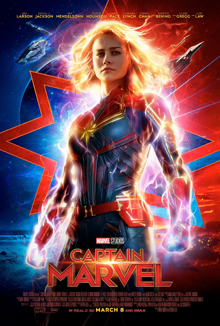
This film draws you in for a significant portion of its runtime with traditional or neutral content before springing its woke agenda. Know before you go!
NOT A WOKE TRAP despite the high woke score. Captain Marvel's ideology is visible from the opening act. The film does not hide its feminist empowerment messaging or its refugee allegory. The trailers and marketing made the ideological content reasonably clear. Conservative audiences who went in cautiously suspicious were not ambushed. The film is aggressively ideological, but it is not a trap because it does not disguise itself as something neutral and then deliver a lecture at the two-hour mark. The woke content is front-loaded and consistent throughout.
Captain Marvel is the MCU's most deliberately ideological film, and the filmmakers would not dispute this. Released on International Women's Day 2019, directed by a female co-director specifically because the studio wanted a woman behind the camera for their first female-led superhero film, scored by the first female MCU composer, and structured around a feminist empowerment narrative that makes its thesis explicit rather than implicit. This is not a film that happens to have a female protagonist. It is a film about feminism, with superhero action sequences attached.
The plot structure makes this clear. Carol Danvers begins the film with her memories suppressed, her emotions under control, and a male authority figure (Jude Law's Yon-Rogg) telling her she is not ready, that she must master herself before she can be effective, that emotion is weakness. By the film's climax, she has reclaimed her memories, unleashed her emotions, and discovered that her suppressed power was not a limitation to overcome but a resource that male authority had deliberately blocked to control her. The film's final confrontation is not hero defeating villain in combat. It is Carol refusing to fight Yon-Rogg on his terms and blasting him with full power instead. His response, 'I just want to know what you can do,' functions as the movie's thesis statement: she does not have to prove anything to him. She does not owe him a fair fight.
This is a coherent feminist narrative. It is also a bad superhero story. A protagonist who cannot be threatened, whose power cannot be credibly matched by any villain in the film, and who resolves her character arc through a therapy session disguised as a memory recovery montage is not dramatically interesting. Doctor Strange struggled against his limitations and earned his power through humility and sacrifice. Tony Stark built a suit of armor in a cave and grew into his heroism. Captain Marvel always had the power. It was just being suppressed by a bad man. Once she stops listening to him, she wins effortlessly. That is not a hero's journey. It is a grievance narrative.
The film's secondary ideological freight is a refugee allegory. The Skrulls, presented to Carol (and the audience) as the film's alien villains, turn out to be peaceful refugees being hunted to extinction by the Kree. Carol, whose military service with the Kree was based on a lie, switches sides and becomes the Skrulls' protector. The Kree, previously presented as the good guys, are imperial hunters of an indigenous people. The allegory is not subtle. The film literally ends with Carol flying off to find the Skrulls a new home.
Conservative audiences will find the refugee reversal particularly pointed. The film's military, the Kree-aligned Starforce that Carol served with loyally, are revealed as oppressors. The 'enemy' she was trained to fight are victims. The intelligence she trusted was propaganda. The lesson is unambiguous: institutional military service is often service of imperial violence. The film's heroine must defect from the military establishment to become genuinely heroic.
The '90s setting provides some genuine nostalgia and a few good jokes, mostly through Samuel L. Jackson's younger, more easygoing Nick Fury. The Marvel de-aging technology on Jackson is impressive. The cat, Goose the Flerken, is legitimately entertaining. The action sequences are competent but lack the inventiveness of the better MCU entries.
Brie Larson is the subject of persistent fan controversy, and some of that controversy is unfair projection. Her performance as Carol Danvers is the film's actual problem rather than anything inherently wrong with the actress. The character is written without vulnerability, without a compelling arc of growth, and without a meaningful relationship to anyone in the film that generates genuine emotion. She is competent and physical but not emotionally available to the audience in the way that Robert Downey Jr.'s Tony Stark or Chris Evans' Steve Rogers were from their first appearances. You admire her power. You do not particularly like her or worry about her.
The decision to use 'Just a Girl' by No Doubt during a climactic fight sequence is the most unambiguous moment of deliberate feminist signaling in the MCU. No Doubt's song is literally about a woman who resents being condescended to because of her gender. Playing it over Carol beating up male Kree soldiers is not subtle filmmaking. It is a music video for a political message.
For the VVWS, Captain Marvel scores heavily woke. The feminist empowerment narrative is not incidental, it is the film's architecture. The military is the villain's institution. The refugee allegory positions border enforcement (hunting Skrulls) as oppression. The male authority figure is a manipulative abuser. These are not elements of a story that also has politics. They are the politics. The traditional scores are minimal: some genuine friendship and loyalty between Carol and Maria Rambeau, a guardian role for the Skrull refugees, brief sacrifice themes that are not developed into the film's emotional core.
This is not a film for conservative audiences. It was not designed to be. Watch it to understand what Captain Marvel is before she shows up in Endgame, then move on.
Formula: Weighted Score = Severity × Authenticity Multiplier × Centrality Multiplier
🔴 Woke Tropes
| Trope | Severity | Authenticity | Centrality | Score |
|---|---|---|---|---|
| Feminist Empowerment as Central Narrative | 5 | 0.7 | 1.8 | 6.3 |
| Feminist Lecture: You Don't Have to Prove Yourself to Anyone | 4 | 0.7 | 1.8 | 5.04 |
| Anti-Military / Institution as Imperial Oppressor | 3 | 1 | 1 | 3 |
| Refugee Sympathy Allegory | 3 | 1 | 1 | 3 |
| Male Authority Figure as Manipulative Villain | 3 | 0.7 | 1 | 2.1 |
| TOTAL WOKE | 19.4 | |||
🟢 Traditional Tropes
| Trope | Severity | Authenticity | Centrality | Score |
|---|---|---|---|---|
| Sacrifice and Protection of the Vulnerable | 3 | 1 | 0.5 | 1.5 |
| Female Friendship and Loyalty | 2 | 0.7 | 0.5 | 0.7 |
| Resilience and Getting Back Up | 3 | 0.7 | 0.5 | 1.05 |
| TOTAL TRADITIONAL | 3.3 | |||
Score Margin: -16 WOKE
Director: Anna Boden and Ryan Fleck
PROGRESSIVE / INDEPENDENT FILM SENSIBILITY. Boden and Fleck are indie film directors known for Half Nelson (2006), which starred Ryan Gosling as a drug-addicted inner-city teacher and was praised extensively by progressive film critics. Their work is socially conscious and left-leaning. Captain Marvel was a massive step up in scale from anything they had done before. Their instinct is toward character-driven social commentary, and they imported that sensibility into a $150 million blockbuster with uneven results. They have not made a major Hollywood film since.Anna Boden and Ryan Fleck are a directing duo who built their reputation on intimate indie dramas about broken people in hard circumstances (Half Nelson, Mississippi Grind). Their hiring for Captain Marvel was a diversity hire by Marvel, which publicly emphasized the significance of having a female co-director for their first female-led superhero film. Their inexperience with blockbuster scale shows in the film's uneven pacing and action sequences. The ideological content, however, reflects their sensibilities precisely.
Writer: Anna Boden, Ryan Fleck, Geneva Robertson-Dworet
Geneva Robertson-Dworet is a screenwriter who also wrote Tomb Raider (2018). Her work skews toward female-led action with feminist themes. The three-writer team produced a script that is leaner on plot coherence than most MCU entries but heavier on ideological freight. The script's central metaphor, a woman who was told to suppress her emotions and control herself by a manipulative male authority figure and who must reclaim her power by feeling everything, is explicitly feminist. This is not incidental. It is the film's entire architecture.
Adult Viewer Insight
Conservative adults should understand what Captain Marvel is before deciding whether to watch it. It is not a film that happened to end up with woke themes through committee drift. It was intentionally designed as a feminist empowerment narrative, released on International Women's Day, with a female director specifically selected for the film's gender politics. The refugee allegory and anti-military messaging are features, not bugs. Watch it for MCU continuity if needed. Do not expect a balanced film.
Parental Guidance
PG-13, ages 10 and up for content. The primary parental concern is ideological. The feminist messaging is persistent and explicit. The male mentor/authority figure being revealed as a manipulative villain who suppressed the female protagonist's power is a potentially distorting lesson about male authority. Worth discussing with children.
Find Captain Marvel on Amazon Prime Video, rent, or buy:
▶ Stream or Buy on AmazonAs an Amazon Associate, VirtueVigil earns from qualifying purchases.
Community Discussion 0
Subscribe to comment.
Join the VirtueVigil community to share your perspective on this review.