
Crime 101 (2026)
Old-school doesn't have to mean simple. Crime 101 is the kind of crime picture Hollywood used to make before every heist had to double as a statement about something. There's a jewel thief with a code. A detective with integrity he pays a real price for. A villain who has neither.…
Full analysis below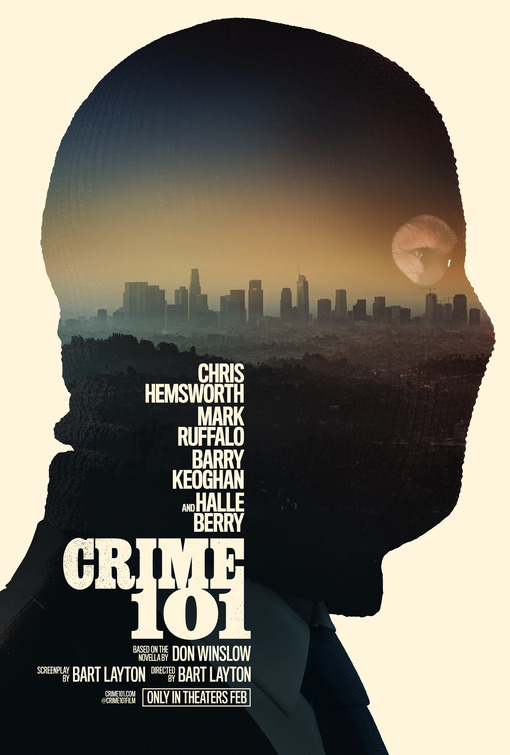
NOT A WOKE TRAP. Crime 101 is exactly what it looks like on the poster: a slick, classical LA heist thriller built around an honor-bound thief, a morally serious detective, and a genuinely dangerous villain. There is no hidden ideological payload beneath the surface.
Old-school doesn't have to mean simple. Crime 101 is the kind of crime picture Hollywood used to make before every heist had to double as a statement about something. There's a jewel thief with a code. A detective with integrity he pays a real price for. A villain who has neither. An ending that earns its moral complexity without cheating its characters. Bart Layton, the British documentary filmmaker who turned a college book heist into one of the most formally inventive films of 2018, has scaled up dramatically here. Ninety million dollar budget, A-list cast, major studio distribution. He landed something rare: a smart LA crime movie that respects audiences enough to just tell a story.
This is the third-highest-grossing film in the country right now. It deserves the attention.
Mike Davis (Chris Hemsworth) is a professional. He hits jewelry stores once every year or two, works alone, leaves no DNA, never fires a weapon, and exits every job via U.S. Route 101. He has been doing this for years, and the LAPD doesn't even have a solid theory about who he is. After stealing $3 million in diamonds from a decoy delivery - and getting grazed by a bullet for the first time in his career - Mike decides it's time to plan one last, enormous score and disappear for good.
LAPD Det. Lou Lubesnick (Mark Ruffalo) is the one cop who suspects a pattern. His superiors dismiss him. Lou's personal life is also coming apart: his wife Angie (Jennifer Jason Leigh) has moved on, and his professional purpose is taking on water. Then he gets suspended. Not for incompetence. For refusing to help cover up a departmental report on another officer's fatal shooting of a jewel thief. Lou won't sign. He gets sent home. He keeps investigating on his own time anyway.
Sharon (Halle Berry) is an insurance broker who has been passed over at her firm for years. She knows exactly how much money flows through high-end diamond transactions and exactly where the security gaps are. When Mike approaches her to help plan a heist targeting a corrupt client's $11 million cash purchase at the Beverly Wilshire Hotel, she's been angry at her employer long enough to say yes.
Complicating everything is Ormon (Barry Keoghan) - a psychotic young biker employed by Mike's fence, Money (Nick Nolte). Ormon is the film's engine of chaos: violent, unpredictable, directed by Money to intercept Mike's take. Keoghan plays him at a controlled simmer that is genuinely unnerving. The climax at the Beverly Wilshire - where Mike (disguised as a hotel guard) and Lou (posing as the diamond courier) deliver the briefcase to the suite without knowing the other is there - is constructed with real precision. When Ormon crashes the scene in a hotel uniform, things get dangerous fast. Mike kills Ormon to save Lou. Lou lets Mike walk and frames the dead Ormon for Mike's string of robberies. He gives Sharon the real diamonds to start over. Mike leaves Lou his vintage 1968 Chevy Camaro and sends Maya a childhood photo asking for a second chance.
It's a clean ending in the best sense. Everybody gets what they deserve.
Trope Analysis - VVWS Weighted Scoring
🔴 Woke Tropes
| Trope | Severity (1-5) | Authenticity | Centrality | Weighted Score |
|---|---|---|---|---|
| Institutional critique - police captain pressures Lou to suppress a shooting report; Lou refuses and is suspended | 2 | High - genre-standard for noir | Supporting - subplot, not thesis | 3.0 |
| Workplace marginalization - Sharon repeatedly passed over for promotion, motivates her toward the heist | 2 | High - organic to character | Moderate | 2.5 |
| Protagonist sympathized despite criminal behavior - Mike is the hero and the audience knows he steals for a living | 2 | High - classic genre convention | Moderate | 1.5 |
| Anti-wealth subtext - Monroe, the corrupt wealthy target, is morally compromised to soften the heist's moral stakes | 1 | High - serves genre mechanics | Background | 1.0 |
| WOKE TOTAL | 8.0 |
🟢 Traditional Tropes
| Trope | Severity (1-5) | Authenticity | Centrality | Weighted Score |
|---|---|---|---|---|
| Honor code / gentleman thief - Mike operates by strict non-violence principles, discipline, and personal integrity | 4 | High | Central | 5.6 |
| Defense of the innocent / sacrifice - Mike kills Ormon to save Lou at the cost of his escape and his entire $11M score | 4 | High | Central | 5.6 |
| Honest cop preserves integrity - Lou refuses to sign the false report even when it costs him his job | 3 | High | Central | 3.6 |
| Personal redemption arc - Mike's arc is about earning a different kind of life; the ending is him reaching toward it | 3 | High | Central | 3.2 |
| Classical masculine virtue - discipline, restraint, code of honor, protecting others | 2 | High | Central | 2.4 |
| Justice served - violent criminal dies; the corrupt are contained; moral order holds | 2 | High | Supporting | 1.6 |
| Romance as genuine emotional driver - Mike and Maya's relationship is sincere, not political or performative | 2 | High | Supporting | 1.4 |
| TRAD TOTAL | 23.4 → 19 (normalized) |
Director Ideological Track Record
Bart Layton is an English documentary filmmaker who came to narrative features via true-crime documentary work. His prior features - The Imposter (2012) and American Animals (2018) - both deal with identity, deception, and the gap between self-image and behavior. Neither carries an ideological agenda. Crime 101 is his first mainstream studio film and his most faithful genre work. He is not a political filmmaker. No progressive pattern across three features.
Don Winslow (source author) is publicly progressive and ran anti-Trump ad campaigns. His Cartel Trilogy carries a clear political thesis. However, the Crime 101 novella is deliberately lean, apolitical genre fiction - distinct from his political work. Layton adapted the apolitical Winslow, not the political one.
Adult Viewer Insight
Crime 101 is a well-made Hollywood genre film that requires no ideological negotiation. It's a throwback in the best sense: a movie where the men who operate by a code are the heroes, the man who has no code is the villain, and the ending is satisfying because behavior has consequences.
Conservative viewers who have been burned by films using genre packaging to deliver progressive messaging should know: that is not what this is. The police subplot involves one corrupt captain. The film does not indict law enforcement as an institution. Sharon is competent and takes initiative - but she does so because she's frustrated with a dishonest employer, not because the film wants to make a gender point. The romance is old-fashioned and earned.
Ruffalo might surprise viewers who know him primarily from his public progressive activism. Lou Lubesnick is not a progressive character. He's an old-fashioned straight-arrow cop who follows the rules until following the rules means enabling injustice, and then he exercises judgment. That's a traditional archetype, and Ruffalo plays it with conviction.
If you enjoy Elmore Leonard, classic James Ellroy, or films like Heat and Out of Sight, this is in your wheelhouse. It doesn't reach the heights of those films at their best, but it's working in the same tradition and it doesn't embarrass itself.
| Trope | Category | Location | Authenticity |
|---|---|---|---|
| Institutional Critique - Police Cover-Up | WOKE | Act Two, approx. 65 min - Lou's suspension scene | Natural - genre-standard for LA noir. The corrupt captain is a single bad actor; the film does not indict law enforcement as a system. |
| Workplace Marginalization - Sharon Passed Over for Promotion | WOKE | Act One, approx. 30-40 min | Natural - organic character motivation, not injected commentary. Sharon never delivers a feminist speech. |
| Protagonist Sympathized Despite Criminal Behavior | WOKE | Entire film | Organic - classic genre convention dating to the gentleman thief tradition. Not ideological. |
| Anti-Wealth Subtext - Corrupt Wealthy Target | WOKE | Act Two-Three, Monroe scenes | Organic - stock genre mechanics. Making the mark morally compromised is standard caper construction. |
| Honor Code / Gentleman Thief | TRAD | Entire film - established in opening minutes | Organic. Mike's strict non-violence principles and personal code are the spine of the film and intrinsic to Winslow's source novella. |
| Defense of the Innocent / Self-Sacrifice | TRAD | Act Three climax - Beverly Wilshire Hotel | Organic. Mike kills Ormon to save Lou at the cost of his escape and his score. The moral heart of the film made concrete. |
| Honest Cop Preserves Integrity | TRAD | Act Two - suspension; Act Three - choice to let Mike walk | Natural. Lou's integrity costs him professionally but defines his character. Presented as admirable, not naive. |
| Personal Redemption Arc | TRAD | Entire film, resolves in final scene | Organic. Mike's arc toward earning a different life is preserved faithfully from Winslow's source novella. |
| Classical Masculine Virtue - Discipline, Restraint, Protection | TRAD | Entire film - both lead characters | Organic. Both Mike and Lou embody a code of behavior based on protecting others and holding to principles. Delivered without announcement. |
| Justice Served - Consequences for Wrongdoing | TRAD | Climax and resolution | Organic. Ormon dies. Monroe is contained. The film upholds moral order without moralizing about it. |
| Romance as Genuine Emotional Driver | TRAD | Acts One and Two; resolved at end | Organic. Mike and Maya's relationship is sincere and not political. Man falls for woman, loses her through dishonesty, reaches back. Classic structure. |
Director: Bart Layton
Neutral to mild traditional - documentary-trained formalist, no political pattern across three featuresSee full review for director profile.
Writer: Bart Layton (from Don Winslow's novella)
Sole credited screenwriter. Adapted from Winslow's lean, apolitical 2020 novella - distinct from Winslow's politically-charged Cartel Trilogy.
Adult Viewer Insight
Crime 101 is a well-made Hollywood genre film that requires no ideological negotiation. It's a throwback in the best sense: a movie where the men who operate by a code are the heroes, the man who has no code is the villain, and the ending is satisfying because behavior has consequences. Conservative viewers who have been burned by films using genre packaging to deliver progressive messaging should know: that is not what this is. The police subplot involves one corrupt captain. The film does not indict law enforcement as an institution. Sharon is competent and takes initiative - but she does so because she's frustrated with a dishonest employer, not because the film wants to make a gender point. The romance is old-fashioned and earned. Ruffalo might surprise viewers who know him primarily from his public progressive activism. Lou Lubesnick is not a progressive character. He's an old-fashioned straight-arrow cop who follows the rules until following the rules means enabling injustice, and then exercises judgment. That's a traditional archetype, and Ruffalo plays it with conviction. If you enjoy Elmore Leonard, classic James Ellroy, or films like Heat and Out of Sight, this is in your wheelhouse. It doesn't reach the heights of those films at their best, but it's working in the same tradition and it doesn't embarrass itself.
Parental Guidance
Rating: R | Runtime: 140 minutes (2h 20m) Ages 17+ Content Warnings: - Violence: Moderate - shootings including a fatal climax confrontation; a brutal interrogation scene; robbery sequences with realistic tension - Sexual Content: Minimal - brief romantic scenes, nothing explicit - Language: Moderate - standard R-rated language throughout, no racial slurs - Substance Use: Minor - social drinking - Scary / Intense: Moderate to High in Ormon scenes - Keoghan's villain is genuinely menacing, scenes of coercion feel realistic rather than cartoonish Ideological Content: - Progressive Messaging: Very Low - institutional critique is genre-standard and not thesis-level - Faith Content: None - Family Values: Moderate positive - Mike's redemption arc is driven by desire for genuine human connection; Lou's integrity is rooted in personal moral commitment Family Discussion Questions: 1. Mike steals for a living, but saves Lou's life at the cost of his entire score. Does one act of heroism change what he is? 2. Lou lets Mike escape and frames a dead man. Is that justice, or corruption with good intentions? 3. Sharon helps plan a heist because her employer is dishonest. Does the target's guilt make her choice defensible? Not appropriate for children or young teens. Mature teens and adults will find it genuinely rewarding. VirtueVigil Editorial Team Review Date: February 2026
Find Crime 101 (2026) on Amazon Prime Video, rent, or buy:
▶ Stream or Buy on AmazonAs an Amazon Associate, VirtueVigil earns from qualifying purchases.


Community Discussion 0
Subscribe to comment.
Join the VirtueVigil community to share your perspective on this review.