
Cruella
Disney's Cruella is what happens when a studio takes one of its most iconic villains and runs her through the Joker-meets-The-Devil-Wears-Prada sympathy machine.…
Full analysis below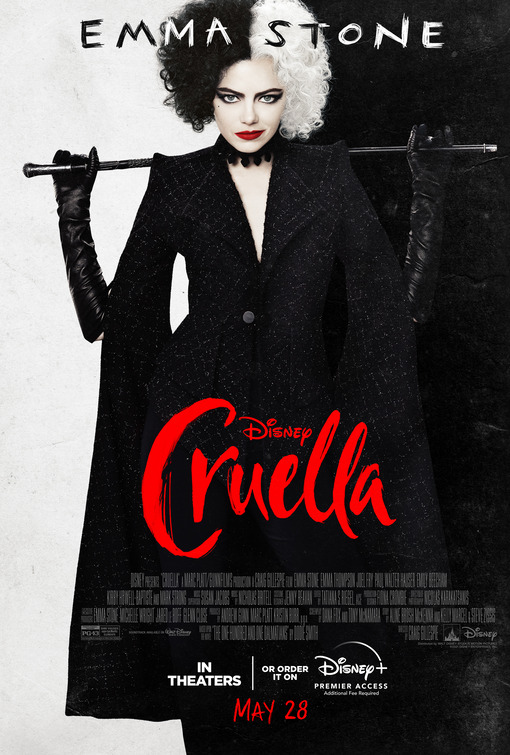
This film draws you in for a significant portion of its runtime with traditional or neutral content before springing its woke agenda. Know before you go!
NOT A WOKE TRAP. Cruella's feminist, anti-establishment identity is the entire premise. The trailers showcased the punk aesthetic, the female rivalry, and the revenge framework. There is zero concealment of the film's ideological orientation.
Disney's Cruella is what happens when a studio takes one of its most iconic villains and runs her through the Joker-meets-The-Devil-Wears-Prada sympathy machine. The result is a slickly produced, often entertaining film that works better as a fashion spectacle than as a character study, and whose ideological commitments are more interesting than its plot.
The premise is simple: Estella Miller, a creative, rebellious child with distinctive black-and-white hair, loses her adoptive mother Catherine when the Baroness von Hellman's Dalmatians push Catherine off a cliff. Orphaned and wracked with guilt (she blames herself for provoking the dogs), Estella flees to London and grows up as a small-time thief alongside her friends Jasper and Horace. When she finally gets a job in fashion under the Baroness, she discovers that the Baroness is the woman responsible for her mother's death and transforms herself into Cruella, a punk-rock fashion guerrilla who wages an escalating war against the establishment.
Emma Stone is the primary reason to watch this film. She commits fully to the dual role, toggling between Estella's vulnerability and Cruella's manic showmanship with genuine skill. Emma Thompson matches her blow for blow as the Baroness, delivering a performance of ice-cold narcissism that is the film's most purely enjoyable element. Their scenes together crackle with energy. The costume design, by Jenny Beavan, is legitimately spectacular. Beavan won the Academy Award for her work, and it is easy to see why. Every outfit tells a story. The film's 1970s London setting is rendered with loving detail, and the soundtrack (featuring The Clash, Blondie, Nina Simone, and The Doors, among others) is excellent.
The problems emerge when you scratch the surface. Cruella is a villain origin story that does not actually want its protagonist to be a villain. The film goes to extraordinary lengths to justify Estella's behavior and remove any genuine moral darkness from her character. The Baroness, not Cruella, is the real monster. The Baroness murdered Cruella's mother, ordered a baby killed, drove her husband to death, and treats everyone around her with casual cruelty. By contrast, Cruella's crimes are limited to property damage, fashion pranks, and dog theft. She is never cruel to people. She is never dangerous. She is, in the film's framing, entirely justified in everything she does.
This is the ideological core of the film: Cruella is a girlboss origin story in which a brilliant, misunderstood woman smashes the patriarchal and institutional barriers that keep her down. The Baroness represents Old Money, Old Power, and Old Rules. Cruella represents New, rebellious, authentic self-expression. The film is explicit about this framing. Multiple scenes position Cruella as an anti-establishment hero fighting a system designed to crush individual creativity. Her allies are a diverse coalition: Jasper and Horace (loyal working-class friends), Anita Darling (a Black female journalist), Artie (an openly gay fashion shop owner), and John (the Baroness's conscience-stricken valet). The Baroness's world is uniformly white, wealthy, and oppressive.
Artie, played by John McCrea, is marketed as Disney's openly gay live-action character. His queerness is understated, expressed through flamboyant fashion and a brief moment where he adjusts Cruella's outfit with the line 'I have always been a little different.' The character is more symbol than person, a progressive checkbox rather than a developed human being. He appears in perhaps ten minutes of screen time. Disney's pattern of claiming firsts in queer representation while keeping the actual content minimal enough to edit for international markets is well-established by now, and Cruella follows this playbook precisely.
The film's biggest ideological problem is its relationship with its own protagonist. Cruella de Vil, in the original One Hundred and One Dalmatians (both the novel and the animated film), is a genuinely terrible person who wants to skin puppies for a fur coat. The 2021 film needs this character to be sympathetic, so it rewrites her entirely. The Dalmatians are recast as the Baroness's attack dogs rather than victims. Cruella does not harm animals. The puppy-skinning motivation is nowhere to be found. The film even ends with Cruella gifting Dalmatian puppies to Anita and Roger, a gesture of generosity that directly contradicts the character's established nature.
This is a trend in Disney's live-action strategy: take a villain, strip away the villainy, add a tragic backstory involving a dead or absent mother, and repackage them as a misunderstood hero. Maleficent did it. Cruella does it. The ideological implication is that evil does not really exist. Bad people are just good people who were hurt by worse people. This is a fundamentally progressive position on human nature, and Cruella embraces it without reservation.
The film has genuine virtues: Stone and Thompson are both excellent. The costume design is world-class. The pacing, despite the 134-minute runtime, mostly works. The heist and fashion-show sequences are inventively staged. Paul Walter Hauser steals every scene he is in as Horace. Nicholas Britell's score is effective.
But Cruella is also a film that asks you to root for a character named after cruelty while ensuring she is never actually cruel. It is a punk movie made by a corporation worth $200 billion. It is an anti-establishment story that exists to sell Disney+ subscriptions. The contradictions are the point, even if the film does not seem aware of them.
Cruella grossed $233 million worldwide during a pandemic-affected release, won the Academy Award for Best Costume Design, and earned generally positive reviews (74% on Rotten Tomatoes). A sequel is in development. The film works as entertainment. As ideology, it is a carefully calibrated piece of corporate feminism that wants credit for being rebellious while never actually rebelling against anything that would hurt the brand.
Formula: Weighted Score = Severity × Authenticity Multiplier × Centrality Multiplier
🔴 Woke Tropes
| Trope | Severity | Authenticity | Centrality | Score |
|---|---|---|---|---|
| Girlboss Narrative / Female Empowerment Through Rebellion | 4 | High | High | 5.04 |
| Villain Rehabilitation / Evil Does Not Exist | 3 | Moderate | High | 2.1 |
| Diverse Coalition as Moral Shorthand | 2 | Moderate | Moderate | 1.4 |
| Token Gay Character (Artie) | 2 | Low | Low | 0.7 |
| Anti-Establishment as Default Virtue | 3 | Moderate | Moderate | 2.1 |
| Dead Mother as Backstory Engine | 2 | Moderate | High | 1.4 |
| Corporate Feminism / Punk Without Consequences | 3 | Low | Moderate | 1.5 |
| TOTAL WOKE | 14.2 | |||
🟢 Traditional Tropes
| Trope | Severity | Authenticity | Centrality | Score |
|---|---|---|---|---|
| Loyalty and Chosen Family | 4 | High | High | 5.04 |
| Justice for the Dead / Honoring Your Mother | 3 | High | High | 3.78 |
| Consequences of Narcissism and Selfishness (The Baroness) | 3 | High | Moderate | 2.1 |
| Resourcefulness and Self-Reliance | 2 | High | Moderate | 1.4 |
| TOTAL TRADITIONAL | 12.3 | |||
Score Margin: -2 WOKE
Director: Craig Gillespie
MODERATE. Gillespie's filmography is eclectic (Lars and the Real Girl, I Tonya, Cruella) with no consistent ideological thread. He is a competent stylist who serves the material rather than imposing a worldview.Gillespie replaced Alex Timbers as director. His strongest previous work, I Tonya (2017), shared Cruella's interest in outsider women fighting against establishment power structures. He brings a kinetic visual energy and strong sense of period style. His direction of Cruella is his most commercially successful work, though the film's ideological content is more attributable to the writers and Disney's corporate direction than to Gillespie personally.
Writer: Dana Fox & Tony McNamara
Fox and McNamara wrote the screenplay from a story by Aline Brosh McKenna, Kelly Marcel, and Steve Zissis. McNamara's influence is most visible in the sharp, witty dialogue and the power dynamics between Estella and the Baroness. He previously wrote The Favourite (2018), which shares Cruella's interest in women weaponizing style and cunning against institutional power. McKenna (The Devil Wears Prada) contributed the fashion-world setting and mentor-protege dynamics.
Adult Viewer Insight
Conservative adults will notice that Cruella is a girlboss origin story that frames rebellion against institutional authority as inherently virtuous. The Baroness is the villain, not the system, but the film uses the Baroness as a stand-in for patriarchal, old-money power structures. There is an openly gay character (Artie) in a minor role. The film's diverse coalition of allies is deliberate. However, the core emotional story of a daughter seeking justice for her murdered mother is universal and traditionally motivated. The friendship between Estella, Jasper, and Horace has genuine warmth. The film is not a lecture. It is a stylish heist movie with a feminist lens. Parents who are comfortable with that framing will find it entertaining. Those who object to Disney rehabilitating villains into sympathetic antiheroes should skip it.
Parental Guidance
Recommended age: 10+. Cruella is darker than most Disney films. A mother dies on screen (pushed off a cliff by dogs). The protagonist engages in theft, deception, and escalating property destruction throughout the film. There are themes of abandonment, betrayal, and revenge. The Baroness is revealed to have ordered a baby killed. There is no graphic violence, sexual content, or profanity, but the emotional themes and the moral complexity of rooting for a character who embraces a villainous identity may be confusing for younger children. The punk rock aesthetic and fashion content will appeal to tweens and teens.
Find Cruella on Amazon Prime Video, rent, or buy:
▶ Stream or Buy on AmazonAs an Amazon Associate, VirtueVigil earns from qualifying purchases.
Community Discussion 0
Subscribe to comment.
Join the VirtueVigil community to share your perspective on this review.