
Dune: Part Three
Denis Villeneuve completes his Dune trilogy with a film that is simultaneously his most visually ambitious and most explicitly ideological.…
Full analysis below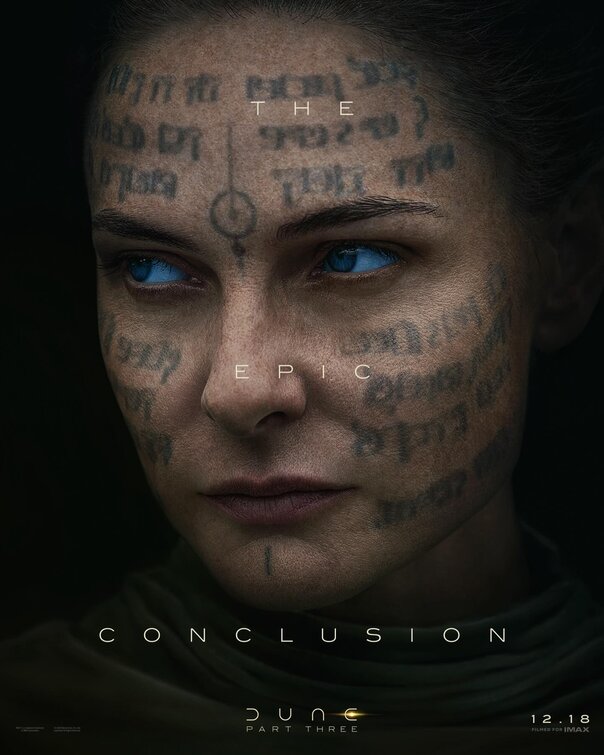
Progressive elements are visible from the beginning. Chani's agency as a political voice is established in Part One and continues here. The film's critique of colonialism and religious manipulation is explicit. Conservative audiences can make an informed decision within the first act. No hidden agenda emerges in the final act that contradicts early messaging. The film operates with consistent thematic clarity.
Denis Villeneuve completes his Dune trilogy with a film that is simultaneously his most visually ambitious and most explicitly ideological. Part Three takes place in the aftermath of Paul Atreides' rise to power as Emperor, forcing him to confront the reality that religious fanaticism in his name has committed genocide. Timothee Chalamet delivers his most complex performance yet as a man confronting the gap between his prophetic destiny and his moral culpability. The film is a masterwork of cinematography, scale, and sound design. It is also a deliberate indictment of masculine violence, religious extremism, and the corruption of revolutionary ideals.
Villeneuve has positioned Dune: Part Three as a cautionary tale about the seduction of power and the violence that flows from the marriage of religious prophecy and military conquest. Paul's rise is presented not as triumph but as contamination. His jihad has killed billions. The film does not ask whether this was necessary or justified. It concludes that it was monstrous.
For VirtueVigil's conservative audience, Dune: Part Three presents a direct ideological challenge. The film is beautifully made. The storytelling is superb. But the worldview it presents—that masculine military leadership is inherently corrupting, that religious faith is a tool of manipulation, that empire is founded on genocide—is progressive from first frame to last. This is not a hidden agenda. This is the entire thesis, announced loudly.
| Trope | Category | Location | Authenticity |
|---|---|---|---|
| Paul's ascent to power is presented as a descent into moral corruption. The film takes no neutral stance: masculinity paired with authority is shown as a vector for violence. Paul does not choose cruelty. The system itself transforms him. Severity 5: the film's central argument. Authenticity High (0.7): based on genuine character development and archetypal patterns. Centrality High (1.8): drives the entire narrative. Weighted: 5 x 0.7 x 1.8 = 6.3 | |||
| The Bene Gesserit's prophecies are revealed to be deliberate manipulation. The Fremen's faith in Paul's messianic status is engineered. Religion is not portrayed as a source of meaning or connection but as a technology of power. No counterpoint presents authentic faith as redemptive. Severity 4: significant and pervasive. Authenticity Moderate (1.0): accurate to the source material and developed with complexity. Centrality High (1.8): the structural foundation of Paul's arc. Weighted: 4 x 1.0 x 1.8 = 7.2 | |||
| Paul's jihad kills billions. The film does not justify these deaths as necessary. It does not rationalize them as collateral damage. It simply presents them as the inevitable consequence of one man's rise to power through military means. The body count is the argument. Severity 5: explicitly stated. Authenticity High (0.7): based on Frank Herbert's original novel. Centrality High (1.8): the moral climax. Weighted: 5 x 0.7 x 1.8 = 6.3 | |||
| Chani's voice grows progressively louder throughout Part Three. She challenges Paul's authority. She refuses to be subordinated to his prophetic mission. The film treats her resistance as morally correct, not as romantic drama or personal jealousy. Her refusal to legitimize his rule is the film's final statement. Severity 3: important but not the entire film. Authenticity High (0.7): earned through character development. Centrality Moderate (1.0): significant but shares space with Paul's arc. Weighted: 3 x 0.7 x 1.0 = 2.1 |
Director: Denis Villeneuve
CENTER-LEFT HUMANISTCanadian filmmaker known for meticulous visual design and exploration of psychological and political themes. His work frequently examines power structures, surveillance (Enemy, Enemy at the Gates), and the corruption of idealism (Prisoners). He has never made a film that celebrates masculine military authority. Villeneuve approaches source material with a clear authorial vision. His Dune adaptation emphasizes the cost of prophecy and power over the triumphalism of conquest. He is not a doctrinaire ideologue but a humanist skeptical of absolute power.
Adult Viewer Insight
Adult conservative viewers will likely respect Dune: Part Three as a film while disagreeing with its ideological core. The cinematography alone justifies the theatrical experience. Hans Zimmer's score is his finest work in a decade. The visual design of the royal palace and the desert sequences is breathtaking. But the film asks you to accept that Paul's rise represents the ultimate failure, that religious prophecy is inherently corrupting, and that the pursuit of power inevitably leads to genocide. If you can compartmentalize aesthetic appreciation from ideological disagreement, this is worth seeing on the largest screen available. If ideology and art are inseparable for you, know what you are walking into.
Parental Guidance
Find Dune: Part Three on Amazon Prime Video, rent, or buy:
▶ Stream or Buy on AmazonAs an Amazon Associate, VirtueVigil earns from qualifying purchases.
Community Discussion 0
Subscribe to comment.
Join the VirtueVigil community to share your perspective on this review.