
EPiC: Elvis Presley in Concert
EPiC: Elvis Presley in Concert is a 97-minute love letter to the greatest live performer in American history, and it earns every minute of that devotion. Baz Luhrmann, who directed the 2022 Austin Butler biopic, discovered 68 boxes of lost concert footage in a Kansas salt mine during that production.…
Full analysis below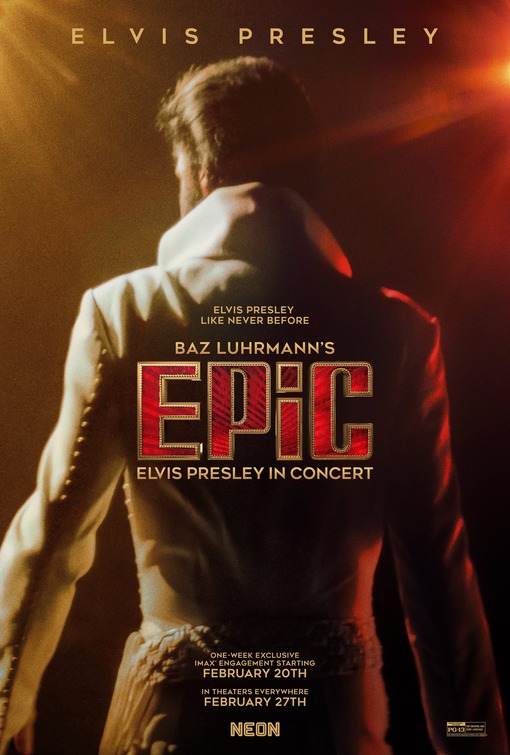
No woke trap present. The film is a straightforward celebration of Elvis Presley as a performer, cultural icon, and American legend. The marketing accurately represents the content. There is a brief acknowledgment of the cultural appropriation debate and a passing reference to Elvis's silence during the civil rights era and Vietnam, but these are handled as organic historical context, not ideological lectures. They occupy less than five minutes of the 97-minute runtime. Conservative audiences will not feel ambushed.
EPiC: Elvis Presley in Concert is a 97-minute love letter to the greatest live performer in American history, and it earns every minute of that devotion. Baz Luhrmann, who directed the 2022 Austin Butler biopic, discovered 68 boxes of lost concert footage in a Kansas salt mine during that production. Over two years, his team and Peter Jackson's Park Road Post facility restored this 50-year-old celluloid to jaw-dropping IMAX fidelity. The result is not a traditional documentary and not a standard concert film. It is something rarer: a time machine.
The footage spans Elvis's 1970-1972 Las Vegas residency, the period when he was at the absolute peak of his performing powers. We see the jumpsuit-era Elvis commanding a stage with a force that makes modern pop concerts look like amateur hour. He conducts a full orchestra and gospel choir with his entire body. He holds thousands of people in the palm of his hand. He drops to his knees, drenched in sweat, singing 'How Great Thou Art' with a voice that could shake the foundations of a cathedral. And then, mid-ballad, he cracks a joke about his pants being too tight, catches a bra thrown from the audience, drapes it over his head, and keeps singing. The man was simultaneously the most powerful and the most charming performer who ever lived.
Luhrmann structures the film around Elvis's own voice. A rediscovered 45-minute audio recording of Presley talking about his life provides the narrative spine. We hear Elvis discuss his humble beginnings in Tupelo, Mississippi. His love for gospel music. The impact of his mother's death. The way fame reshaped his identity. These moments are woven between concert performances that build from the opening strains of 'Also Sprach Zarathustra' into 'An American Trilogy' through deep cuts and crowd favorites to the devastating closer of 'Can't Help Falling in Love.'
The setlist reads like a statement of purpose. 'An American Trilogy' weaves together 'Dixie,' 'The Battle Hymn of the Republic,' and 'All My Trials' into a single patriotic anthem that only Elvis could deliver without irony. 'How Great Thou Art' and 'Oh Happy Day' are performed with the fervor of a tent revival, Elvis's gospel roots on full, unapologetic display. 'Burning Love' and 'Suspicious Minds' remind you that this man could make an arena of strangers feel like they were at the most intimate show on earth. Every song is presented as Elvis actually performed it, not sanitized for modern sensibilities, not recontextualized through a revisionist lens.
There are brief nods to the cultural appropriation debate. The film acknowledges, mostly through its prologue montage, that Elvis drew from Black gospel, blues, and R&B traditions. A journalist asks Elvis about Vietnam and he says 'I'm just an entertainer,' with Luhrmann noting Colonel Tom Parker's lurking presence. These moments occupy perhaps three to four minutes of the runtime. They are not lectures. They are not apologies. They are historical context presented quickly and moved past. The Guardian's critic complained that Luhrmann refuses to 'meaningfully hold Elvis to account.' From VirtueVigil's perspective, that is not a flaw. It is a virtue. This film is not interested in tearing down an American icon to satisfy contemporary ideological demands. It is interested in showing you why he was an icon in the first place.
The technical restoration is breathtaking. Peter Jackson's team, the same crew that restored Beatles rehearsal footage for Get Back, has brought 55-year-old celluloid to life with enough visual clarity to fill an IMAX screen. You can see the pores on Elvis's skin, the sweat rolling down his neck, the microphone reverberating from the power of his voice. Camera operators with 16mm cameras are visible running around the stage like war correspondents, and Luhrmann wisely keeps them in frame. The effect is intimate and visceral in a way that no modern concert film achieves, because modern concerts are designed for cameras. These performances were designed for the people in the room.
The audience response has been extraordinary. An A+ CinemaScore, a 99% Verified Hot audience score on Rotten Tomatoes, an 8.5 on IMDb, and reports of moviegoers applauding, dancing in their seats, and leaving theaters with tears in their eyes. The film premiered at Graceland on what would have been Elvis's 91st birthday. It is expanding to 1,608 locations this weekend. Critics have been nearly as enthusiastic: 96% on Rotten Tomatoes, 88 on Metacritic with 'universal acclaim.'
For conservative audiences, EPiC is that increasingly rare cultural product: a film that celebrates an American legend without apologizing for him. It presents Elvis's faith, his patriotism, his humor, his masculine charisma, and his transcendent talent as things worthy of admiration. It does not deconstruct him. It does not psychoanalyze him through a modern progressive lens. It does not turn the story of a Tupelo kid who became the King of Rock and Roll into a guilt narrative about privilege and appropriation. It just shows you the man, on stage, doing what God put him on this earth to do.
That makes EPiC not just a great concert film. It makes it a cultural statement. In a media landscape that has spent years tearing down American heroes, Baz Luhrmann has built one back up. Thank you, thank you very much.
Formula: Weighted Score = Severity × Authenticity Multiplier × Centrality Multiplier
Score Margin: +15 TRAD
Director: Baz Luhrmann
Maximalist showman with genuine affection for Elvis Presley. While Luhrmann's broader filmography includes progressive cultural elements (Moulin Rouge's bohemian ethos, The Great Gatsby's critique of capitalism), his Elvis work is driven by personal admiration rather than ideology. He grew up watching Elvis movies in Australia and returned to the subject out of love, not agenda.Australian director (b. 1962), known for his extravagant visual style. His filmography includes Strictly Ballroom (1992), Romeo + Juliet (1996), Moulin Rouge! (2001), The Great Gatsby (2013), and Elvis (2022). The 2022 Elvis biopic earned Austin Butler an Oscar nomination and grossed $288 million worldwide. EPiC is Luhrmann's follow-up, built from 68 boxes of lost footage discovered in Kansas salt mines during production of the biopic. Luhrmann describes the film as 'something new in the Elvis canon' that reveals the performer's humanity and inner life.
Writer: Baz Luhrmann
Luhrmann shaped the film's narrative structure, weaving concert footage with a 45-minute audio recording of Elvis discussing his own life. There is no traditional screenplay. The film is assembled from archival materials with Luhrmann's editorial vision providing the storytelling framework.
Adult Viewer Insight
Parental Guidance
Find EPiC: Elvis Presley in Concert on Amazon Prime Video, rent, or buy:
▶ Stream or Buy on AmazonAs an Amazon Associate, VirtueVigil earns from qualifying purchases.
Community Discussion 0
Subscribe to comment.
Join the VirtueVigil community to share your perspective on this review.