
Eternals
Eternals is the most ambitious and the most divisive film in the Marvel Cinematic Universe. It is also the first MCU film to fail with both critics and general audiences, earning a 47% on Rotten Tomatoes and a 5.9 on IMDB - the lowest ratings in the franchise's history.…
Full analysis below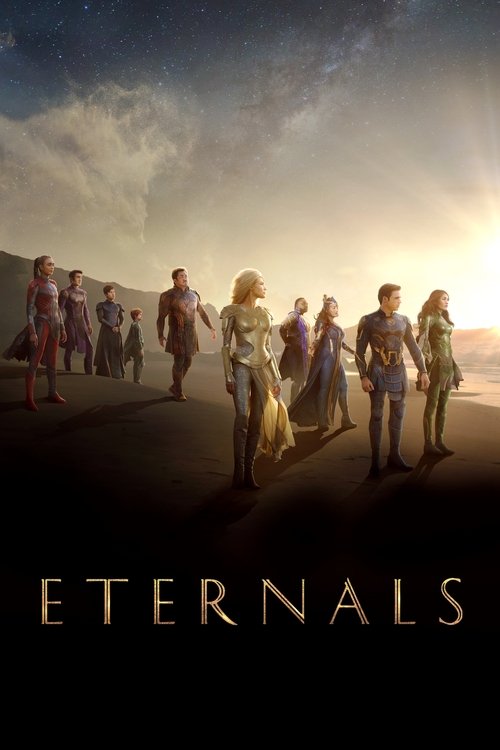
This film draws you in for a significant portion of its runtime with traditional or neutral content before springing its woke agenda. Know before you go!
NOT A WOKE TRAP. Eternals was sold on its diversity from the first Comic-Con panel. Kevin Feige explicitly promoted Phastos as the MCU's first openly gay superhero. Lauren Ridloff's Makkari was highlighted as the MCU's first deaf hero. The ensemble was presented as deliberately diverse. The sex scene between Sersi and Ikaris was discussed in pre-release interviews. Everything progressive about Eternals was in the marketing materials. Review-bombers knew what was coming before they ever saw a frame.
Eternals is the most ambitious and the most divisive film in the Marvel Cinematic Universe. It is also the first MCU film to fail with both critics and general audiences, earning a 47% on Rotten Tomatoes and a 5.9 on IMDB - the lowest ratings in the franchise's history. Whether you attribute this to the film's genuine structural problems or to its groundbreaking diversity depends on which audience you belong to. The honest answer is both.
The premise is cosmic: ten immortal beings called Eternals were sent to Earth 7,000 years ago by the Celestial Arishem to protect humanity from predatory creatures called Deviants. After the Deviants were eliminated in 1521, the Eternals scattered, living secretly among humans for 500 years. In the present day, they must reunite when they discover their true purpose: they were not sent to protect Earth but to prepare it for the 'Emergence' of a new Celestial - a planet-sized being gestating inside the Earth whose birth will destroy the planet.
This is a fascinating concept. A superhero team that discovers they are the instruments of humanity's extinction and must choose between their creator's orders and the civilization they have grown to love - that is a premise worthy of serious science fiction. Chloé Zhao, fresh off her Best Director Oscar for Nomadland, was the filmmaker hired to make it serious. She shoots on location, uses natural light, composes frames like landscape paintings, and slows the MCU's typical frenetic pacing to something resembling contemplation.
The problem is that the film tries to do everything. Ten main characters, each with a distinct personality, power set, and emotional arc. 7,000 years of flashbacks. A love story between Sersi and Ikaris that spans millennia. A murder mystery involving their leader Ajak. A planetary apocalypse countdown. Phastos's domestic life with his husband Ben and son Jack. Sprite's unrequited love for Ikaris. Druig's moral crisis over mind-controlling humans. Thena's cosmic PTSD. Gilgamesh's loyal guardianship. Kingo's career as a Bollywood star. Each of these could anchor a film. Together, they create narrative gridlock.
The diversity is undeniable and deliberate. The ensemble includes: a British-Chinese lead (Gemma Chan), a Scottish lead (Richard Madden), a Pakistani-American Bollywood star (Kumail Nanjiani), a Black gay father (Brian Tyree Henry), a Black deaf speedster (Lauren Ridloff), an Irish trickster (Barry Keoghan), a Korean strongman (Don Lee), a Mexican-American matriarch (Salma Hayek), Angelina Jolie as a warrior with PTSD, and a child (Lia McHugh). Kit Harington plays the sole traditional white male hero - a supporting role with minimal screen time who exists to tease a sequel.
Phastos's same-sex relationship is handled with more screen time and emotional weight than Lightyear's. He has a husband (Haaz Sleiman), a young son, and a domestic life that functions as his reason to fight for Earth's survival. They share the MCU's first same-sex kiss. The relationship is not background dressing - it is Phastos's primary motivation. When Phastos says he lost faith in humanity after seeing what his technology created (specifically the atomic bomb at Hiroshima), it was his family that restored his faith. The relationship is narratively integrated, not decorative.
Makkari's deafness is presented without comment or sentimentality. She communicates in sign language. Other Eternals sign back. It is normalized to the point of invisibility, which is either progressive triumph or calculated representation depending on your perspective.
The sex scene between Sersi and Ikaris is the MCU's first. It is brief, tasteful, and lit like a Renaissance painting. It exists because Zhao wanted to show these immortal beings as having full emotional and physical lives. It is not explicit. But its presence in a superhero franchise aimed at all ages was a choice that expanded the MCU's content territory in a direction some families did not welcome.
Ikaris's arc is the film's most traditionally resonant element. He is a man torn between obedience to his god (Arishem) and his love for Sersi and humanity. He ultimately sides with Arishem, murders Ajak to prevent her from stopping the Emergence, and fights his former teammates. When the Emergence is stopped anyway, Ikaris - consumed by guilt - flies into the Sun. This is a genuinely tragic arc: a loyal soldier who chose duty over love and was destroyed by the contradiction. In a different film, it would be devastating. In this film, it is one thread among twelve.
The film's traditional values are present but subordinate. Gilgamesh's selfless protection of Thena - a millennium-long act of devotion that costs him his life - is beautiful. Ajak's decision to defy Arishem and save humanity is a classic sacrifice-for-love arc. The theme of choosing to protect human life over cosmic obligation has traditional resonance. But these elements are outweighed by the film's overriding commitment to representation as a structural principle.
Eternals is not a bad film. It is an overstuffed, gorgeous, ambitious film that tries to be both a Terrence Malick meditation and a Marvel blockbuster and succeeds at neither. Its progressive content is extensive, integrated, and impossible to separate from the viewing experience. Its traditional content is genuine but secondary. The 47% on Rotten Tomatoes reflects structural failure as much as ideological resistance. The 5.9 on IMDB reflects an audience that saw the diversity campaign and decided it was enough to reject.
For VirtueVigil's purposes, the numbers are clear. The diversity is not incidental; it is the design principle. Every major casting choice, every relationship, every character change from the source material was made to maximize representation across as many axes as possible. The traditional elements that survive - Ikaris's tragic loyalty, Gilgamesh's sacrifice, the defense of humanity - are real but insufficient to offset the volume and intentionality of the progressive content.
Formula: Weighted Score = Severity × Authenticity Multiplier × Centrality Multiplier
🔴 Woke Tropes
| Trope | Severity | Authenticity | Centrality | Score |
|---|---|---|---|---|
| Maximum Diversity Ensemble Casting | 5 | Low | High | 5.25 |
| First Openly Gay MCU Superhero | 4 | High | Moderate | 3.36 |
| Source Material Race/Gender Swaps | 4 | Low | High | 4.2 |
| Disability Representation as Normalized | 2 | High | Low | 0.93 |
| MCU's First Sex Scene | 3 | Moderate | Low | 1.4 |
| Female and Non-White Leadership Dominant | 3 | Moderate | Moderate | 2.1 |
| Cosmic Institutional Authority as Villain | 3 | Moderate | Moderate | 2.5 |
| TOTAL WOKE | 19.7 | |||
🟢 Traditional Tropes
| Trope | Severity | Authenticity | Centrality | Score |
|---|---|---|---|---|
| Ikaris's Tragic Obedience | 3 | High | Moderate | 2.1 |
| Gilgamesh's Selfless Devotion | 3 | High | Low | 1.05 |
| Phastos's Family as Motivation to Save Earth | 2 | High | Moderate | 1.4 |
| Choosing to Protect Humanity | 2 | High | Moderate | 1.4 |
| TOTAL TRADITIONAL | 6.0 | |||
Score Margin: -14 WOKE
Director: Chloé Zhao
PROGRESSIVE. Zhao is a Best Director Oscar winner (Nomadland, 2021) whose filmmaking centers on marginalized communities, natural landscapes, and characters on the edges of society. She pushed for Eternals to be shot on location with natural light - a creative triumph - and also pushed for the film's inclusive casting, the gay relationship, and the sex scene. She has spoken about wanting to show 'the full breadth of humanity' in the MCU. Her creative instincts are genuine but they come with a clear ideological orientation.Zhao grew up in Beijing and was educated at Mount Holyoke College and NYU's Tisch School. Her early films (Songs My Brothers Taught Me, The Rider) are quiet, observational stories about people in overlooked communities. Nomadland won her the Academy Award for Best Director, making her the first Asian woman to win the award. Marvel hired her specifically because she brought an art-house sensibility to genre filmmaking. The result is a film that looks beautiful, feels overstuffed, and asks the MCU to carry more thematic weight than its formula can support.
Writer: Chloé Zhao, Patrick Burleigh, Ryan Firpo & Kaz Firpo
The Firpo cousins wrote the original story and early drafts. Zhao rewrote the screenplay significantly. Patrick Burleigh contributed additional script work. The resulting screenplay tries to serve ten main characters, 7,000 years of history, cosmic mythology, a love triangle, a murder mystery, a planetary apocalypse, and themes about free will, mortality, and the value of human civilization - all in 156 minutes. The ambition is admirable. The execution is scattered. The film's biggest problem is not ideology but basic structural overload.
Producers
- Kevin Feige (Marvel Studios)
- Nate Moore (Marvel Studios)
Full Cast
Adult Viewer Insight
Conservative adults will find Eternals exhausting. The diversity is not subtle and it is not incidental - it is the organizing principle of the cast. Every character change from the comics was made to add a representation box. The same-sex relationship is given real screen time and emotional weight, not a blink-and-miss moment. The sex scene, while brief, marks a boundary-expansion in the MCU that family audiences did not ask for. The best thing conservative viewers can take from Eternals is Ikaris's arc - a man destroyed by choosing obedience to a higher power over love - which has genuine theological resonance if you are willing to engage with it. But the film does not ask you to engage with Ikaris. It asks you to celebrate the diversity of the ensemble. That is where conservative and progressive viewers will permanently disagree.
Parental Guidance
Recommended age: 13 and up. Rated PG-13 for fantasy violence and action, some language, and brief sexuality. Contains a brief sex scene (silhouette-level, no nudity) between male and female characters. Contains a same-sex kiss between two male characters. A major character commits suicide by flying into the Sun. A character is betrayed and killed by someone she trusted. The Hiroshima bombing is referenced and shown in its aftermath. The film runs 156 minutes, which is long for younger viewers. The violence is standard MCU fare - laser beams, cosmic energy, creature fights - but a character death by betrayal may be emotionally intense for younger children. The diversity content is extensive and parents should preview if they wish to discuss the representation choices with their children.
Find Eternals on Amazon Prime Video, rent, or buy:
▶ Stream or Buy on AmazonAs an Amazon Associate, VirtueVigil earns from qualifying purchases.
Community Discussion 0
Subscribe to comment.
Join the VirtueVigil community to share your perspective on this review.