
Frankenstein
Guillermo del Toro has been trying to make this movie since the mid-1990s. That is not a figure of speech. He first announced Frankenstein as a project at Universal in 2008. Before that, he had been sketching designs and taking script notes for years. He cast Doug Jones as the Creature.…
Full analysis below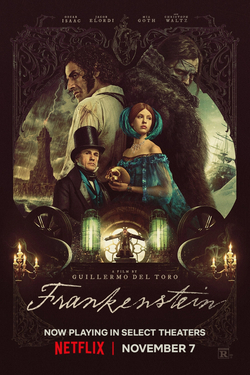
NOT A WOKE TRAP. The themes that progressive critics celebrate in Frankenstein (sympathy for the outcast, critique of male arrogance, institutional failure) are intrinsic to Mary Shelley's original 1818 novel. They are 200 years old. Del Toro is not inserting modern ideology; he is faithfully adapting one of the foundational texts of Western literature. The marketing is transparent: this is a Gothic tragedy about a creator and his creation. The Creature's suffering is the entire point of the story and always has been. Shelley wrote the novel when she was 18 years old in 1816. To call her themes 'woke' would be to call the entire Romantic literary tradition a progressive psyop. There is no bait-and-switch. What you see in the trailer is what you get in the theater.
Guillermo del Toro has been trying to make this movie since the mid-1990s. That is not a figure of speech. He first announced Frankenstein as a project at Universal in 2008. Before that, he had been sketching designs and taking script notes for years. He cast Doug Jones as the Creature. He wanted Bernie Wrightson to design the monster. Universal shelved it for their doomed Dark Universe franchise. Del Toro moved on to Pacific Rim, Crimson Peak, The Shape of Water, Pinocchio. He won two Oscars. He kept coming back to Frankenstein.
In 2016, he admitted: "Part of me has for more than 25 years chickened out of making it. I dream I can make the greatest Frankenstein ever, but then if you make it, you've made it. Whether it's great or not, it's done."
Netflix finally gave him $120 million and total creative freedom. The result is a film that is unmistakably the work of a man who has been thinking about this story for his entire adult life. It is lavish, earnest, emotionally overpowering at its best, and occasionally undisciplined at its worst. It is, above all, a sincere film. In an era of franchise cynicism and algorithmic content, that sincerity counts for a lot.
The question VirtueVigil has to answer is whether del Toro's Frankenstein smuggles modern progressive ideology into a classic story, or whether it is a faithful adaptation of one of Western literature's foundational texts. The answer is mostly the latter. But "mostly" is doing some work.
The film opens on an Arctic expedition in 1857. A Danish Navy ship, the Horisont, is trapped in ice near the North Pole. The crew discovers a gravely injured man: Victor Frankenstein. They bring him aboard. Almost immediately, a humanoid creature attacks the ship, demanding Victor's surrender. The captain shoots the Creature into the water. Victor begins telling his story.
Victor's mother dies giving birth to his younger brother William, who becomes their father's favorite. Baron Leopold Frankenstein is a renowned physician and a cold, abusive parent. Young Victor, grieving his mother and resenting his father's cruelty, becomes a brilliant surgeon obsessed with conquering death through science.
He is expelled from the Royal College of Surgeons of Edinburgh for reanimating corpses. The tribunal calls it sacrilege. But wealthy arms dealer Henrich Harlander is impressed and offers Victor unlimited funding and an isolated tower for his experiments. There is one unnamed condition.
Victor enlists William's help building the laboratory and falls for Elizabeth, Harlander's niece and William's fiancee. She declines his advances. When an impatient Harlander demands results, Victor assembles a body from criminals and soldiers killed in the Crimean War.
Harlander then reveals his condition: he is dying of syphilis and wants his brain transplanted into the Creature's body. Victor refuses. Harlander tries to sabotage the experiment and falls to his death. Lightning strikes the Creature. It fails to reanimate. The next morning, Victor finds the Creature alive.
Victor marvels at the Creature's strength and rapid healing, but grows frustrated by his inability to teach it. He begins imitating his father's cruel discipline. He becomes afraid of the Creature's physical power. Elizabeth visits and questions Victor's treatment, bonding with the Creature and teaching him to say her name. When William discovers Harlander's body, Victor lies and claims the Creature killed him.
Victor sends William and Elizabeth away, then sets his laboratory ablaze with the Creature inside. Hearing the Creature call his name, Victor tries to go back in, but the tower explodes, severing his leg.
The Creature escapes and shelters in the gears of a family's mill. Over a year, he secretly provides firewood and builds a sheep pen. The family calls their invisible helper the "Spirit of the Forest."
When the family leaves to hunt wolves, the Creature befriends their blind patriarch, who teaches him to read and speak. This is the emotional center of the film. David Bradley plays the Blind Man with such tenderness that when the Creature reads aloud for the first time, the moment feels miraculous.
The Creature returns to the lab ruins and discovers the truth about his creation. He goes back to find the Blind Man being attacked by wolves. The Creature fights them off but cannot save him. The family returns and, believing the Creature killed their patriarch, shoots him.
The Creature discovers he cannot die. He is immortal. He will spend eternity alone.
He confronts Victor at William and Elizabeth's wedding, demanding a companion. Victor refuses, fearing reproduction. In the ensuing chaos, Victor accidentally shoots Elizabeth while aiming at the Creature. William is mortally wounded and, with his dying breath, calls Victor a "monster." The Creature carries Elizabeth to a cave and comforts her as she dies.
Victor pursues the Creature to the Arctic. The Creature tries to destroy himself with dynamite but survives. Father and son reconcile. Victor addresses the Creature as "son." The Creature calls Victor "father." Victor dies from his injuries. The Creature frees the ship from the ice. The captain turns home. The Creature stands alone in the Arctic dawn, reaching toward the sunlight.
| Trope | Severity | Authenticity | Centrality | Weighted Score |
|---|---|---|---|---|
| Anti-institutional critique (Royal College as censorious, aristocratic hierarchy as corrupt) | 2 | High (0.7) | Low (0.5) | |
| Sympathetic outsider/monster narrative (Creature as innocent victim of society's fear and cruelty) | 3 | High (0.7) | High (1.8) | |
| Critique of patriarchal masculinity (Victor's arrogance and cruelty echo his abusive father, creating a cycle of toxic male authority) | 3 | High (0.7) | High (1.8) | |
| Female character as sole moral compass (Elizabeth is the only person who treats the Creature with genuine compassion; her kindness contrasts with every male character's violence or selfishness) | 2 | High (0.7) | Moderate (1.0) | |
| Capitalist/militarist critique (Harlander as arms dealer who sees miraculous creation only as a vehicle for personal survival) | 2 | Moderate (1.0) | Moderate (1.0) |
| Trope | Severity | Authenticity | Centrality | Weighted Score |
|---|---|---|---|---|
| Playing God punished (Victor's attempt to conquer death is explicitly called sacrilege and leads to total destruction of everyone he loves) | 4 | High (0.7) | High (1.8) | |
| Father-son reconciliation as emotional climax (Victor and Creature call each other 'father' and 'son' before Victor's death; family bonds as sacred even between creator and creation) | 4 | High (0.7) | High (1.8) | |
| Faithful adaptation of classic Western literature (no modern revisionism, no identity politics, no anachronistic social commentary imposed on a 200-year-old story) | 3 | High (0.7) | Moderate (1.0) | |
| Sacrifice and redemption (Elizabeth's compassion costs her life; Victor's remorse leads to reconciliation; the Creature shows mercy by freeing the ship) | 3 | High (0.7) | High (1.8) | |
| Clear moral consequences for transgression (every character who acts wrongly faces consequences; the film operates within a coherent moral universe) | 3 | High (0.7) | Moderate (1.0) | |
| Period-faithful setting with no anachronistic modern ideology (Victorian-era European setting presented without modern political overlay) | 2 | High (0.7) | Moderate (1.0) | |
| Religious and Miltonian moral framework (creation as sacrilege, Paradise Lost as thematic backbone, the Creature as a fallen Adam figure) | 2 | High (0.7) | Moderate (1.0) |
Mary Shelley published Frankenstein in 1818. The themes that progressive critics celebrate in this film (sympathy for the outcast, critique of male arrogance, institutional failure, the hubris of unchecked science) are literally two centuries old. They are foundational to the Western literary canon. Del Toro is not inserting modern ideology into a classic; he is faithfully adapting a novel that has always contained these themes.
The marketing was transparent. The trailer showed a Gothic tragedy about a creator and his creation. Del Toro described it as an "incredibly emotional story," not a horror film. There is no bait-and-switch.
Moreover, the progressive readings coexist with deeply traditional ones. The film's central moral lesson is that playing God has consequences. Victor's punishment is total and absolute: he loses his brother, the woman he loves, his health, and eventually his life. The Creature's punishment is immortality without companionship. The film's moral universe is coherent and unforgiving. This is not progressive relativism. It is old-fashioned moral storytelling.
This is a fair question given del Toro's personal politics (self-described anarchist, outspoken on immigration) and the fact that the sympathetic-monster narrative has become a tool in progressive storytelling. Here is the honest assessment.
- The Creature as a symbol of the marginalized and misunderstood
- Victor as a critique of patriarchal arrogance and toxic masculinity
- Elizabeth as the moral center in contrast to the men's violence
- The anti-institutional stance (the Royal College rejects Victor's work as sacrilege)
- Del Toro's stated belief that "hate can only breed without understanding"
- The unmistakable message that playing God leads to catastrophe
- A clear moral universe where transgression is punished
- Father-son reconciliation as the emotional climax
- No race-swapping of historically European characters (Oscar Isaac is the closest thing to a departure, and his ethnicity is never foregrounded)
- No modern anachronisms shoved into the period setting
- No lectures about contemporary social issues
- The film treats Mary Shelley's novel with genuine reverence
- The Miltonian framework treats creation, sin, and redemption as cosmic realities
- The ending is not nihilistic; it is bittersweet and redemptive
Frankenstein is a film made by a progressive director who faithfully adapted a classic novel whose themes happen to align with both progressive and traditional readings. Del Toro does not weaponize the material. He does not turn the Creature into a metaphor for modern identity politics. He tells the story Shelley wrote: a scientist defies the natural order, creates life, treats it cruelly, and pays the ultimate price. If you find that "woke," your quarrel is with Mary Shelley, not Guillermo del Toro.
Conservative audiences who enjoy Gothic literature, horror classics, and stories with clear moral consequences will find Frankenstein rewarding. It is long (150 minutes), occasionally indulgent, and not as tightly structured as del Toro's best work. But it is sincere, beautiful, and morally serious in a way that most modern blockbusters are not.
Guillermo del Toro (Mexican, b. 1964). Two-time Oscar winner (The Shape of Water, Pinocchio). Self-described anarchist and atheist raised Catholic. His films consistently center outsiders and monsters as objects of empathy. Politically progressive but not didactic in his filmmaking. Frankenstein was his dream project for 30+ years.
Guillermo del Toro, J. Miles Dale (longtime del Toro collaborator), Scott Stuber (former Netflix film chief). Produced under del Toro's multi-year Netflix deal.
Oscar Isaac (Victor), Jacob Elordi (the Creature), Mia Goth (Elizabeth/Claire), Christoph Waltz (Harlander), Felix Kammerer (William), David Bradley (the Blind Man), Charles Dance (Baron Leopold), Lars Mikkelsen (Captain Anderson), Ralph Ineson (Professor Krempe). A strong, overwhelmingly European cast appropriate to the setting.
Dan Laustsen, del Toro's regular DP (Crimson Peak, The Shape of Water). Oscar-nominated for this film.
Alexandre Desplat, two-time Oscar winner who previously scored The Shape of Water and Pinocchio for del Toro. Nominated for Best Original Score.
Tamara Deverell with set decorator Shane Vieau. Oscar-nominated. The film's visual design draws heavily from Bernie Wrightson's 1983 Frankenstein illustrations.
Guillermo del Toro is politically progressive. He has described himself as an anarchist. He is outspoken on immigration, has criticized walls and borders, and has publicly supported various progressive causes. He left Catholicism and identifies as an atheist.
But here is the thing: his films are not progressive propaganda. They are something more interesting. Del Toro's body of work is obsessed with Catholic imagery, moral consequence, the reality of evil, and the possibility of redemption. Pan's Labyrinth (2006) is a fairy tale set during the Spanish Civil War where a girl escapes fascist cruelty through a fantasy world that may or may not be real. It is anti-fascist, but it is also deeply concerned with obedience, sacrifice, and the afterlife. The Shape of Water (2017) is a romance between a mute woman and an amphibian creature that celebrates the beauty of outcasts. It won Best Picture. Crimson Peak (2015) is a Gothic romance that plays like a Victorian ghost story with no modern ideology whatsoever.
Del Toro's progressivism shows up in his thematic sympathies (he consistently sides with the monster, the outsider, the marginalized) rather than in didactic messaging. He does not lecture. He creates worlds of extraordinary beauty and violence and lets the stories speak for themselves. Frankenstein fits this pattern perfectly.
The comparison to recent Hollywood adaptations is instructive. A lesser filmmaker would have made the Creature a metaphor for systemic oppression. Del Toro makes the Creature a person. That is a crucial difference.
1. Victor's attempt to conquer death results in the destruction of everything he loves. The film is unambiguous about this. It is not celebrating scientific ambition; it is warning against it. The Royal College's accusation of sacrilege is vindicated by the plot.
2. Victor's father was cold and abusive. Victor becomes cold and abusive toward the Creature. The cycle of cruelty between fathers and sons is the film's central dramatic engine. This reads as a critique of patriarchal authority, and it is one. But it is also the story Shelley told.
3. Elizabeth's kindness toward the Creature, the Blind Man's friendship, and ultimately Victor's deathbed reconciliation with his "son" are the film's moral anchors. The characters who show compassion are the ones the audience loves. The characters who show cruelty are punished.
4. The Creature's discovery that he cannot die is presented not as a superpower but as a curse. Eternal life alone is worse than death. This is a deeply conservative anthropological claim: human beings need family, love, and belonging. Without them, even immortality is meaningless.
5. Del Toro has described seeing Boris Karloff's Frankenstein as a child as a religious experience, comparing the Creature to a saint or messiah. The entire film functions as an act of artistic devotion. Del Toro spent 30 years building toward this. His sincerity is the film's greatest asset.
Formula: Weighted Score = Severity × Authenticity Multiplier × Centrality Multiplier
🔴 Woke Tropes
| Trope | Severity | Authenticity | Centrality | Score |
|---|---|---|---|---|
| Anti-Institutional Critique | 2 | High | Low | 0.7 |
| Sympathetic Outsider/Monster Narrative | 3 | High | High | 3.78 |
| Critique of Patriarchal Masculinity | 3 | High | High | 3.78 |
| Female Character as Sole Moral Compass | 2 | High | Moderate | 1.4 |
| Capitalist/Militarist Critique | 2 | Moderate | Moderate | 2 |
| TOTAL WOKE | 11.7 | |||
🟢 Traditional Tropes
| Trope | Severity | Authenticity | Centrality | Score |
|---|---|---|---|---|
| Playing God Punished | 4 | High | High | 5.04 |
| Father-Son Reconciliation as Sacred | 4 | High | High | 5.04 |
| Faithful Adaptation of Classic Western Literature | 3 | High | Moderate | 2.1 |
| Sacrifice and Redemption | 3 | High | High | 3.78 |
| Moral Consequences for Transgression | 3 | High | Moderate | 2.1 |
| Period-Faithful Setting | 2 | High | Moderate | 1.4 |
| Religious/Miltonian Moral Framework | 2 | High | Moderate | 1.4 |
| TOTAL TRADITIONAL | 20.9 | |||
Score Margin: +9 TRAD
Director: Guillermo del Toro
Self-described anarchist and atheist (raised Catholic). Progressive on immigration and social issues. His films consistently champion outsiders, monsters, and the marginalized against institutional power. But his politics are filtered through a deeply personal, spiritual, fairy-tale sensibility rather than didactic messaging.Mexican filmmaker (b. 1964, Guadalajara). One of the most celebrated genre directors alive. Won Best Picture and Best Director at the 90th Academy Awards for The Shape of Water (2017). Won Best Animated Feature for Guillermo del Toro's Pinocchio (2022). His filmography spans Pan's Labyrinth (2006), Crimson Peak (2015), The Devil's Backbone (2001), Pacific Rim (2013), and the Hellboy films. Frankenstein was his 'dream project' for over 30 years, one he repeatedly delayed because he feared it would not live up to his vision. He was raised Catholic but became an atheist after witnessing human suffering. His films consistently explore the tension between innocence and cruelty, beauty and horror, faith and doubt. He describes the Creature as a 'saint' or 'messiah' figure, not a monster. Del Toro was notably snubbed for Best Director at the 98th Academy Awards despite the film receiving nine nominations.
Writer: Guillermo del Toro
Del Toro wrote the screenplay himself, adapting Mary Shelley's 1818 novel with a focus on faithfulness to the book's Miltonian tragedy framework. He drew inspiration from Frank Darabont's screenplay for Kenneth Branagh's 1994 Mary Shelley's Frankenstein, which he called 'pretty much perfect.' The screenplay restructures the novel into two acts (Victor's Tale and the Creature's Tale), preserving the novel's nested narrative structure while giving the Creature equal screen time and narrative authority. Del Toro has described the adaptation as 'philosophically faithful' to Shelley while expanding it into a Victorian-era Gothic romance with his signature fairy-tale and body-horror sensibilities.
Adult Viewer Insight
Conservative adults will find Frankenstein more aligned with traditional values than they might expect from a director with del Toro's politics. The film's central message is that playing God is catastrophic, that cruelty begets cruelty, and that the only path to redemption is compassion and family bonds, even between a creator and his monstrous creation. There is no modern political messaging shoehorned into the period setting. No identity politics lectures. The Creature is not a metaphor for any contemporary social group. He is a person, created without consent, treated with cruelty, and desperate for love. That is the story Shelley wrote in 1818, and del Toro honors it. The film is long and occasionally indulgent (del Toro's visual maximalism can feel overwhelming), and some viewers will find the pacing of the first act slow. But the Creature's Tale in the second half is magnificent, and the final reconciliation scene between Victor and the Creature is earned, moving, and morally serious. If you enjoy Gothic literature, classic horror, and films that treat their source material with reverence, Frankenstein is worth your 150 minutes.
Parental Guidance
Rated R for violent content and some grisly images. Recommended for ages 15+. The film contains graphic body horror in the creation sequence (stitched-together corpse parts, reanimation), multiple deaths including a character falling from a tower, a character's leg being severed in an explosion, wolf attacks, and a character being shot. The violence is not gratuitous but is presented within a Gothic horror framework that may be intense for younger viewers. There is no sexual content beyond a brief kiss. Language is period-appropriate with no modern profanity. The themes are heavy: abandonment, abuse, immortality as a curse, and the death of innocent characters including a bride and a brother. Children under 15 should not watch this film. Mature teenagers who enjoy Gothic literature and classic horror will find it rewarding but should be prepared for emotional intensity.
Find Frankenstein on Amazon Prime Video, rent, or buy:
▶ Stream or Buy on AmazonAs an Amazon Associate, VirtueVigil earns from qualifying purchases.
Community Discussion 0
Subscribe to comment.
Join the VirtueVigil community to share your perspective on this review.