
Furiosa: A Mad Max Saga
Let's address the elephant in the Wasteland right up front: Furiosa is not woke. It's not even close. And the fact that a vocal slice of the internet spent months insisting otherwise tells you more about the state of online culture discourse than it does about anything George Miller put on screen.
Full analysis below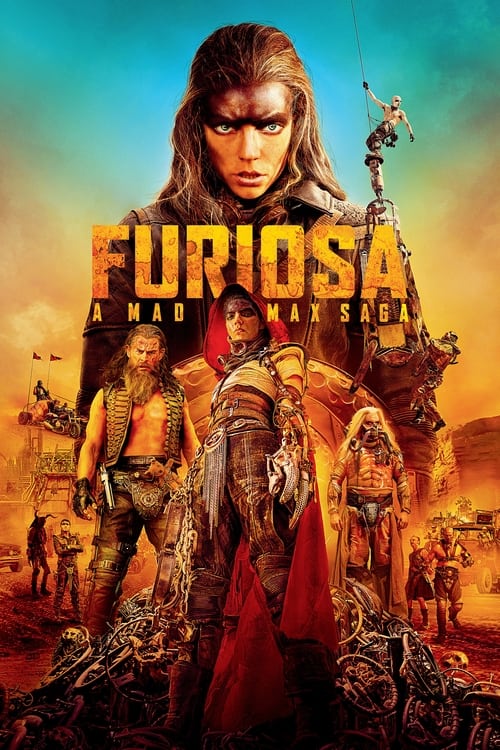
NOT A WOKE TRAP. Despite a loud online discourse claiming Furiosa is feminist propaganda or part of some woke Hollywood agenda, the film itself tells a straightforward revenge and survival story rooted in classical storytelling. The female lead was established in Fury Road nine years earlier. George Miller did not insert her as a diversity checkbox. He created a character, the audience loved her, and he told her origin story. The film's actual themes, which include family, home, resilience, and the cost of vengeance, are about as traditional as it gets. Conservative viewers who enjoyed Fury Road will find more of the same here: relentless action, a hostile world, and characters who earn everything through suffering and will. The culture war noise around this film has almost nothing to do with what's actually on screen.
Let's address the elephant in the Wasteland right up front: Furiosa is not woke. It's not even close. And the fact that a vocal slice of the internet spent months insisting otherwise tells you more about the state of online culture discourse than it does about anything George Miller put on screen.
Furiosa: A Mad Max Saga is the origin story of the character Charlize Theron made iconic in 2015's Fury Road. Here she's played by Anya Taylor-Joy as an adult and Alyla Browne as a child, and the film spans roughly 15 years of her life across five chapters. It opens in the Green Place of Many Mothers, one of the last fertile lands in the post-apocalyptic wasteland, where a young Furiosa is kidnapped by scouts from a biker horde led by the charismatic, unhinged warlord Dementus (Chris Hemsworth). Her mother, Mary Jabassa (Charlee Fraser), chases after her and is captured and crucified in front of Furiosa by Dementus's men. That image, a mother tortured and killed while her daughter watches helplessly, sets the emotional engine of the entire film.
From there, Furiosa is traded to Immortan Joe at the Citadel and narrowly avoids becoming one of his breeding wives by cutting off her hair, disguising herself as a mute War Boy, and spending over a decade working her way up through the ranks. She earns the trust of Praetorian Jack (Tom Burke), the War Rig commander, who becomes her mentor, ally, and eventual partner. Together they plan an escape. But Dementus, who has ruined Gastown through incompetent rule, ambushes them. Jack is dragged to death behind a motorcycle. Furiosa loses her left arm escaping. She returns to the Citadel, orchestrates the defeat of Dementus's horde, captures him, and uses his still-living body as fertilizer to grow a peach tree from the pit her mother gave her.
That's not a feminist manifesto. That's a revenge epic. And one of the most brutally satisfying ones in recent memory.
The culture war discourse around this film started before Fury Road even released. In 2015, a men's rights blogger named Aaron Clarey called for a boycott of Fury Road, describing it as "feminist propaganda posing as a guy flick" because Charlize Theron's Furiosa "barked orders at Mad Max." The fact that Miller had consulted Eve Ensler (author of The Vagina Monologues) to coach the actresses playing Immortan Joe's captive wives fueled the narrative further. Never mind that Ensler was brought on specifically because the film depicts sex trafficking and Miller wanted authenticity. The label stuck in certain corners of the internet.
When Furiosa was announced as a prequel centered entirely on the female character, the cycle repeated. "Is Furiosa woke?" trended on Google. YouTube commentators produced hours of content declaring the film dead on arrival. Some claimed the box office underperformance ($174 million worldwide against a $168 million budget) proved audiences had rejected feminist Hollywood.
Here's the problem with that theory: Furiosa flopped for boring reasons that have nothing to do with ideology. Prequels almost always underperform (see Solo: A Star Wars Story). The film opened against The Garfield Movie on Memorial Day weekend and lost the family audience entirely. The nine-year gap between Fury Road meant a generation of potential viewers had no attachment to the franchise. The R rating excluded teenagers. Amazon's Fallout TV series had just scratched the post-apocalyptic itch for millions of streamers. And $168 million was simply too much to spend on an R-rated prequel to a film that itself only made $380 million.
None of that is about wokeness. It's about market math.
Now, what's actually in the movie? Furiosa's core drive is to get home. To the Green Place. To her mother's world. That's it. She's not fighting for social justice or systemic change. She's fighting to return to the people she loves. When she can't do that (because her mother is dead and the star map to the Green Place was on the arm she had to sever), her drive shifts to vengeance. Classical, primal, Old Testament vengeance. She hunts Dementus across the Wasteland and plants a tree in his living body.
The film's emotional spine is the mother-daughter bond. Mary Jabassa rides alone into enemy territory to rescue her child, kills multiple men with her bare hands, and ultimately dies protecting Furiosa. The Green Place itself is a matriarchal community, yes, but it's also presented as the last bastion of agriculture, family structure, and genuine civilization in a world of male-dominated warlord tyranny. The Vuvalini (the Many Mothers) aren't a political statement. They're the only people in the Mad Max universe who managed to build something worth defending.
Preaetorian Jack is a genuinely good man. He sees Furiosa's potential, trains her, fights beside her, and dies for her. The film doesn't diminish him to elevate her. He's competent, brave, and morally grounded. His death is the film's most devastating moment because it costs Furiosa the one person who treated her as an equal and a partner. Tom Burke plays him with quiet authority, and the relationship between Jack and Furiosa is one of mutual respect, not gender competition.
Chris Hemsworth, meanwhile, gives the performance of his career as Dementus. He's flamboyant, terrifying, and weirdly sympathetic. Hemsworth plays him as a man who lost his own family and overcompensated by building a horde, adopting Furiosa, and consuming everything in his path. He's the dark mirror of Furiosa's grief. She channels loss into purpose; he channels it into chaos. The film understands that both responses are human.
Anya Taylor-Joy has maybe 30 lines of dialogue in the entire film. It's an almost entirely physical performance, communicated through her enormous eyes, her posture, and her controlled movements. Some audiences found this underwhelming. But Miller's choice was deliberate: Furiosa becomes silent because speaking got her nothing in a world that only respects force. Her silence is strategic, not passive. It's the survival mechanism of someone who learned early that the loudest person in the room is usually the first to die.
Alyla Browne, as the young Furiosa, is outstanding. She carries the first act with a fierce physicality that makes the transition to Taylor-Joy feel natural. Miller used subtle AI-assisted blending to smooth the handoff between the two actresses, a technical choice that works seamlessly.
Is the film flawless? No. At 148 minutes, the middle chapters drag. The Gastown and Bullet Farm power struggles feel repetitive. Some of the CGI, particularly in wide shots and the de-aging effects, looks conspicuously digital compared to Fury Road's practical-stunt approach. And the five-chapter structure, while ambitious, occasionally makes the film feel more like a chronicle than a story with forward momentum.
But the accusation that Furiosa is woke propaganda is genuinely laughable if you've watched the film. The strongest traditional value on display is the sacredness of family and home. Every single thing Furiosa does is motivated by love for her mother and longing for her homeland. The Green Place isn't framed as a feminist utopia; it's framed as home. The peach tree she grows from Dementus's body is a monument to her mother, not a political statement.
The film received a 90% critics score and 89% audience score on Rotten Tomatoes. It was named to the National Board of Review's Top Ten Films of 2024. Despite the strong critical reception, it was largely shut out of Oscar season, not appearing on any Academy shortlists. The box office failure likely contributed to that snub, but the quality of the filmmaking is undeniable.
George Miller is almost 80 years old. He made this film because he had a story to tell about a character he created. He's been building this mythology since 1979. The idea that he suddenly became a woke propagandist in his late 70s, after decades of films that celebrate individual grit, survival instinct, and the human refusal to be broken, doesn't survive contact with his actual work.
Furiosa is a film about loss, resilience, and the fire that keeps burning when everything else has been taken from you. It's classical storytelling in a post-apocalyptic wrapper. And it deserved better than both its box office and the culture war it never asked to be part of.
Formula: Weighted Score = Severity × Authenticity Multiplier × Centrality Multiplier
🔴 Woke Tropes
| Trope | Severity | Authenticity | Centrality | Score |
|---|---|---|---|---|
| Female Lead in Traditional Male Genre | 2 | High | High | 2.52 |
| Matriarchal Society Presented Positively | 2 | High | Moderate | 1.4 |
| Male Villains Dominate the Antagonist Pool | 2 | High | Moderate | 1.4 |
| Breeding Wives / Sex Slavery as World-Building | 2 | High | Low | 0.7 |
| TOTAL WOKE | 6.0 | |||
🟢 Traditional Tropes
| Trope | Severity | Authenticity | Centrality | Score |
|---|---|---|---|---|
| Family and Home as Ultimate Motivation | 5 | High | High | 6.3 |
| Mother-Daughter Bond as Sacred | 5 | High | High | 6.3 |
| Resilience Through Suffering | 4 | High | High | 5.04 |
| Male Mentor as Honorable Figure | 4 | High | Moderate | 2.8 |
| Vengeance as Primal Justice | 4 | High | High | 5.04 |
| Silence and Stoicism as Strength | 3 | High | Moderate | 2.1 |
| Civilization Built and Defended Through Sacrifice | 3 | High | Moderate | 2.1 |
| TOTAL TRADITIONAL | 29.7 | |||
Score Margin: +14 TRAD
Director: George Miller
APOLITICAL CRAFTSMAN. Miller's five-decade filmography spans hypermasculine action (Mad Max), children's animation (Happy Feet, Babe), and literary drama (The Witches of Eastwick, Lorenzo's Oil). He defies political categorization.George Miller is one of cinema's genuine originals. Born in 1945 in Queensland, Australia, he trained as a medical doctor before pivoting to filmmaking. His career spans an almost absurd range: Mad Max (1979) invented a new genre of automotive apocalypse fiction. The Road Warrior (1981) perfected it. Beyond Thunderdome (1985) went bigger and stranger. Then he disappeared into family films for two decades: producing Babe (1995), directing Babe: Pig in the City (1998), and making Happy Feet (2006), which won the Oscar for Best Animated Feature. He also directed The Witches of Eastwick (1987) with Jack Nicholson and Lorenzo's Oil (1992), a true-story medical drama. Then he returned to Mad Max with Fury Road (2015), a film many critics consider the greatest action movie ever made. It earned 10 Oscar nominations and won six. Furiosa is his fifth Mad Max film and arguably his most narratively ambitious. Miller doesn't fit into political boxes. He hired Eve Ensler as a consultant on Fury Road to ensure the depiction of sex trafficking felt authentic, which upset MRA commentators. But his films consistently celebrate individual resilience, self-reliance, and the refusal to submit to tyranny. These are not progressive talking points. They're classical heroic archetypes. Miller is 79 years old and still making films that put directors half his age to shame. His ideology is craft. His politics are cinema.
Writer: George Miller & Nico Lathouris
Miller co-wrote with Nico Lathouris, an Australian actor-playwright who also co-wrote Fury Road. Lathouris has deep roots in Greek tragedy and classical narrative structure, which shows in Furiosa's five-chapter epic format. The screenplay reportedly existed in some form before Fury Road was even shot; Miller had Furiosa's full backstory written out to inform Charlize Theron's performance. This is not a cash-grab sequel. This script was baked into the franchise's foundation.
Adult Viewer Insight
Conservative viewers should ignore the online noise and judge this film on its own terms. Furiosa is a revenge story driven by family loyalty and the desire to go home. The female lead isn't a girl-boss lecture; she's a survivor who earns everything through suffering, silence, and sheer will. The male characters are a mix of competent allies (Praetorian Jack) and compelling villains (Dementus, Immortan Joe). Nobody is diminished for the sake of gender politics. The film is violent, intense, and emotionally heavy. It's also one of the best-crafted action films of 2024. If you liked Fury Road, you'll find a worthy companion piece here. If the MRA boycott talk from 2015 kept you away, you missed out then and you'll miss out again. Miller doesn't make propaganda. He makes cinema.
Parental Guidance
Recommended age: 16+ for intense sustained violence, disturbing imagery, and thematic heaviness. The film depicts the on-screen crucifixion and torture of Furiosa's mother, which is deeply disturbing. There is an attempted rape scene (Rictus tries to assault teenage Furiosa; she escapes). A man is dragged to death behind a motorcycle. The climax involves a character being used as living fertilizer, which is shown. Vehicular mayhem and mass casualties are constant. Language is sparse but includes some profanity. There is no sexual content beyond the implied threat of sexual slavery (the breeding wives). Substance use is minimal. The thematic content around vengeance, loss, and the moral cost of survival is heavy and best suited for mature teens who can process it. For families who do watch together, the mother-daughter relationship and the question of whether vengeance brings peace are excellent discussion points.
Find Furiosa: A Mad Max Saga on Amazon Prime Video, rent, or buy:
▶ Stream or Buy on AmazonAs an Amazon Associate, VirtueVigil earns from qualifying purchases.
Community Discussion 0
Subscribe to comment.
Join the VirtueVigil community to share your perspective on this review.