Good Luck, Have Fun, Don't Die
Hollywood doesn't often make movies that tell you to put down your phone - and mean it.…
Full analysis below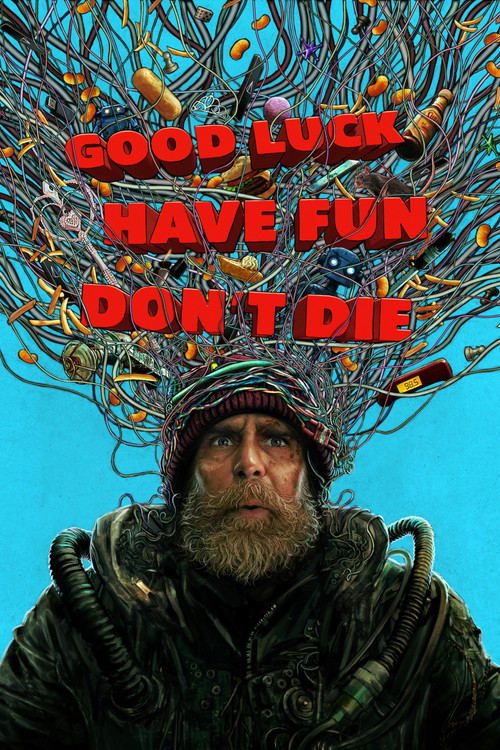
Good Luck, Have Fun, Don't Die's themes are front-loaded and unambiguous. What looks like a chaotic ensemble action comedy is, at its core, a film that argues technology is cannibalizing human civilization - and that the cure is analog, human, and embodied. That is not a woke message. The school shooting subplot involving Juno Temple's character Susan creates some political sensitivity, but it is used to explore grief and corporate exploitation of tragedy (child cloning), not to advocate for gun control. Conservative viewers should not feel baited.
Hollywood doesn't often make movies that tell you to put down your phone - and mean it. Yet here is Gore Verbinski, the eccentric auteur behind Pirates of the Caribbean and Rango, delivering a sprawling, deranged, 134-minute action comedy whose central villain isn't a foreign despot, a mad scientist, or a criminal mastermind. It's the smartphone. The algorithm. The artificial intelligence that promises to make your life better and will, if left unchecked, make your life over.
Good Luck, Have Fun, Don't Die is one of the stranger films to emerge from the post-pandemic studio ecosystem - self-financed at $20 million via Constantin Film, distributed by the scrappy independent Briarcliff Entertainment, and anchored by Sam Rockwell doing what Sam Rockwell does best: playing an unhinged, inexplicably compelling weirdo who turns out to be the sanest person in the room. The result is a chaotic, funny, flawed, and ultimately warm-hearted movie that will confound critics looking for easy ideological slots. This isn't woke. It isn't conservative in any self-conscious, flag-waving sense. It is, at its core, a film that loves human beings and fears what we're doing to ourselves.
A man dressed in a transparent plastic trashbag raincoat, wires trailing from every pocket, bomb strapped to his chest, walks into Norm's Diner in West Hollywood at 10:10 PM. His name, per the credits, is simply "The Man from the Future" - played by Sam Rockwell with kinetic, barely-contained energy. He announces to the baffled patrons, fork-frozen over their burgers, that he is there to save the world. He has been here before. One hundred and seventeen times before, give or take. Each attempt has failed. Each failure has sent him back to this exact diner, this exact night, to try again with a new combination of volunteers.
The world he's trying to save is ours, only slightly worse: a Los Angeles where high school teachers have essentially surrendered to students who do nothing but stare at phones, where a corporation is offering to clone children killed in school shootings (for a fee, naturally), and where virtual reality has become so consuming that some people - like Ingrid's partner Tim - have simply chosen to live there permanently and never come back.
The night's mission: get across town to a specific house where a nine-year-old boy - himself a clone, unbeknownst to those who call him son - is hours away from completing an AI singularity that will seize control of global infrastructure. The Man doesn't want to destroy the AI. Destroying it is, apparently, irrelevant across every timeline - it always gets built. He needs to install a security protocol that will keep the AI from going rogue. To do that, he needs the right team.
The team he assembles this time: Mark and Janet (Michael Peña and Zazie Beetz), teachers whose marriage is fraying; Susan (Juno Temple), a mother grieving her cloned-but-wrong son Darren; Scott (Asim Chaudhry), an amiable nobody; and Ingrid (Haley Lu Richardson), a young woman with a severe allergy to all electronic devices and wifi - the film's most important character, as it turns out.
What follows is part heist, part survival thriller, part flashback anthology. Verbinski structures the film's midsection as a series of character vignettes - we see how each person arrived at this diner, what technology has already taken from them - before the whole ensemble charges toward a climax that involves zombie-like phone-addicted teenagers, a brutal AI ambush, and a twist ending that reframes everything. The real resolution isn't installing the security protocol. It's Ingrid's allergy: the solution to the AI singularity is to give every human being on earth the same biological aversion to electronic devices that Ingrid was born with. Radical, absurd, and weirdly poetic.
Trope Analysis - VVWS Weighted Scoring
🔴 Woke Elements
| Trope | Severity (1-5) | Authenticity Mult. | Centrality Mult. | Weighted Score | Notes |
|---|---|---|---|---|---|
| Race-conscious ensemble casting | 3 | 1.0 (Moderate) | 0.5 (Low) | 1.50 | Diverse cast is Hollywood-standard, not ideologically foregrounded. No character's race is weaponized as a political statement. |
| School shooting as emotional backstory | 3 | 0.7 (High) | 0.5 (Low) | 1.05 | Susan's loss is authentic and emotionally motivated, not a gun-control sermon. It's the setup for a corporate exploitation of grief plot, not a political statement. |
| Corporate tech as institutional villain | 2 | 1.0 (Moderate) | 1.0 (Moderate) | 2.00 | The child-cloning company is presented as predatory. This reads more as anti-corporatist populism than progressive ideology - but it's present. |
| TOTAL WOKE SCORE | 5 |
🟢 Traditional Elements
| Trope | Severity (1-5) | Authenticity Mult. | Centrality Mult. | Weighted Score | Notes |
|---|---|---|---|---|---|
| Anti-AI / anti-tech core message | 5 | 0.7 (High) | 1.8 (High) | 6.30 | The AI singularity is unambiguously the villain. Technology addiction is presented as a civilizational threat. This is the entire film's premise. |
| Real-world human connection > virtual reality | 4 | 0.7 (High) | 1.8 (High) | 5.04 | Ingrid's partner Tim chose VR over her. The resolution is literally about re-grounding humanity in physical, embodied existence. |
| Individual heroism saves civilization | 4 | 0.7 (High) | 1.8 (High) | 5.04 | The Man from the Future is a lone individual who takes personal responsibility for humanity's survival - 117 times over, without institutional support. |
| Maternal sacrifice as moral anchor | 4 | 0.7 (High) | 1.0 (Moderate) | 2.80 | The Man's mother dies protecting him in the post-apocalyptic bunker. Her sacrifice frames his entire mission. Motherhood is presented as sacred. |
| Heterosexual couples as emotional core | 3 | 0.7 (High) | 1.0 (Moderate) | 2.10 | Mark and Janet's fractured but real marriage is the film's central relational drama. The resolution allows for their reconciliation. |
| TOTAL TRAD SCORE | 21 |
Score Margin: +16 TRAD
Woke Trap Assessment
Verdict: NOT A WOKE TRAP
The films that constitute woke traps are the ones that lure you in with conventional genre packaging - superhero action, family comedy, holiday warmth - then pivot into progressive messaging once they have your ticket. Good Luck, Have Fun, Don't Die does not do this.
Its skepticism of technology and artificial intelligence is front-loaded, relentless, and without apology. There is no moment where the film pivots to celebrate the AI or position it as misunderstood. The villain is the machine. The heroes are the analog humans - especially Ingrid, whose biological incompatibility with electronics is presented as a gift, not a disability. The film's resolution is, in effect, a plea for humanity to return to embodied, unmediated life. That is a genuinely traditionalist impulse.
The diverse casting is notable but does not function ideologically. No character delivers a DEI speech. No subplot concerns systemic racism. The school shooting backstory - the element most likely to raise conservative eyebrows - is used to explore the horror of corporate exploitation of grief, not to advance a gun-control argument. If anything, the film's message about Susan's cloned son is a bioethics warning: there are things technology should not try to replace.
Conservative viewers who walk in expecting a progressive trojan horse will be surprised. This film is broadly on your side.
Creative Team At A Glance
Director: Gore Verbinski - Verbinski is Hollywood's most reliably strange mainstream filmmaker. Mouse Hunt, The Ring, Pirates of the Caribbean, Rango, A Cure for Wellness - these are the films of a director with no obvious political agenda and a consistent fascination with systems that corrupt and consume individuals. His body of work reads as anti-authoritarian in a pre-ideological sense. He doesn't make films for progressives or for conservatives. He makes films about things he finds genuinely disturbing. Right now, he finds AI disturbing. So should you.
Writer: Matthew Robinson - Robinson developed this script over years from an abandoned TV pilot. His thematic throughline - authentic human experience vs. mediated, technologized living - is consistent and not politically pointed. His script is messy (reviewers have noted the film's ambition exceeds its coherence at points), but its emotional intelligence is genuine.
Cast ideological profile: Mixed, leaning apolitical. Sam Rockwell carries no meaningful public activist footprint. Michael Peña is a practicing Scientologist with no progressive track record. Zazie Beetz has made some public progressive statements but her role here is substantive and not ideologically coded. Haley Lu Richardson has advocated for mental health awareness. Juno Temple is apolitical publicly. This is as ideologically neutral a cast as contemporary Hollywood assembles.
Director/Writer Ideological Track Record
Gore Verbinski's films have never been political in a topical sense. A Cure for Wellness (2016) - his most thematically relevant prior work - is a horror film about a Swiss wellness clinic that turns out to be harvesting its wealthy clients for a parasitic corporate immortality project. The metaphor for how modernity sells us 'cures' that deepen our captivity is as applicable to Big Tech as to Big Pharma. Verbinski did not make that film as a comment on Obamacare or any current event. He made it because the concept disturbed him.
Good Luck, Have Fun, Don't Die operates in the same register. Verbinski is not making a film about AI to please progressive Hollywood (Hollywood, notably, is deeply invested in AI). He is making it because he finds it frightening, absurd, and worth addressing while the window is open. The film was shot in Cape Town on a modest $20 million budget, with a small independent distributor. This is not a studio-mandated message movie. It is an idiosyncratic artist's response to a cultural moment.
Matthew Robinson similarly has no public political track record worth flagging. His script's tone - dark comedy laced with genuine horror about what we're becoming - is consistent with a writer who distrusts institutional power broadly, not a writer advancing a specific political coalition's agenda.
Adult Viewer Insight
For the conservative adult viewer, Good Luck, Have Fun, Don't Die is a genuinely refreshing anomaly in 2026's theatrical landscape. It is a movie that:
1. Identifies artificial intelligence and technology addiction as existential civilizational threats - not as tools of empowerment
2. Centers a mother's sacrifice as the emotional and moral anchor of its protagonist's journey
3. Presents a heterosexual couple's commitment and fracture as its primary relational drama
4. Resolves with an argument that human beings should be less connected to technology, not more
5. Features an individual hero who takes personal, repeated, costly responsibility for saving the world - without government assistance, without institutional backing, and without a committee to report to
None of this is coded progressive. Some of it is coded libertarian. Most of it is coded as common sense.
The film has significant rough edges. At 134 minutes, it runs long. Its structure - flashback vignettes interrupting the main action - fragments momentum. Some tonal shifts are jarring even by Verbinski's surrealist standards. And the R rating is real: the language is consistent, the violence includes multiple deaths (some brutal), and a brief sexual reference earns its rating. This is not a family movie.
But for adults who have found themselves looking at a theater marquee full of franchise IP and identity-politics prestige bait, Good Luck, Have Fun, Don't Die is the rare thing: a swing. An original, weird, sometimes brilliant movie made by a filmmaker who actually believes in what he's saying. Believe it or not, what he's saying is that we need to put down our phones, live in our bodies, and stop letting machines think for us.
Sam Rockwell, dressed in a plastic trashbag with a bomb on his chest, has never been more relatable.
Parental Guidance
Rating: R - For pervasive language, violence and grisly images, and brief sexual content.
Not appropriate for children or young teens. Here's what parents need to know:
- Language: Strong language is consistent throughout. Characters under extreme stress do not moderate their speech.
- Violence: Multiple characters are killed, including by gunshot, stabbing, and drone strike. A flashback depicts a school shooting (not graphic but emotionally intense). A post-apocalyptic bunker scene shows a mother killed by a drone - the emotional centerpiece of the protagonist's backstory.
- Disturbing concepts: A corporation clones children who died in school shootings. The clones are slightly wrong - uncanny, not quite human - and are required to recite advertisements daily to remain "operational." This is genuinely disturbing and may frighten or upset younger viewers who encounter it.
- Brief sexual content: Not explicit; more a comedic reference consistent with the film's R-rated satirical tone.
- Thematic weight: The film's anxiety about AI, screen addiction, and technology's displacement of human connection may be more disturbing to thoughtful teens than the violence. That is not a reason to avoid it for older teens - it is, frankly, a reason to watch it with them and talk about it.
Recommended age: 17+. For mature teenagers who can handle the violence and disturbing imagery, this film offers a genuinely worthwhile conversation starter about technology, authentic human experience, and what we're trading away for the convenience of the screen.
Formula: Weighted Score = Severity × Authenticity Multiplier × Centrality Multiplier
🔴 Woke Tropes
| Trope | Severity | Authenticity | Centrality | Score |
|---|---|---|---|---|
| Race-Conscious Ensemble Casting | 3 | Moderate | Low | 1.5 |
| School Shooting as Emotional Backstory | 3 | High | Low | 1.05 |
| Corporate Tech as Predatory Institution | 2 | Moderate | Moderate | 2 |
| TOTAL WOKE | 4.5 | |||
🟢 Traditional Tropes
| Trope | Severity | Authenticity | Centrality | Score |
|---|---|---|---|---|
| Anti-AI Civilizational Warning | 5 | High | High | 6.3 |
| Human Connection Over Virtual Reality | 4 | High | High | 5.04 |
| Individual Heroism and Personal Responsibility | 4 | High | High | 5.04 |
| Maternal Sacrifice as Moral Anchor | 4 | High | Moderate | 2.8 |
| Heterosexual Couple as Emotional Core | 3 | High | Moderate | 2.1 |
| TOTAL TRADITIONAL | 21.3 | |||
Score Margin: +16 TRAD
Director: Gore Verbinski
Populist/Apolitical AuteurGregor 'Gore' Verbinski (b. 1964) is one of Hollywood's most idiosyncratic mainstream directors. Known for Pirates of the Caribbean (2003-2007), The Ring (2002), Rango (2011), and the underrated psychological horror A Cure for Wellness (2016), Verbinski has never been a political filmmaker in any conventional sense. His work tends toward the surreal, the sensory, and the philosophically layered - more Kafka than CNN. A Cure for Wellness in particular displayed a deep skepticism of corporate control, institutional deception, and modernity's false promises of progress. Good Luck, Have Fun, Don't Die continues that thematic thread with a more comedic, crowd-pleasing surface. Verbinski has no documented record of progressive activism or public ideological statements. His sensibility reads as instinctively anti-authoritarian rather than ideologically aligned.
Writer: Matthew Robinson
Matthew Robinson is a screenwriter whose credits include The Invention of Lying (2009) and Monster Trucks (2016). Good Luck, Have Fun, Don't Die originated as a TV pilot concept that Robinson developed over years before landing at 3 Arts Entertainment. The script's evolution from a literary-major slice-of-life pilot to a time-loop AI apocalypse comedy is one of the more unusual development arcs in recent memory. Robinson's thematic preoccupation - technology corroding authentic human experience - runs consistently through his work and suggests a writer more interested in humanist comedy than progressive politics.
Adult Viewer Insight
Good Luck, Have Fun, Don't Die is one of the few 2026 theatrical releases that is explicitly, unambiguously anti-AI and anti-technology addiction - and means it. Gore Verbinski, working outside the major studio system on a modest $20 million budget, has made an original genre film whose ideological center is traditionalist in all the ways that matter: it prizes embodied human connection over virtual mediation, celebrates individual sacrifice and responsibility, and identifies artificial intelligence as a genuine civilizational threat rather than a tool of liberation. Conservative adults should approach this film not with skepticism but with cautious appreciation. Its flaws are structural, not ideological.
Parental Guidance
Rated R for pervasive language, violence and grisly images, and brief sexual content. Not appropriate for children or young teens. Key concerns: multiple character deaths (gunshots, stabbing, drone strike), a school shooting depicted in flashback, and a deeply unsettling subplot involving the cloning of children killed in mass shootings - the clones are subtly wrong and are required to recite advertisements to function. The film's thematic content (AI apocalypse, technology addiction destroying families and relationships) may be more disturbing to sensitive viewers than the violence. For mature teenagers 17+, this could serve as an excellent conversation starter about technology, authenticity, and what civilization is trading away for screen time.
Find Good Luck, Have Fun, Don't Die on Amazon Prime Video, rent, or buy:
▶ Stream or Buy on AmazonAs an Amazon Associate, VirtueVigil earns from qualifying purchases.



Community Discussion 0
Subscribe to comment.
Join the VirtueVigil community to share your perspective on this review.