
Good Will Hunting
Will Hunting is twenty years old, smarter than everyone in any room he has ever walked into, and entirely alone. He works as a janitor at MIT.…
Full analysis below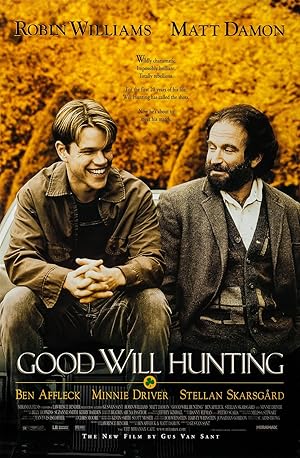
No trap. Good Will Hunting is a genuinely mixed film that earns its traditional score through the mentor-student relationship, the value placed on emotional honesty, and Will's ultimate choice to pursue love and healing over self-sabotage. The woke elements are real: there is a running critique of elite institutions, some anti-authority framing, and the script occasionally lectures about class and intelligence. But these are visible from the beginning, not hidden until the third act. The film's core message, that a damaged young man needs to learn to trust and be loved, is not a progressive message. It is a universal one.
Will Hunting is twenty years old, smarter than everyone in any room he has ever walked into, and entirely alone. He works as a janitor at MIT. He solves advanced math proofs that have stumped doctoral candidates, leaves the solutions on a hallway chalkboard anonymously, and goes home to South Boston to drink with his friends. He has read everything. He has understood everything he has read. And he cannot let anyone close enough to actually matter to him.
Good Will Hunting is a great film. I want to be direct about that before I work through its complications. Robin Williams won his Oscar and he earned it. Matt Damon's script is honest about who Will is in ways that most films about genius never manage. Ben Affleck gives a supporting performance that is quietly the film's moral backbone. The famous 'it's not your fault' scene is one of the most emotionally true sequences in modern American cinema. These things are real.
Sean Maguire is the character who makes the film work. Robin Williams plays him as a man who has also been damaged, who lost the love of his life and built a smaller, quieter existence afterward, and who recognizes in Will the same terror of being truly known that he once had himself. Maguire is not an enabler. He does not flatter Will's genius or excuse his self-destruction. He tells Will the truth: that none of what happened to him was his fault, and that he has been using his intelligence as a weapon against anyone who might get close enough to hurt him. The therapy in this film is not therapy as political prop. It is therapy as love, as someone refusing to stop showing up even when the other person is doing everything possible to drive them away.
Chuckie Sullivan is the film's traditional heart. When he tells Will that the best part of his day is the thirty seconds before he knocks on Will's door in the morning, because in that thirty seconds he can tell himself that maybe today Will has finally taken off and built the life he deserves, that moment crystallizes everything the film is trying to say about what it means to love someone. Chuckie is not threatened by Will's intelligence. He is not competing with it. He wants Will to outgrow South Boston because Chuckie loves him enough to want him to become what he is capable of becoming. That is male friendship written honestly.
The film's complications are real and worth naming. There is a streak of anti-establishment sentiment that occasionally crosses from character motivation into authorial thesis. The scenes where Will demolishes an arrogant Harvard student at a bar, and where he takes apart the government recruiters who try to hire him, are satisfying in the moment but carry some of Damon's twenty-something resentment toward elite institutions. The class politics are present and pointed. Professor Lambeau is not exactly a villain but he is not quite a hero either; the film views his ambition for Will's talent as something less pure than Maguire's love for Will as a person.
These elements prevent a higher score. But they do not undermine the film's fundamental message: that healing requires trust, trust requires vulnerability, vulnerability requires courage, and the courage to be loved is harder than any academic problem. Will's final act, driving to California for Skylar, leaving the note that says 'I had to go see about a girl,' is not a progressive ending. It is a romantic one. A man choosing love over fear, relationship over isolation, another person over the safety of his own walls.
Good Will Hunting is messier than either its admirers or its critics want it to be. The genius is real. The heart is real. The politics are mixed. On balance, the film earns its traditional lean.
Formula: Weighted Score = Severity × Authenticity Multiplier × Centrality Multiplier
🔴 Woke Tropes
| Trope | Severity | Authenticity | Centrality | Score |
|---|---|---|---|---|
| Anti-Institutional Intellectualism | 3 | High | Moderate | 2.1 |
| Class Resentment as Moral Framework | 3 | Moderate | Moderate | 3 |
| Therapy as Primary Solution | 2 | Moderate | Low | 1 |
| Disrespect for Authority | 2 | High | Low | 0.7 |
| TOTAL WOKE | 6.8 | |||
🟢 Traditional Tropes
| Trope | Severity | Authenticity | Centrality | Score |
|---|---|---|---|---|
| Male Mentorship Across Class Lines | 5 | High | High | 6.3 |
| Loyalty of Male Friendship | 5 | High | Moderate | 3.5 |
| Love as Healing Catalyst | 4 | High | Moderate | 2.8 |
| Working-Class Dignity | 4 | High | Moderate | 2.8 |
| Accountability and Healing Through Truth | 4 | High | Moderate | 2.8 |
| TOTAL TRADITIONAL | 18.2 | |||
Score Margin: +11 TRAD
Director: Gus Van Sant
LEFT (Openly progressive, LGBTQ filmmaker)Gus Van Sant is an openly gay filmmaker with a long career in independent cinema. My Own Private Idaho, Drugstore Cowboy, Milk: his filmography reflects progressive sensibilities. Good Will Hunting is arguably the most mainstream and emotionally accessible film he has directed, and also the most tonally traditional. He was working from a screenplay by Damon and Affleck that had a strong conservative-adjacent emotional core: male mentorship, working-class dignity, the idea that therapy is useful but love is what actually heals. Van Sant brought craft and restraint to material that could easily have become mawkish. He trusted his actors and he trusted the script. The result is a film whose ideology is messier than its director's typical work and more interesting for it.
Writer: Matt Damon, Ben Affleck
Damon and Affleck wrote Good Will Hunting in their mid-twenties, drawing heavily on their own experiences growing up in the Boston working class and feeling out of place in elite academic environments. The script won the Academy Award for Best Original Screenplay and launched both of their careers. It is not a political manifesto. It is a story about a specific young man with a specific wound, and the specific people who help him. The anti-Harvard-establishment elements are real but they serve the character. The therapy scenes are the heart of the script: Damon wrote Will's brilliance but also his self-destructive terror of being truly known. The 'it's not your fault' scene is among the most celebrated in modern American screenwriting.
Producers
- Lawrence Bender (Be Gentlemen Ltd.) — Long-time Tarantino collaborator. No strong ideological signal on this project.
Full Cast
Adult Viewer Insight
Good Will Hunting is interesting for traditional audiences precisely because it is not a propaganda piece in either direction. It takes male emotional damage seriously without turning it into a lecture about toxic masculinity. Sean Maguire is not trying to feminize Will or teach him to express himself for social approval. He is trying to help a young man stop punishing himself for things that were done to him. That is a genuinely conservative therapeutic instinct: not identity reconstruction but wound acknowledgment. The film also gives real weight to male friendship in Chuckie's arc. These things are worth engaging with.
Parental Guidance
Find Good Will Hunting on Amazon Prime Video, rent, or buy:
▶ Stream or Buy on AmazonAs an Amazon Associate, VirtueVigil earns from qualifying purchases.
Community Discussion 0
Subscribe to comment.
Join the VirtueVigil community to share your perspective on this review.