
Hacksaw Ridge
Hacksaw Ridge is one of the most purely traditional films Hollywood has produced in the last twenty years. It is a story about faith, and it takes that faith seriously in a way that most war films don't dare.…
Full analysis below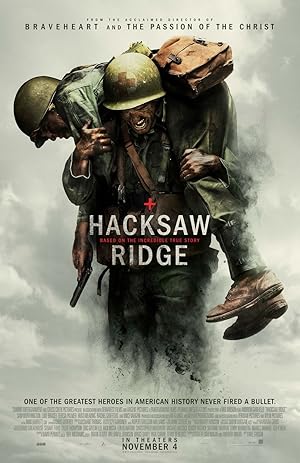
Not a woke trap. Hacksaw Ridge is exactly what Mel Gibson advertises: a faith-driven war film about a conscientious objector who saves 75 lives through prayer and sheer will. The faith content is front and center from the opening scene. Desmond Doss reads Scripture. He refuses to touch a rifle on religious grounds. There is no hidden progressive payload. Conservative and religious audiences will feel at home within minutes.
Hacksaw Ridge is one of the most purely traditional films Hollywood has produced in the last twenty years. It is a story about faith, and it takes that faith seriously in a way that most war films don't dare. Desmond Doss isn't a conscientious objector in the progressive sense, a man opposed to war on pacifist or political grounds. He is a Seventh-day Adventist who believes killing is wrong because God says so in the Bible. That's it. He holds his ground not because of ideology but because of Scripture. The film respects that distinction.
The setup is deceptively simple. Desmond Doss grows up in rural Virginia, the son of a World War I veteran (Hugo Weaving) so destroyed by what he witnessed that he became an alcoholic and nearly killed his wife with his service pistol. Desmond's faith is his inheritance and his escape from that darkness. When Pearl Harbor happens and all the men in town enlist, Desmond follows. He wants to serve his country. He just won't carry a gun.
What follows in boot camp is the most authentic depiction of institutional pressure I've seen in a war film. His sergeant, his captain, his fellow soldiers, and eventually the Army brass all try to break him, court-martial him, discharge him. The scenes where he stands alone in a military courtroom with his conscience and his Bible against the entire United States Army are quietly devastating. Andrew Garfield plays Doss with no vanity whatsoever: he's earnest, soft-spoken, and absolutely immovable. It's the performance of his career.
Then Gibson unleashes the second act, and the film becomes something else entirely.
The battle for Hacksaw Ridge on Okinawa is among the most terrifying combat sequences ever filmed. Gibson does not spare the audience. Bodies are torn apart. Men die screaming. The ridge is described as the mouth of hell, and Gibson renders it as such. This is not Saving Private Ryan's Omaha Beach, though the comparison is apt in terms of sheer physical intensity. Where Spielberg's sequence is chaos made coherent through craft, Gibson's is chaos made purposeful through faith. Doss moves through the carnage whispering 'Lord, help me get one more.' And he keeps getting one more. Seventy-five men saved in a single night, lowered one by one down a cliff on a rope Doss tied himself.
This is the film's central argument, stated plainly and without apology: faith is not weakness. A man who refuses to carry a gun is not a coward. Refusing to compromise your conscience under the most extreme possible pressure is the definition of courage.
From a VirtueVigil perspective, the traditional elements are overwhelming. The faith is genuine, specific, and treated with complete seriousness. The patriotism is sincere without being propagandistic. The father-son dynamic, with Weaving's broken veteran father seeking and earning redemption, is one of the most emotionally honest treatments of damaged masculinity I've seen in mainstream American cinema. The courtship between Doss and Dorothy (Teresa Palmer) is genuinely sweet, deliberately old-fashioned, and treated as sacred rather than merely romantic. They don't sleep together before marriage. The film doesn't snicker at this. It presents chastity as natural.
The woke tropes are minimal and honestly unavoidable given the subject matter. A man who refuses to touch a weapon could be read as anti-military. Gibson ensures this reading is impossible: Doss is the most ferociously pro-military figure in the film. He wants to serve his country. He just does it differently. The only other progressive reading is around pacifism, and even that dissolves when you realize Doss never argues against the war or against others carrying weapons. He's not a pacifist. He's a man with a specific covenant with God.
The ending, where the men who tortured him in boot camp are the first to insist he be present for the final assault, is earned. Not every inspirational war film earns its finale. This one does.
Hacksaw Ridge is the film Mel Gibson was born to make. It is deeply strange that it exists in Hollywood's current landscape. It shouldn't be possible. But it is, and it's magnificent.
Formula: Weighted Score = Severity × Authenticity Multiplier × Centrality Multiplier
🔴 Woke Tropes
| Trope | Severity | Authenticity | Centrality | Score |
|---|---|---|---|---|
| Pacifist / Anti-Violence Framing | 2 | 0.7 | 1 | 1.4 |
| Individual vs. Institution / Anti-Conformity | 2 | 1 | 0.5 | 1 |
| TOTAL WOKE | 2.4 | |||
🟢 Traditional Tropes
| Trope | Severity | Authenticity | Centrality | Score |
|---|---|---|---|---|
| Faith as Moral Courage (Specific, Sincere Christianity) | 5 | 0.7 | 1.8 | 6.3 |
| Patriotism / Voluntary Military Service | 5 | 0.7 | 1.8 | 6.3 |
| Masculine Heroism / Physical Courage | 4 | 0.7 | 1 | 2.8 |
| Father-Son Relationship / Damaged Masculinity Seeking Redemption | 3 | 0.7 | 1 | 2.1 |
| Traditional Courtship / Marriage Before Combat | 3 | 0.7 | 0.5 | 1.05 |
| Conscience Held Against Institutional Pressure | 4 | 0.7 | 1 | 2.8 |
| TOTAL TRADITIONAL | 21.4 | |||
Score Margin: +19 TRAD
Director: Mel Gibson
SOCIALLY CONSERVATIVE. Gibson is one of Hollywood's most openly traditional directors. His career has been defined by faith-based conviction, masculine heroism, and unflinching violence as moral consequence. The Passion of the Christ remains the most successful independent film ever made. His worldview is Catholic, traditionalist, and unapologetically masculine.Mel Gibson returned to directing after a decade-long hiatus with Hacksaw Ridge, winning the Directors Guild of America Award and earning an Academy Award nomination for Best Director. His previous directorial works include Braveheart (1995, Best Director Oscar), Apocalypto (2006), and The Passion of the Christ (2004). Gibson has a well-documented history of controversial public statements, but his directorial output reflects a coherent artistic vision: faith under pressure, sacrifice, and redemption through suffering. Hacksaw Ridge is his most disciplined film, balancing intimate character work with combat sequences of extraordinary visceral power. The Omaha Beach of this generation is the ridge assault in this film.
Writer: Robert Schenkkan, Andrew Knight
Robert Schenkkan is a Pulitzer Prize-winning playwright (The Kentucky Cycle). Andrew Knight is an Australian screenwriter (The Water Diviner). The screenplay is based on the true story of Corporal Desmond T. Doss and draws heavily from the 2004 documentary The Conscientious Objector. The writing is deliberately old-fashioned in the best sense: clear character motivation, earned emotional beats, and a second act that delivers on every promise the first act makes.
Adult Viewer Insight
Parental Guidance
Find Hacksaw Ridge on Amazon Prime Video, rent, or buy:
▶ Stream or Buy on AmazonAs an Amazon Associate, VirtueVigil earns from qualifying purchases.
Community Discussion 0
Subscribe to comment.
Join the VirtueVigil community to share your perspective on this review.