Heretic
Let's not dance around it. Heretic is not a horror film that happens to touch on religion. It is a theological assault on Christianity - and on all monotheistic faith - dressed in genre clothing and delivered via Hugh Grant's most charming, murderous performance.…
Full analysis below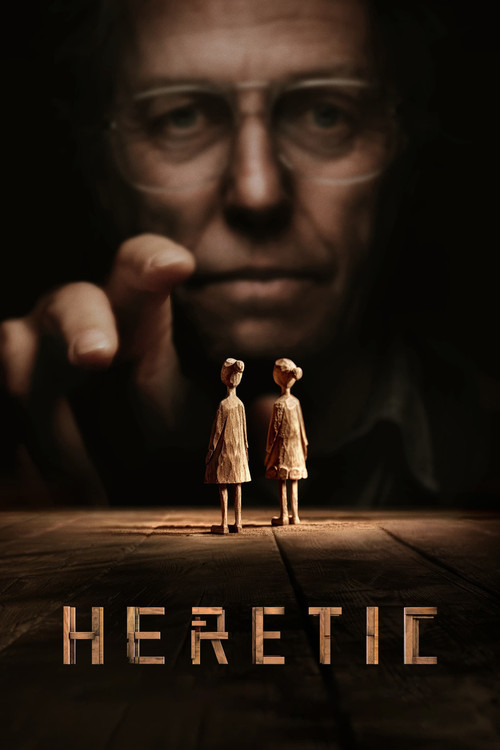
This film draws you in for a significant portion of its runtime with traditional or neutral content before springing its woke agenda. Know before you go!
Religious critique is the stated premise from the first act.
Let's not dance around it. Heretic is not a horror film that happens to touch on religion. It is a theological assault on Christianity - and on all monotheistic faith - dressed in genre clothing and delivered via Hugh Grant's most charming, murderous performance. The film exists to make one argument: that religion is a con, an evolutionary "iteration" of ancient control systems, and that people who believe are either naive, manipulated, or both. The two Mormon missionaries at the center of the story are not complex characters - they are props, foils for the film's real protagonist: Mr. Reed's atheist monologue.
Hollywood's secular elite loved it. Critics gave it a 96% on Rotten Tomatoes. A24 - the same studio behind Hereditary, Midsommar, and Men - distributed it with pride. Ordinary audiences were more skeptical: CinemaScore C+. That gap tells you everything.
Sister Paxton (Chloe East, playing a 19-year-old) and Sister Barnes (Sophie Thatcher, 20) are Mormon missionaries working a list of "investigators" - people who indicated interest in the LDS church. The film opens with them already being mocked in public: teenagers pull down Paxton's skirt, exposing her LDS temple garments and laughing at her "magical underwear." Shaken but pressing on, they arrive at the home of Mr. Reed (Hugh Grant), a bespectacled, seemingly jovial middle-aged man in a rural Colorado home.
Reed appears warm and erudite. He owns a copy of the Book of Mormon. He's "studied theology for decades." He invites them in, saying his wife is in the kitchen baking a blueberry pie. They smell it. They sit down. Then things go wrong.
Barnes notices the smell is coming from a scented candle - no wife, no pie. When they try to leave, the front door is locked on a timer. Reed reappears and tells them calmly that the door won't open until the timer ends. They are trapped.
The Lectures
Reed's agenda unfolds in a series of theatrical "lessons," each designed to destabilize the women's faith:
The Iterations Argument. Reed presents portraits of ancient deities - Mithras, Horus, Krishna - and argues that Jesus Christ is simply a remix of older myths. All religions are "iterations" of earlier ones. Judaism begat Christianity, which begat Islam, which begat Mormonism. Each is a refinement of a "system of control." He declares it's "all terrifying, isn't it?" (The missionaries push back - they've heard the Horus comparison before and call it out. Reed doesn't engage; he pivots.)
The Two Doors. Reed offers the women a choice: a door for believers and a door for non-believers. Both doors lead to the same basement. The message is blunt: it doesn't matter what you believe. The outcome is the same. Faith is functionally meaningless.
The Fake Resurrection. In the basement, a decrepit woman appears, eats poisoned pie, and dies. Reed claims she is "a prophet of God" and that they'll witness her resurrection. She rises and describes the afterlife. Barnes identifies it immediately as consistent with near-death-experience hallucinations. It was staged by an accomplice.
The Microchip. After Barnes signals an attack, Reed slashes her throat and claims she wasn't "real" - removing a metal rod from her arm and calling it a microchip proving life is a simulation. Paxton identifies it as a contraceptive implant. The whole "resurrection" was theater. Reed's improvised brutality was itself a cover when the plan went off-script.
The One True Religion. Reed leads Paxton through an underground chute into a series of chambers. The final one contains caged, emaciated women. This is his "one true religion": domination, control. He hasn't debunked religion - he's built his own.
The Ending
Paxton stabs Reed with a letter opener. He stabs her back. As they bleed on the basement floor, Paxton begins to pray. Reed mocks her. She responds that she doesn't pray expecting material results - she prays out of love for other people. Barnes, barely alive, kills Reed by bashing his skull in with a nail-covered plank, then collapses and dies. Paxton escapes through a vent. Outside, a butterfly lands on her hand - a callback to an earlier scene about faith in the afterlife. The film ends on this ambiguous image.
Trope Analysis - VVWS Weighted Scoring
🔴 Woke Tropes
| Trope | Severity | Authenticity | Centrality | Weighted Score |
|---|---|---|---|---|
| Religion as evolutionary "system of control" - the film's core thesis | 5 | Low (1.4) | High (1.8) | 12.6 |
| Jesus equated with Horus/Mithras - "copycat" mythology argument | 5 | Low (1.4) | High (1.8) | 12.6 |
| Believers portrayed as intellectually defenseless against secular skepticism | 5 | Moderate (1.0) | High (1.8) | 9.0 |
| Prayer framed as statistically ineffective (study cited on prayer and healing) | 5 | Moderate (1.0) | Moderate (1.0) | 5.0 |
| Christians publicly mocked (temple garments) without narrative consequence | 4 | Moderate (1.0) | Low (0.5) | 2.0 |
| TOTAL WOKE | 41.2 |
🟢 Traditional Tropes
| Trope | Severity | Authenticity | Centrality | Weighted Score |
|---|---|---|---|---|
| Women of faith show genuine moral courage under extreme duress | 5 | High (0.7) | High (1.8) | 6.3 |
| Paxton's final prayer - faith as selfless love, not transactional bargaining | 5 | High (0.7) | Moderate (1.0) | 3.5 |
| Reed's "rational atheism" exposed as its own tyrannical cult | 4 | High (0.7) | Moderate (1.0) | 2.8 |
| Butterfly ending - ambiguous affirmation of spiritual continuity | 3 | High (0.7) | Low (0.5) | 1.05 |
| TOTAL TRAD | 13.65 |
Score Margin: -27 WOKE
Woke Trap Assessment
Heretic is a partial woke trap - and this distinction matters for our audience.
This is not a straightforward anti-Christian hate film in the same category as The Da Vinci Code. The film is more sophisticated: Reed is ultimately exposed as a monster, and his "religion of rational skepticism" is revealed as a literal cult of domination with caged victims in his basement. The film does not fully validate its villain.
But here is the trap: mainstream critics are calling it "thought-provoking" and "even-handed." It is neither. Reed's theological arguments - Jesus as a remix of Horus, religion as a control system, prayer as statistically useless - are given cinematic authority of revelation for 90 minutes. The missionaries are mostly silent. Their rebuttal is minimal. The film stacks the rhetorical deck entirely in Reed's favor for its entire second act, then tries to walk it back with a villain reveal in the third.
Exposing your villain's argument as evil after spending two hours presenting it as intellectually devastating is not intellectual honesty. It's having it both ways.
Some Christians will see the butterfly ending and Paxton's prayer scene and conclude the film "respects faith in the end." It doesn't. It respects faith the way a prosecutor respects the defense's case right before winning on a technicality.
Creative Team At A Glance
Scott Beck and Bryan Woods are Iowa-native filmmakers who broke into Hollywood writing A Quiet Place (2018) - one of the finest implicitly traditional horror films in recent memory, centered on family, sacrifice, and protection of children. Heretic is a sharp pivot. Beck and Woods have been candid: this film came from decades of personal philosophical questioning. They are not cynical activists. But they are secular intellectuals who find religious doubt more cinematically interesting than religious conviction, and that asymmetry shapes every frame.
A24 has made its brand out of art-house horror that systematically deconstructs traditional institutions: family (Hereditary), community (Midsommar), masculinity (Men), and now faith (Heretic). This is not coincidence. Their audience is not yours.
Director/Writer Ideological Track Record
Beck and Woods filmography, ideologically mapped:
- A Quiet Place (writers, 2018) - Pro-family, pro-sacrifice, implicitly pro-life. Culturally traditional.
- Haunt (2019) - Competent horror, no notable ideological content.
- Heretic (2024) - Theological skepticism as horror. Significant ideological leap.
The directors stated openly that Heretic was about "religious ideologies Trojan horsing into a genre movie." Their own words. Trojan horse.
A24's pattern with religion and tradition:
- Hereditary (2018) - Family destroyed by a demonic cult
- Midsommar (2019) - Western woman finds "liberation" in pagan cult
- Men (2022) - Grotesque imagery attacking masculine/Christian archetypes
- Heretic (2024) - Direct debate-style assault on monotheistic faith
A24 treats Western Christian tradition as something to be dissected and consumed by horror. They are excellent filmmakers. They are also consistent in their targets.
Adult Viewer Insight - Can Christians Watch This?
Thoughtful adult Christians can watch Heretic - but should do so with their intellectual defenses fully raised, not lowered.
What the film actually argues:
1. All religions are derivative. Reed's "iterations" thesis is the film's intellectual centerpiece. It is also largely discredited. The Horus/Jesus comparison is an internet-age myth that serious historians of religion - including non-Christian ones - have debunked repeatedly. Heretic presents it as devastating. It isn't.
2. Religion is a system of control. The film endorses this structurally, by revealing that Reed runs a literal control system in his basement. The implication: he's not wrong about religion, he's just worse at concealing it than the institutions he critiques.
3. Faith without proof is intellectual weakness. The film gives Paxton one genuine redemptive moment: her prayer is not transactional. She prays for others, not miracles. It's theologically honest and genuinely moving. But it's a single beat against 90 minutes of skeptical assault.
The honest verdict: Heretic is a brilliant film made in bad faith. Its theological arguments are mostly freshman-level skepticism - the kind that sounds devastating if you've never read Chesterton, Kreeft, Lewis, or any of the serious apologetics tradition. Christians who know their faith's intellectual history will recognize Reed's arguments as old and answered. Those who don't may leave shaken.
That is a genuine danger. Because Reed is charming and Hugh Grant plays him as the smartest man in the room. The missionaries mostly stand in stunned silence. That silence is the film's real argument: We couldn't find good answers, so we gave them none.
Parental Guidance
Not appropriate for children or teenagers. Period.
- Violence: Graphic and disturbing. A throat is slashed on screen. A skull is bashed in with a nail-covered board. Prolonged bloody sequences.
- Theological content: Extended, sophisticated arguments against God and Christianity, presented persuasively by a charming character. Teenagers without apologetics training will find the arguments difficult to refute.
- Disturbing imagery: Caged, emaciated women. Staged death and "resurrection." Sustained psychological torture.
- Language: Moderate
- Sexual content: None explicit; brief discussion of contraception
Age recommendation: Adults 25+ with a solid grounding in Christian apologetics. If you watch it, read up on the actual scholarship around the Horus-Jesus comparison and the "religion as control" thesis beforehand. Come prepared.
Review by the VirtueVigil Editorial Team | February 18, 2026 | VVWS v2.1
Formula: Weighted Score = Severity × Authenticity Multiplier × Centrality Multiplier
🔴 Woke Tropes
| Trope | Severity | Authenticity | Centrality | Score |
|---|---|---|---|---|
| Religion as evolutionary 'system of control' | 5 | Low | High | 12.6 |
| Jesus equated with Horus/Mithras - 'copycat' mythology argument | 5 | Low | High | 12.6 |
| Believers portrayed as intellectually defenseless against secular skepticism | 5 | Moderate | High | 9 |
| Prayer framed as statistically ineffective | 5 | Moderate | Moderate | 5 |
| Christians publicly mocked without narrative consequence | 4 | Moderate | Low | 2 |
| TOTAL WOKE | 41.2 | |||
🟢 Traditional Tropes
| Trope | Severity | Authenticity | Centrality | Score |
|---|---|---|---|---|
| Women of faith demonstrate moral courage under duress | 5 | High | High | 6.3 |
| Prayer as selfless love, not transactional bargaining | 5 | High | Moderate | 3.5 |
| Villain's 'rational atheism' exposed as its own tyrannical cult | 4 | High | Moderate | 2.8 |
| Butterfly ending - ambiguous spiritual affirmation | 3 | High | Low | 1.05 |
| TOTAL TRADITIONAL | 13.7 | |||
Score Margin: -27 WOKE
Director: Scott Beck & Bryan Woods
Secular-progressive with stated personal investment in religious doubt; not ideological activists but consistent in their skeptical framing of faithIowa-based filmmaking duo who broke out writing A Quiet Place (2018) - a film with implicitly conservative values around family and sacrifice. Heretic marks a sharp ideological pivot toward theological skepticism. They have stated the film came from decades of personal philosophical questioning: 'Why do we believe what we believe? Or why do we not believe?' Their openness about wanting to Trojan-horse religious ideology into genre filmmaking is telling.
Writer: Scott Beck & Bryan Woods
Also the directors. Their screenplay gives Hugh Grant's Mr. Reed extended, polished anti-religion monologues while keeping the Mormon missionaries largely silent or reactive. The screenplay's structural choices function as ideological choices: skepticism gets the speeches, faith gets the stunned expressions.
Adult Viewer Insight
Thoughtful adult Christians can watch Heretic, but should do so with their intellectual defenses fully raised. Hugh Grant's Mr. Reed delivers extended, persuasive anti-religion monologues (Jesus as a remix of Horus and Mithras, religion as a system of control, prayer as statistically ineffective) while the missionary protagonists mostly stand in stunned silence. The film's third-act twist - revealing Reed as a literal cult leader with caged victims - does not neutralize the rhetorical assault of the preceding 90 minutes. Reed's arguments are mostly discredited freshman philosophy, but the film presents them as devastating, unanswerable truths. Viewers who know Christian apologetics will recognize and rebut them. Viewers who don't may leave shaken. The film's final image - a butterfly landing on Paxton's hand as she emerges from captivity - and her powerful prayer scene ('I pray out of concern for other people, not to produce results') are the film's most honest moments of genuine faith. They are not enough to make this a safe watch without preparation.
Parental Guidance
Not appropriate for children or teenagers. The film contains graphic violence (throat slashing, death by nail-covered board, prolonged blood), sustained psychological horror, disturbing imagery of caged women, and extended theological arguments against Christianity and God that teenagers without apologetics training will find difficult to rebut. The film's sophisticated, charming presentation of anti-Christian arguments makes it particularly dangerous for young viewers still forming their faith. Recommended for adults 25+ with a solid grounding in Christian apologetics only.
Find Heretic on Amazon Prime Video, rent, or buy:
▶ Stream or Buy on AmazonAs an Amazon Associate, VirtueVigil earns from qualifying purchases.


Community Discussion 0
Subscribe to comment.
Join the VirtueVigil community to share your perspective on this review.