
IF (Imaginary Friends)
IF is John Krasinski's most emotionally ambitious film and his most uneven one. But when it works, which is more often than its mixed reviews suggest, it works because Krasinski trusts the audience to feel something genuine.
Full analysis below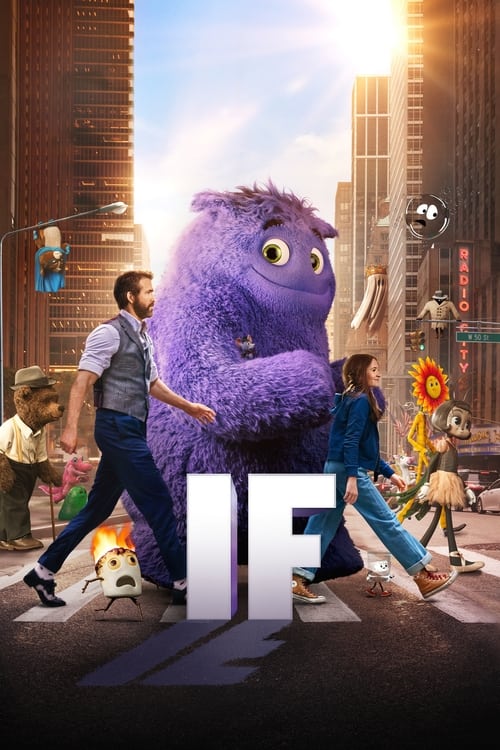
Krasinski's track record includes A Quiet Place and A Quiet Place Part II, both of which are explicitly about family protection and survival with no progressive messaging. IF continues this pattern: the emotional center is a father-daughter relationship and childhood resilience in the face of grief. Conservative families can approach this with confidence.
IF is John Krasinski's most emotionally ambitious film and his most uneven one. But when it works, which is more often than its mixed reviews suggest, it works because Krasinski trusts the audience to feel something genuine.
The film follows 12-year-old Bea, played with mature restraint by Cailey Fleming, who moves into her grandmother's apartment while her father undergoes heart surgery in the same hospital where her mother died years earlier. She is determined to seem older than she is, convinced that pretending she is not scared will somehow make her safer. This is a child's logic, and the film takes it seriously rather than mocking it.
Through a neighbor named Calvin, played by Ryan Reynolds with his trademark mix of humor and barely suppressed sadness, Bea discovers that imaginary friends are real. They are called IFs. They exist in a state of gentle limbo after their children grow up and forget them. Calvin has been trying to find new children for them, but something about the process is not working. Bea turns out to be the key: she can see IFs when most adults cannot, and her empathy for forgotten things gives her a special ability to help them reconnect with the grown-ups who left them behind.
The premise is as inventive as it sounds, and the visual execution is strong. The imaginary friends range from a giant purple bear named Blue (Steve Carell) to a butterfly-like creature named Blossom (Phoebe Waller-Bridge) to an elderly teddy bear named Lewis (Louis Gossett Jr., in his final film appearance). Their Memory Lane retirement home, housed under a Coney Island amusement ride, is one of the film's best ideas.
What the film struggles with is focus. The IF roster is so large and the celebrity voices so distracting that the emotional throughline sometimes gets lost in spectacle. Amy Schumer voicing a giant gummy bear and Jon Stewart playing a spy-character IF are creative choices that exist primarily as jokes rather than emotional anchors. The film would have benefited from fewer imaginary friends and more time with the ones who matter most.
But the core story never loses its footing. Bea's relationship with her father, played with quiet heartache by Krasinski himself, is the emotional engine of everything. This is a film about a child who has already lost one parent and is terrified of losing another. The imaginary friend adventure is the mechanism Bea uses to process that fear. When the film stays focused on this, it is genuinely moving.
Krasinski handles grief with the same restraint he brought to A Quiet Place. Nothing is over-explained. Bea does not give a speech about her feelings. Her fear is visible in how she behaves rather than in what she says. This is good filmmaking regardless of genre. The scene where her grandmother Margaret reconnects with her own childhood imaginary friend by dancing to an old record is the film's finest moment, and it earns it because the emotional setup has been patient and specific.
Louis Gossett Jr.'s final performance deserves particular mention. As Lewis the elderly teddy bear, he is warm and wise without being sentimental. He is the IF who understands that imaginary friends might not need new children at all - they might just need to reconnect with the grown-ups they once belonged to. For a film about the value of childhood imagination, having Gossett as the voice that articulates the film's thesis is a beautiful piece of casting. He will be missed.
Conservative families will find IF is exactly what it advertises: a sincere family film about childhood, grief, and the imagination that helps children survive difficult things. It has no political agenda. The father-daughter relationship is its heart. The film believes in imagination not as escapism but as emotional honesty - a way children tell the truth about what they feel when they cannot find the words.
| Trope | Category | Location | Authenticity |
|---|---|---|---|
| Father-Daughter Bond | TRADITIONAL | Throughout - Bea's entire emotional journey is shaped by her love for her hospitalized father and her terror of losing him; their relationship is the engine of everything | Authentic. Krasinski cast himself as the father, which adds a layer of real-life parental investment. The father-daughter dynamic is drawn with care and specificity - not generic father-love but a particular man and a particular child. Strong traditional content. |
| Defense of the Innocent | TRADITIONAL | IF retirement home arc - Bea takes on the cause of the forgotten imaginary friends with no personal benefit; pure compassion for neglected, vulnerable beings | Authentic. Bea's impulse to help the IFs is the film's moral core. She is not asked to do this. She chooses it. The film presents this as natural and admirable without turning it into a lecture. |
| Childhood Resilience | TRADITIONAL | Bea's arc throughout - a child facing real loss who processes it through imagination rather than avoidance; the resolution requires her to actively engage with her fear rather than hide from it | Authentic. The film is clear that imagination is not escapism - it is how Bea tells the truth about her fear. She is not running from grief; she is working through it in the way children do. This is a healthy model for children dealing with difficulty. |
| Intergenerational Bonds | TRADITIONAL | Margaret (grandmother) subplot - the grandmother and granddaughter relationship provides warmth and context; Margaret reconnects with her own childhood IF, demonstrating that imagination is not something to be left behind | Authentic. The grandmother sequence is the film's emotional peak. The relationship between Bea and Margaret is specific and loving without sentimentality. Grandparent-grandchild bonds are presented as rich and important. |
| Grief Handled With Dignity | TRADITIONAL | Throughout - Bea's dead mother is an absence that shapes the entire film without being exploited for manipulation; the grief is real but handled with restraint | Authentic. Krasinski consistently treats grief as something to be acknowledged and worked through rather than performed. This is one of the marks of his filmmaking - emotional honesty without sentimentality. |
| Progressive Celebrity Voice Cast | WOKE | IF voice cast - Amy Schumer, Jon Stewart, and other progressive public figures voice imaginary friends in supporting roles | Trace-level. The political identities of these celebrities are irrelevant to their characters. Schumer plays a gummy bear. Stewart plays a spy-type character. Neither role carries any political content. Celebrity politics and film content are separate categories here. |
| Culturally Diverse IF Roster | WOKE | The imaginary friends collection includes characters of varied cultural and aesthetic origins - a conscious choice to represent diversity among childhood imaginations | Mild and organic. Children in diverse cities do create imaginary friends from varied cultural backgrounds. This is not a political statement so much as a practical representation of what childhood imagination looks like in a multicultural setting. Low impact. |
Director: John Krasinski
CENTER - apolitical filmmaker whose projects consistently emphasize family, courage, and emotional restraintJohn Krasinski is best known as an actor (The Office, Jack Ryan) but has established himself as a filmmaker whose work is remarkably free of contemporary political messaging. A Quiet Place (2018) is a genuine conservative family classic - a father who gives his life to save his children, a family under existential threat that survives through discipline and sacrifice, a world where the loud die and the quiet endure. A Quiet Place Part II (2021) continued these themes with the teenage daughter stepping into a leadership role earned through demonstrated courage, not by decree. IF is his most overtly sentimental film, built around grief and imagination rather than survival. His filmography carries no progressive agenda. Ideological tendency: APOLITICAL, family-focused.
Writer: John Krasinski
Krasinski wrote all three of his directorial features. As a sole writer-director, his ideological fingerprints are unmediated. His scripts consistently favor emotional restraint, family bonds, and characters who earn their moments rather than claim them. IF is his most whimsical script, but the emotional architecture is the same as his horror films: a child under pressure, a parent who loves deeply, a world that demands something difficult.
Producers
- Allyson Seeger (Sunday Night Productions) — Krasinski's producing partner on A Quiet Place films and IF. No independent ideological signal. Her production work is entirely Krasinski-adjacent.
- Ryan Reynolds / Maximum Effort (Maximum Effort) — Reynolds is primarily known as a savvy entertainment entrepreneur and comedy actor. Maximum Effort is his production company, focused on commercial entertainment and clever marketing. Reynolds is personally centrist-liberal but does not inject politics into his entertainment projects. His involvement in IF is commercial and creative, not ideological.
- Andrew Form (Paramount Pictures) — Veteran producer with credits including A Quiet Place 1 and 2, Transformers films, Friday the 13th, and Teenage Mutant Ninja Turtles. Genre-commercial producer with no political signal.
Full Cast
Fidelity Casting Analysis N/A - ORIGINAL IP
IF is an original screenplay with no source material. Fidelity casting analysis does not apply. The eclectic celebrity voice cast for the imaginary friends (ranging from Emily Blunt and Steve Carell to Amy Schumer and Jon Stewart) reflects the film's concept: imaginary friends are as varied as the children who created them. Several progressive celebrities in the voice cast (Schumer, Stewart) carry no political content in the film itself.
Cailey Fleming (Bea): The young lead of The Walking Dead and The Book of Boba Fett. She carries the film with genuine emotional range beyond her years. Ryan Reynolds (Calvin): Reynolds does his standard sardonic-with-a-warm-heart routine, which works within the film's emotional logic. John Krasinski (Bea's Dad): Krasinski cast himself in the most emotionally pivotal role - the father in the hospital recovering from heart surgery while his daughter discovers imaginary friends. His actual father energy works perfectly. Fiona Shaw (Margaret): The Harry Potter and Fleabag actress brings sharp intelligence to the grandmother role. Louis Gossett Jr.: In his final film appearance, Gossett plays Lewis, an elderly teddy bear IF who inspires Bea. The role is gentle and dignified. The progressive celebrity voices (Schumer, Stewart) play imaginary friends without any political content.
Adult Viewer Insight
Conservative adults who appreciated A Quiet Place will find IF a gentler but recognizably Krasinski film. The same values are present: family bonds under pressure, emotional restraint, characters who earn their moments. The grief at the center of IF is handled with the same seriousness that Krasinski brought to the creature-apocalypse premise of A Quiet Place. Both films are really about parents and children who love each other across the specific terror of potential loss. A note on the celebrity voice cast: several of the IF voices belong to progressive public figures. Jon Stewart hosts a progressive political show. Amy Schumer has been vocal about feminist politics. In IF, they play whimsical characters who say and do nothing political. This is worth acknowledging only because conservative viewers sometimes boycott films on the basis of celebrity politics. In this case, the politics do not enter the film itself. Judge the content, not the bylines. Michael Giacchino's score is worth noting. He is one of the best composers working in family films (Up, Inside Out, The Incredibles), and his IF score supports the film's emotional swings without overwhelming them. The musical intelligence on display is another marker of how seriously Krasinski takes his filmmaking. The film's box office performance ($190 million on a $110 million budget) suggests it underperformed relative to expectation. The mixed critical reception hurt it. But audience scores were warmer than critics, which is a consistent pattern for family films that prioritize emotion over cleverness.
Parental Guidance
Rated PG. Appropriate for children ages 6 and up with a few considerations. Violence: None of significance. The IFs' retirement home has a melancholy quality that young children might find sad rather than scary. Sexual Content: None. Language: None. Scary Content: The emotional premise - a father in the hospital, a child who has already lost her mother - is the film's primary source of intensity. Very young children (under 6) may find the parent-in-danger element upsetting. For older children, this is age-appropriate emotional territory. Substance Use: None. Age Recommendations: Ages 6 and up. Ideal for ages 8-12 as a starting point for conversations about grief and imagination. Discussion Guidance: (1) Why do you think grown-ups stop being able to see imaginary friends? What does that say about what happens to imagination as people get older? (2) Bea tries to pretend she is not scared. Does pretending to be brave make you braver, or does it just hide the fear? (3) Lewis the teddy bear suggests that IFs do not need new children - they need to reconnect with their old ones. What do you think that means about the people who created them?
Find IF (Imaginary Friends) on Amazon Prime Video, rent, or buy:
▶ Stream or Buy on AmazonAs an Amazon Associate, VirtueVigil earns from qualifying purchases.




Community Discussion 0
Subscribe to comment.
Join the VirtueVigil community to share your perspective on this review.