
Interstellar
Interstellar is Christopher Nolan's most emotionally direct film. Where Inception hides its heart inside puzzle boxes, Interstellar puts its heart on the table in the first ten minutes and then spends three hours testing it.…
Full analysis below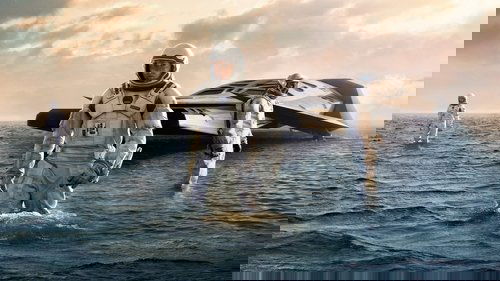
Not a woke trap. The film's progressive elements are minor relative to its overwhelming traditional values framework. Conservative viewers will not feel ambushed.
Interstellar is Christopher Nolan's most emotionally direct film. Where Inception hides its heart inside puzzle boxes, Interstellar puts its heart on the table in the first ten minutes and then spends three hours testing it. The film is about a father who loves his daughter so completely that his love becomes, quite literally, a force that transcends spacetime. That is not a metaphor the film gestures toward. It is the film's actual plot mechanism.
Cooper (Matthew McConaughey) is a former NASA pilot living as a farmer in the near future, when a mysterious blight is killing crops worldwide and the human race is running out of time. Corn is the last viable crop. Dust storms are a constant. His son Tom accepts the world as it is. His daughter Murph does not: she is convinced a ghost is sending her messages through her bookshelf. Cooper discovers that NASA, operating in secret, has been using a wormhole near Saturn to search for habitable planets in another galaxy. He joins the mission. He leaves his children behind. He promises Murph he will return.
He does not return. Not for decades. The time dilation of black holes means that hours near Gargantua equal years on Earth. By the time Cooper emerges from the tesseract beyond the event horizon and finds himself in a space station named Cooper Station, his daughter Murph is ancient and dying. He is essentially unchanged.
This is devastating. Nolan constructs this devastation carefully and earns every tear. The scenes between McConaughey and young Murph (Mackenzie Foy, exceptional) establish a bond that the film then tortures systematically. The video messages Cooper receives from his children as he travels deeper into space, watching them age in real time while he remains the same, are among the most emotionally efficient uses of the time dilation concept in science fiction.
The science is extraordinarily rigorous. Nolan consulted Kip Thane throughout production, and the black hole Gargantua was rendered using equations that required new software to produce. The resulting images were so accurate that they generated a legitimate scientific paper on optical distortions near black holes. The time dilation effects, the wormhole geometry, and the physics of the tesseract are all grounded in real theoretical physics extrapolated for narrative purpose. This is not fake science dressed up to sound impressive. It is the real article, adapted for cinema.
What does Interstellar say about the world?
It says that a father's love for his daughter is the most powerful force in the universe. It says this not as sentiment but as plot. Cooper's love for Murph is literally the mechanism by which the film resolves: in the tesseract, he can communicate across time because the gravitational singularity allows it, and he uses this ability not to send a cosmic message to humanity but to send a message to his daughter's bookshelf. The entire salvation of the human race runs through one father's refusal to let his daughter go.
Conservative audiences should find this framework deeply resonant. Fatherhood is not a peripheral concern in Interstellar. It is the engine. Every decision Cooper makes is filtered through his identity as a father. He takes the mission because a father who watched the human race die would be failing his children in a different way. He spends years in space haunted by Murph's face. The film's climax is not a triumph over a villain or a scientific achievement. It is a reunion.
The film also takes seriously the values of the previous generation. Cooper's father-in-law Donald (John Lithgow) is a quiet, dignified presence who holds the family together while Cooper is gone. He grows the crops. He keeps the house. He raises the grandchildren without complaint. The film treats this unglamorous domestic labor as heroic in a way that blockbuster cinema rarely does. When Donald dies off-screen during Cooper's journey, the loss is registered with appropriate weight.
The film's major woke element is Dr. Amelia Brand (Anne Hathaway). She is the most senior scientist on the mission beyond Professor Brand, her father. Her argument that love is a force as real as gravity, that perhaps humans evolved to love across time the way they evolved to survive in the present, is the film's most contested speech. It reads as mystical hand-waving to hard science fans. But within the film's framework, she is right: Cooper's love for Murph does operate across spacetime. The film validates her thesis. Brand is competent, emotionally complex, and ultimately right about the most important thing in the film. She is not a diversity hire or an ideology vehicle. She is a well-written character who happens to be female. The second female character, Murph herself, is even better written: her decades of grief, anger, and ultimately forgiveness form the film's most complete emotional arc.
Dr. Mann (Matt Damon, cannily cast against type) is the film's surprise villain, and he is well-designed. He is a brilliant man who broke under the loneliness of space and falsified his planet's data to get rescued. His betrayal of Cooper is not ideological. It is human: he chose his own survival over his mission. The film treats this as comprehensible but catastrophic. Mann's failure is a failure of character, not of circumstance. A different kind of man, the film implies, would have died with his integrity intact. This is a traditional moral judgment.
One element worth flagging for conservative audiences: Professor Brand (Michael Caine) spends decades lying to humanity about whether Plan A (saving existing humans) is even possible. He has calculated that it is not, and that Plan B (launching embryo colonies) is the only option. He withholds this information because he believes humanity needs hope to survive. This is a paternalistic deception by an elite scientist who decides what the public can handle. The film does not entirely condemn him for it, which is uncomfortable. It presents his reasoning sympathetically while showing that his deception had real costs. Conservative viewers who distrust elite expert authority will find this thread uncomfortable but the film at least acknowledges the problem.
Interstellar is a film that believes in things: in space exploration, in science, in fatherhood, in the human instinct to survive and reach beyond its limits. It is the most spiritually ambitious of Nolan's films: the final sequence, in which Cooper communicates with his daughter across time from inside a black hole, is essentially a vision of transcendence that is not religious but reaches toward the same emotional register. The pipe organ score is not accidental. This is a film about what human beings are capable of when they love something enough.
Formula: Weighted Score = Severity × Authenticity Multiplier × Centrality Multiplier
🔴 Woke Tropes
| Trope | Severity | Authenticity | Centrality | Score |
|---|---|---|---|---|
| Female Scientist as Co-Lead (Dr. Amelia Brand) | 2 | 0.7 | 1.8 | 2.52 |
| Elite Expert Paternalism (Professor Brand's Deception) | 3 | 1 | 1 | 3 |
| Ecological Collapse Premise (Climate Anxiety Undertone) | 3 | 1 | 0.5 | 1.5 |
| Female Genius Savior (Murph Solves Gravity Equation) | 2 | 0.7 | 0.5 | 0.7 |
| TOTAL WOKE | 7.7 | |||
🟢 Traditional Tropes
| Trope | Severity | Authenticity | Centrality | Score |
|---|---|---|---|---|
| Father's Love as Absolute and Transcendent | 5 | 0.7 | 1.8 | 6.3 |
| Masculine Sacrifice and Duty (The Mission as Obligation) | 4 | 0.7 | 1.8 | 5.04 |
| Agricultural Labor as Dignified and Essential | 3 | 0.7 | 0.8 | 1.68 |
| Human Exceptionalism and Space Exploration (Destiny Narrative) | 4 | 0.7 | 1 | 2.8 |
| Grandfather as Moral Anchor (John Lithgow's Donald) | 3 | 0.7 | 1 | 2.1 |
| Forgiveness and Reconciliation (Murph's Final Release) | 4 | 0.7 | 0.8 | 2.24 |
| Villain as Character Failure Not Systemic Victim (Dr. Mann) | 3 | 1 | 1 | 3 |
| TOTAL TRADITIONAL | 23.2 | |||
Score Margin: +15 TRAD
Director: Christopher Nolan
CENTER. Nolan avoids political messaging in his films and has repeatedly resisted studio pressure to include ideological content. He builds stories around ideas and human relationships rather than causes. Interstellar reflects his genuine interest in physics, space exploration, and the parent-child bond.Following the Batman trilogy (2005-2012) and Inception (2010), Nolan expanded the scope of his ambitions with Interstellar. He consulted theoretical physicist Kip Thane (who won a Nobel Prize in 2017) to ensure the science of the wormhole, the black hole, and the time dilation effects was as accurate as a feature film could depict. The Gargantua black hole rendering was so scientifically accurate that it produced a publishable scientific paper. Nolan intended Interstellar as both a hard science fiction film and a meditation on the parent-child bond and the obligation of each generation to the next.
Writer: Jonathan Nolan, Christopher Nolan
Jonathan Nolan developed an early draft of Interstellar from a concept originated by Kip Thane and producer Lynda Obst. Christopher Nolan rewrote it substantially after taking over the director's chair from Steven Spielberg, who had been attached earlier. The screenplay centers on Cooper's promise to his daughter Murph and the question of whether love can operate as a physical force across spacetime. The Nolans were explicit that the film's heart is not space exploration but parental devotion.
Adult Viewer Insight
Conservative adults who haven't seen Interstellar should make it a priority. This is a film that takes fatherhood seriously as a moral category. Cooper is not an absent father who needs to learn to be present. He is a deeply present father who is forced to be absent, and who carries that cost with him for the entire film. The reunion in the final act, between a man who has barely aged and his elderly dying daughter, is one of the most genuinely moving sequences in American blockbuster filmmaking of the last 20 years. The science is real enough to be interesting and accessible enough not to require a physics degree. The values are old-fashioned in the best possible sense: duty, sacrifice, love, the obligation of each generation to protect the next. Nolan made a film that believes human beings are worth saving. After years of Hollywood presenting humanity as the planet's disease, that conviction hits hard.
Parental Guidance
PG-13. Appropriate for ages 12 and up. Intense space action. Emotionally heavy parent-child separation themes. Brief strong language. Excellent discussion material for families about sacrifice, duty, and love.
Find Interstellar on Amazon Prime Video, rent, or buy:
▶ Stream or Buy on AmazonAs an Amazon Associate, VirtueVigil earns from qualifying purchases.
Community Discussion 0
Subscribe to comment.
Join the VirtueVigil community to share your perspective on this review.