
KPop Demon Hunters
KPop Demon Hunters is the kind of cultural event that forces you to evaluate it on two entirely separate tracks: as a piece of entertainment, and as a vehicle for ideas. On the first track, it is an unqualified triumph.…
Full analysis below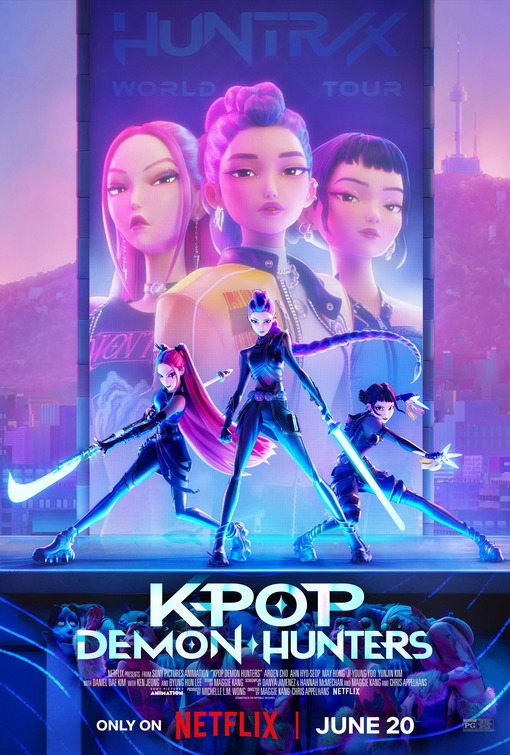
This film draws you in for a significant portion of its runtime with traditional or neutral content before springing its woke agenda. Know before you go!
NOT A WOKE TRAP. The film's progressive elements are front and center from the opening sequence. Three women form the core trio. The villain is a patriarchal demon king. The boy band are literally demons. Rumi's identity struggle is introduced early and is clearly the emotional spine of the film. The marketing never disguised any of this. Conservative audiences can make an informed decision within minutes. The only element that might catch viewers off guard is the depth of the queer identity allegory, which co-director Maggie Kang explicitly confirmed was intentional ('Rumi's story is like she's coming out of the closet'). But even this is thematically consistent with the film's visible emphasis on self-acceptance and shame, not a hidden agenda.
KPop Demon Hunters is the kind of cultural event that forces you to evaluate it on two entirely separate tracks: as a piece of entertainment, and as a vehicle for ideas. On the first track, it is an unqualified triumph. On the second, it is more complicated than either its fans or its critics want to admit.
The premise is deceptively simple. Three young women form Huntrix, a globally famous K-pop girl group who secretly double as demon hunters. They use their singing voices to maintain the Honmoon, a magical barrier that keeps demons from preying on humanity. When a rival boy band called the Saja Boys emerges and starts stealing their fans, the Honmoon weakens, and Huntrix discovers the boys are literally demons. The lead character, Rumi, is hiding a secret: she is half-demon, and the demonic patterns spreading across her skin represent a heritage she is ashamed of. Her journey toward self-acceptance forms the emotional core of the film.
Let's start with what the film does brilliantly, because it does a lot brilliantly. The animation, produced by Sony Pictures Imageworks (the Spider-Verse team), is frequently stunning. Concert lighting, editorial photography aesthetics, and anime-influenced action sequences combine into a visual language that feels genuinely new for American animated features. The musical numbers are not filler. They drive the plot, reveal character, and escalate conflict. 'Golden,' the centerpiece song that earned an Oscar nomination, is a legitimate earworm that functions narratively as both Rumi's desperate attempt to seal the Honmoon and her plea for self-acceptance. The voice cast, headlined by Arden Cho as Rumi and Ahn Hyo-seop as the conflicted demon Jinu, delivers performances with emotional weight that the stylized animation could easily have flattened. Director Maggie Kang's vision, rooted in Korean shamanism and mythology, gives the film a cultural specificity that most animated features lack entirely.
The 97% Rotten Tomatoes score and 500 million Netflix views are not accidents. This is a genuinely well-made film that earns its audience through craft, energy, and emotional sincerity. The comparison to Frozen is inevitable and partly apt: both films center female empowerment through musical storytelling, and both became cultural phenomena that transcended their medium. But KPop Demon Hunters is more culturally specific than Frozen ever was. It is steeped in Korean mythology, Korean shamanic traditions, and the actual mechanics of K-pop fandom in ways that Frozen's Scandinavian aesthetic never attempted with its source material.
Now for the ideological layer, which is where VirtueVigil earns its keep.
The film's progressive elements are numerous and deliberate. The three female leads operate without meaningful male support throughout. Bobby, their male manager (Ken Jeong), is comic relief. Healer Han (Daniel Dae Kim) is a supporting figure. Jinu, the most developed male character, is a sympathetic demon whose arc ultimately exists to service Rumi's growth before he sacrifices himself for her. Celine, Rumi's foster mother and former demon hunter, is the most important mentor figure, and she is female. The film's power structure is matriarchal at every level: the demon hunters are women, the shamanic tradition they draw from is a women's tradition, and the Honmoon is sustained by female voices.
This is not inherently a problem. Korean shamanism genuinely is a women's tradition. Female mudang (shaman women) really did use song and dance as ritual practice. The film is drawing from actual cultural history, not imposing a modern girl-boss framework onto unwilling source material. This is an important distinction that many conservative critics have missed. When the National Review calls the film 'selling unironic junk and political mania to children,' it misses that the 'political mania' is rooted in centuries of Korean spiritual practice that predates contemporary gender politics by a millennium.
But the film is also clearly doing more than cultural preservation. Maggie Kang explicitly stated that Rumi's arc was designed to parallel 'coming out of the closet,' and that the creative team 'talked a lot about mixed heritage, queer identity, and addiction.' The shame Rumi feels about her demon patterns is an allegory for hidden identity, for being something society tells you is wrong. The moment she reveals her demon nature to her bandmates maps directly onto a coming-out narrative. The film's climax, where Rumi performs a song about self-acceptance that breaks Gwi-Ma's trance, argues that shame is the true enemy and that radical self-disclosure is the path to power. These are progressive values packaged in a children's entertainment vehicle.
The boy band as literal demons is the film's most ideologically loaded conceit. The Saja Boys exist to steal female fans, weaken female power structures (the Honmoon), and serve a patriarchal demon king. Their songs are explicitly designed to entrance audiences and drain their agency. One reading of this is straightforward fantasy storytelling. Another is a feminist allegory about how male-dominated entertainment structures consume female attention and energy. The film supports both readings, which is either sophisticated or evasive depending on your perspective.
Religious conservatives have raised legitimate concerns about the film's spiritual framework. The power to defeat evil in KPop Demon Hunters comes from self-acceptance, friendship, and the female shamanic tradition, not from God, prayer, or religious faith. The Christian Research Institute noted that the film 'gets some things right about shame and redemption but fundamentally mislocates the source of healing.' The Living Church offered a more generous reading, finding Augustinian themes of fallenness and grace in Rumi's half-demon nature. A Church of England school banned singing the songs. The spiritual content is genuinely worth discussing with children, not because it is malicious, but because it presents a comprehensive worldview that is not Christian.
What the film does well from a traditional perspective should also be acknowledged. The central relationship is between a young woman and her foster mother, and it is treated with genuine emotional complexity. Celine's love for Rumi is unconditional but imperfect. Rumi's anger at Celine for never fully accepting her demon side is raw and earned. The film argues that family bonds, even complicated ones, are worth fighting for. Jinu's backstory, a man who traded his family for fame and was condemned for it, is a cautionary tale about the cost of ambition disconnected from community. The Honmoon itself is a metaphor for tradition: a barrier created by generations of women that must be maintained through collective effort, not individual achievement. The climax rejects the harsh, demon-hating lyrics of 'Takedown' in favor of 'Golden,' a song about acceptance. The film is arguing against dehumanization even of enemies, which is not a progressive value exclusively. It is also a Christian one.
The cultural impact is undeniable. 500 million Netflix views. Four simultaneous Billboard Hot 100 top-ten songs. TIME's Breakthrough of the Year. Two Oscar nominations. Won Best Animated Feature and Best Original Song at both the Critics' Choice and Golden Globes. The PGA Award. A sequel in development. Foreign Policy called it 'a new chapter of the Korean Wave.' Nikkei Asia credited it with 'powering a new, broader wave of international enthusiasm for things South Korean.' WBUR called it 'the perfect crystallization of the overall export power of Korean culture and how the country has so skillfully blended art and commerce for mass global appeal.'
As a piece of filmmaking, KPop Demon Hunters deserves most of its accolades. The animation is beautiful. The music is infectious. The emotional beats land. The cultural specificity is refreshing. As an ideological artifact, it is a progressive film that wears its values openly enough to not constitute a trap, but packages them in entertainment compelling enough to make them feel inevitable rather than chosen. The National Review's critique ('selling unironic junk and political mania to children') misidentifies the problem. The film is not junk. It is very good junk food, which is precisely what makes its worldview so effective at reaching audiences who would never sit through a lecture.
Bottom line: conservative families can watch this without feeling ambushed. The girl-power framing, the queer identity allegory, and the non-Christian spiritual framework are all visible from the opening minutes. The question is not whether the film has a perspective. It does. The question is whether its craft is good enough to justify engaging with that perspective. On that count, the answer is yes.
Formula: Weighted Score = Severity × Authenticity Multiplier × Centrality Multiplier
🔴 Woke Tropes
| Trope | Severity | Authenticity | Centrality | Score |
|---|---|---|---|---|
| All-Female Power Structure (Matriarchal Framework) | 4 | 0.85 | 1.8 | 6.12 |
| Queer Identity Allegory (Coming-Out Narrative) | 4 | 0.75 | 1.5 | 4.5 |
| Self-Acceptance as Supreme Virtue / Shame as True Enemy | 3 | 0.8 | 1.8 | 4.32 |
| Male Group as Literal Villains (Boy Band = Demons) | 3 | 0.6 | 1.2 | 2.16 |
| Non-Christian Spiritual Framework (Korean Shamanism) | 3 | 0.9 | 1 | 2.7 |
| Cultural Soft Power Vehicle (Korean Wave Export) | 2 | 0.9 | 0.5 | 0.9 |
| Rejection of Dehumanizing Rhetoric (Anti-Takedown Message) | 2 | 0.85 | 1 | 1.7 |
| Female Sexualization of Males (Comedic Female Gaze) | 1 | 0.7 | 0.3 | 0.21 |
| TOTAL WOKE | 22.6 | |||
🟢 Traditional Tropes
| Trope | Severity | Authenticity | Centrality | Score |
|---|---|---|---|---|
| Family Bonds as Emotional Core (Foster Mother-Daughter) | 4 | 0.9 | 1.5 | 5.4 |
| Sacrifice and Redemption (Jinu's Arc) | 3 | 0.8 | 1.2 | 2.88 |
| Tradition and Heritage as Source of Strength | 3 | 0.9 | 1 | 2.7 |
| Consequences of Ambition Disconnected from Community | 3 | 0.8 | 0.8 | 1.92 |
| Good vs. Evil Framework (Clear Moral Universe) | 3 | 0.7 | 1 | 2.1 |
| Loyalty and Sisterhood (Friendship as Duty) | 2 | 0.85 | 1 | 1.7 |
| TOTAL TRADITIONAL | 16.7 | |||
Score Margin: -8 WOKE
Director: Maggie Kang & Chris Appelhans
CENTER-LEFT to LEFT. Kang has described the film as a 'love letter to K-pop' and to her Korean heritage. She explicitly stated that Rumi's identity arc was modeled on 'coming out of the closet' and drew from discussions about 'mixed heritage, queer identity, and addiction.' Appelhans co-directed Wish Dragon (2021) for Sony and brings craft-first sensibilities. The pair cite Bong Joon-ho as a primary influence, specifically his genre-blending approach in The Host.Maggie Kang is a Korean American filmmaker who pitched the original concept to producer Aron Warner in 2018. This is her feature directorial debut, though she has extensive experience at Sony Pictures Animation. Kang's vision was rooted in Korean mythology and shamanism, specifically the historical use of song and dance in the rituals of Korean shaman women (mudang). She deliberately designed the Huntrix characters to resist the 'Marvel female superhero' template, wanting characters who 'had potbellies and burped and were crass and silly and fun' alongside their strength. Chris Appelhans previously directed Wish Dragon and brings animation craft expertise. Their collaboration balances Kang's cultural vision with Appelhans' technical animation experience.
Adult Viewer Insight
Conservative adults should watch KPop Demon Hunters, and not just because their kids already have. The film is the most successful piece of children's entertainment since Frozen, and understanding what it says (and doesn't say) is more useful than dismissing it. The National Review's take ('selling unironic junk and political mania to children') is intellectually lazy. The film is rooted in Korean shamanism, a real spiritual tradition with real cultural weight. Dismissing it as 'political mania' reveals more about the critic's cultural blind spots than about the film's ideology. Where conservative engagement is warranted: the film's thesis that the power to defeat evil comes from within and from friendship, rather than from God, faith, or external moral authority. This is worth discussing with children, not as a denunciation of the film, but as an opportunity to compare worldviews. The queer identity allegory is real (Kang confirmed it) but not explicit. There are no same-sex relationships, no direct references to sexuality, and the characters are shown being attracted to boys. The allegory operates at the level of theme (shame, hidden identity, self-acceptance) rather than representation. Progressive adults will find the film validates their worldview comprehensively. They should note that the film's most emotionally powerful moments, the foster mother relationship, Jinu's sacrifice, the rejection of dehumanizing lyrics, are rooted in values that conservatives share. The film is better than the culture war around it.
Parental Guidance
PG. Suitable for ages 8 and up. The demon imagery may scare very young children (Gwi-Ma is a giant fiery mouth that eats souls). Action violence is stylized and non-graphic. One comedic scene features exaggerated male sexualization (shirt-bursting abs). The spiritual framework is Korean shamanism, not Christianity, and teaches that inner strength and friendship defeat evil. The queer identity allegory is thematic, not explicit. No profanity beyond mild language. No nudity. No drug content. Conservative Christian families should preview and be prepared to discuss the spiritual elements. The film is a good conversation starter about worldview differences, not a stealth attack on faith.
Find KPop Demon Hunters on Amazon Prime Video, rent, or buy:
▶ Stream or Buy on AmazonAs an Amazon Associate, VirtueVigil earns from qualifying purchases.
Community Discussion 0
Subscribe to comment.
Join the VirtueVigil community to share your perspective on this review.