
Madame Web
Madame Web is one of the most comprehensively terrible superhero films ever produced by a major studio.…
Full analysis below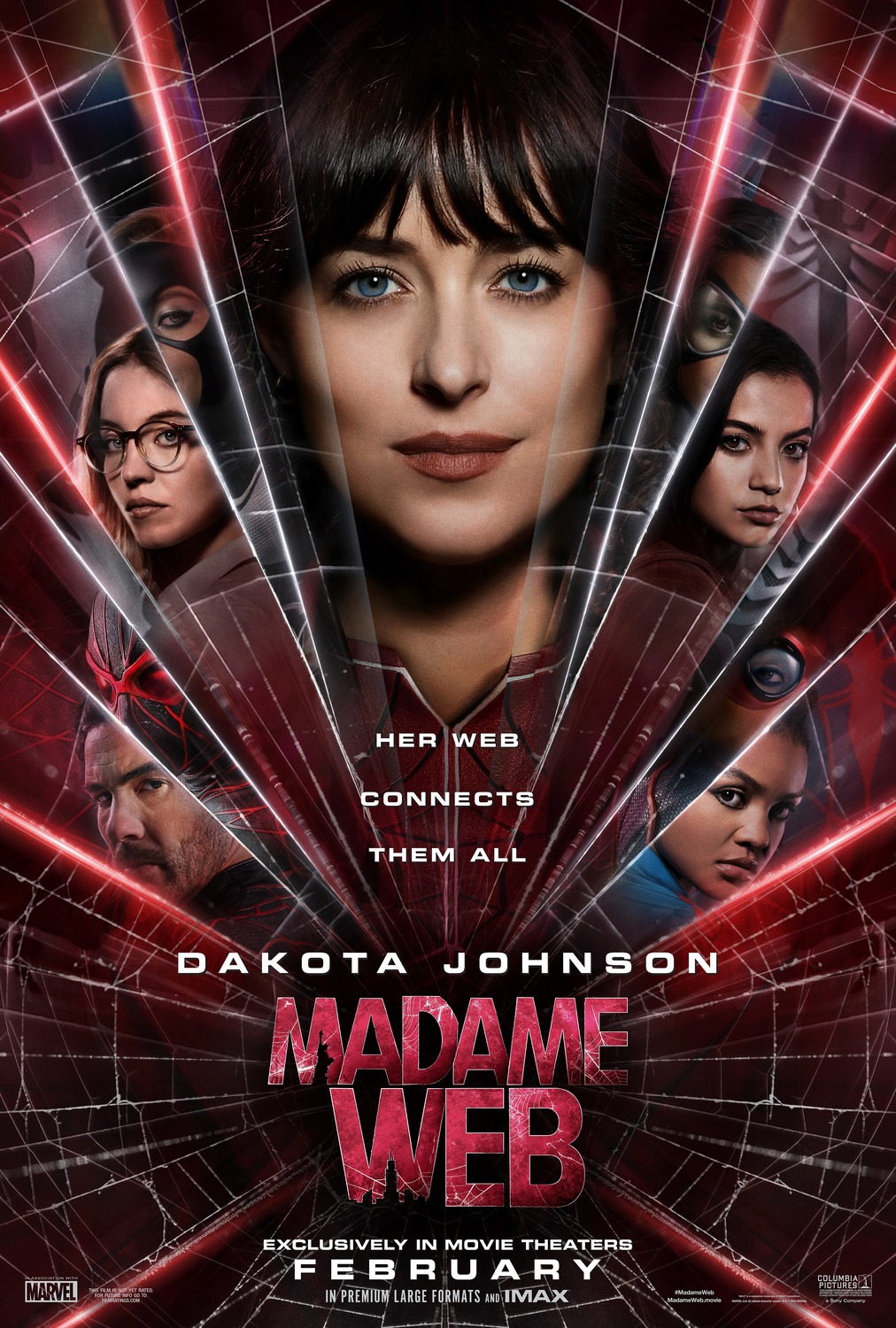
This film draws you in for a significant portion of its runtime with traditional or neutral content before springing its woke agenda. Know before you go!
NOT A WOKE TRAP. The all-female hero ensemble, the maternal protection arc, and the girl-boss framing are all visible from marketing materials and the first ten minutes. There is nothing hidden. Conservative viewers will recognize the ideological territory immediately. The real surprise is not the ideology but the staggering incompetence of the filmmaking. This is a film that fails on craft before it fails on politics.
Madame Web is one of the most comprehensively terrible superhero films ever produced by a major studio. It earned an 11% on Rotten Tomatoes, grossed $100.5 million worldwide against a budget of $80-100 million (a catastrophic loss after marketing costs), and won three Golden Raspberry Awards: Worst Picture, Worst Actress, and Worst Screenplay. These accolades are all deserved.
The premise is this: Cassandra Webb (Dakota Johnson) is a New York City paramedic who, after a near-death experience, begins having visions of the future. She discovers that a villain named Ezekiel Sims (Tahar Rahim) is hunting three teenage girls, Julia Cornwall (Sydney Sweeney), Anya Corazon (Isabela Merced), and Mattie Franklin (Celeste O'Connor), because he has foreseen that they will become Spider-Women and kill him. Cassie must protect the girls, confront the truth about her mother's death in the Amazon, and learn to control her clairvoyant powers.
On paper, this is workable. A reluctant mentor with psychic abilities protecting three future heroes from a precognitive villain is a perfectly fine structure for a superhero origin story. The problem is execution. Every single element fails.
The script, credited to four writers including the team responsible for Morbius, is a disaster of convenience and contrivance. Characters make decisions that no rational person would ever make because the plot requires them to. Cassie is wanted for kidnapping and possibly murder, yet she walks freely through New York City, boards an international flight to Peru, and moves around without taking basic precautions to hide her identity. She arrives in the Peruvian Amazon and immediately finds the exact person she is looking for. A wonder bar appears beneath a parked car at the precise moment she needs it. The three teenagers are told to stay put and promptly leave to go to a diner, where the villain naturally finds them. This happens not once but repeatedly. The film's plot runs entirely on characters being stupid enough to create danger.
Dakota Johnson's lead performance has become legendary for the wrong reasons. She delivers every line with the emotional investment of someone waiting for a delayed flight. In scenes requiring fear, urgency, or grief, she barely registers a pulse. There are moments when people die in front of her and her reaction suggests mild annoyance rather than horror. Whether this is a performance choice (playing Cassie as emotionally numb), a direction failure (Clarkson not getting the range she needed), or simply disinterest (Johnson visibly did not want to be here), the result is a protagonist you cannot care about because she does not appear to care about anything herself.
Tahar Rahim's villain fares even worse, though through less fault of his own. Rahim is a genuinely talented actor. His performance in A Prophet is electrifying. Here, the studio apparently changed significant amounts of his dialogue in post-production, resulting in ADR dubbing that frequently does not match his lip movements. The effect is disorienting and unintentionally hilarious. He looks like a foreign film that has been badly dubbed into English, except this is supposed to be the final product. His motivation (kill teenagers before they kill him) is paper-thin, and his powers (vague spider abilities plus a black-and-red suit) make him a discount Spider-Man fighting a discount psychic.
The three young actresses are wasted. Sweeney, Merced, and O'Connor have varying degrees of talent, but the script gives them nothing to play except victims who need saving. We see them in their Spider-Women costumes only in brief flash-forward visions. The entire film is essentially a prologue to the story you want to see, and that story never arrives. Sony cannot actually use Spider-Man in these films, so the Spider-Women tease is all tease and no payoff.
The ideological content is mild and mostly botched. The film clearly wants to be a female empowerment story: a woman discovers her power, mentors three young women, and defeats a male villain through cunning rather than brute force. But the execution is so limp that the empowerment message never lands. Cassie does not feel empowered. She feels confused and annoyed for two hours and then the movie ends. The three girls do not grow into heroes. They remain passive throughout.
There are specific woke markers. Anya Corazon's backstory involves her father being deported, leaving her alone. One character wears a shirt with a slogan about girls and math. A baby shower scene contrasts Cassie's abrasive independence against traditionally feminine women who are written as shallow. But none of it coheres into an ideological project because the filmmakers were too incompetent to execute one. The wokeness is there in the ingredients but the recipe is burned beyond recognition.
The traditional elements, what few exist, are genuine. The maternal thread is the film's strongest asset. Cassie's mother died trying to save her from a congenital illness. Cassie's arc is about accepting the same responsibility: she becomes the protector of three vulnerable girls because that is what her mother would have done. The self-sacrifice theme is real. Cassie ends the film blind and paraplegic, having absorbed the physical cost of protecting others. That is a traditional heroism arc played straight, and it is the one thing the film does not completely botch.
Adam Scott's Ben Parker provides the film's only warmth. His scenes with Johnson are the one relationship in the film that feels like actual human interaction. His character's kindness, reliability, and quiet decency are traditionally masculine virtues played without irony.
But these elements cannot rescue the film from its fundamental problems: a script that insults the audience's intelligence, a lead performance that registers as checked out, a villain whose audio does not sync with his mouth, pacing that lurches between boring and baffling, and CGI that looks like it was rendered on a deadline three weeks too tight.
Madame Web is not a culture-war flashpoint. It is not offensive enough to provoke outrage or good enough to earn defense. It is simply bad. Impressively, consistently, almost fascinatingly bad. The kind of bad where you stop being angry and start being curious about how so many professionals at a major studio looked at this film and said yes, this is ready for theaters. The answer, as usual with Sony's Spider-Man Universe, is that the studio's desperation to exploit its Marvel IP license overrode every creative instinct that might have saved the project.
The film's lasting cultural contribution is becoming a punchline. The memes are funnier than the movie. Dakota Johnson's dead-eyed press tour became more entertaining than her performance. Tahar Rahim's dubbed dialogue became more discussed than his character's motivation. And the line from the trailer, "He was in the Amazon with my mom when she was researching spiders right before she died," became shorthand for clumsy exposition in an era that was already drowning in it.
Sony killed the Spider-Man Universe shortly after this film's release. Good.
Formula: Weighted Score = Severity × Authenticity Multiplier × Centrality Multiplier
🔴 Woke Tropes
| Trope | Severity | Authenticity | Centrality | Score |
|---|---|---|---|---|
| All-Female Hero Ensemble | 3 | 0.6 | 1 | 2.88 |
| Girl-Boss Empowerment Without Earning It | 3 | 0.5 | 0.8 | 2.34 |
| Immigration as Sympathetic Backstory | 2 | 0.5 | 0.3 | 1.14 |
| Traditional Femininity Mocked | 2 | 0.5 | 0.2 | 0.88 |
| Girls-in-STEM Signaling | 1 | 0.4 | 0.1 | 0.38 |
| Mystical Indigenous People as Plot Device | 2 | 0.4 | 0.5 | 1.36 |
| TOTAL WOKE | 9.0 | |||
🟢 Traditional Tropes
| Trope | Severity | Authenticity | Centrality | Score |
|---|---|---|---|---|
| Maternal Sacrifice as Central Theme | 4 | 0.8 | 0.9 | 3.84 |
| Self-Sacrifice for the Innocent | 4 | 0.8 | 0.8 | 3.49 |
| Reliable Male Decency (Ben Parker) | 2 | 0.9 | 0.4 | 1.82 |
| TOTAL TRADITIONAL | 9.2 | |||
Score Margin: -4 WOKE
Director: S.J. Clarkson
MODERATE/PROGRESSIVE. Clarkson is a veteran TV director whose credits lean toward prestige television. Her feature film debut here is a catastrophic misfire, but her prior work on Jessica Jones, The Defenders, Succession, and Anatomy of a Scandal suggests a filmmaker comfortable working within both progressive and institutional frameworks without strong personal ideological branding.S.J. Clarkson is a British director born in 1974 who built her career entirely in television before Madame Web became her feature debut. Her credits are impressive in breadth: Jessica Jones, The Defenders, Succession, Anatomy of a Scandal, Collateral, Orange Is the New Black, Dexter, House, Heroes, Life on Mars, and Vinyl. She co-created the British series Mistresses in 2008. Clarkson was hired by Sony in May 2020 to develop and direct their first female-centric Marvel film. She also co-wrote the screenplay alongside Claire Parker, Matt Sazama, and Burk Sharpless. Her Jessica Jones work is the most relevant predecessor here: she directed episodes of a show about a reluctant, abrasive female superhero with psychological damage, which is essentially the template she tried to apply to Cassie Webb. The difference is that Jessica Jones had sharp writing, a compelling villain in Kilgrave, and a star in Krysten Ritter who sold the damaged-hero routine with conviction. Madame Web has none of these things. Clarkson described Cassie as a loner on the outer edges, quirky and abrasive, and compared her to Jessica Jones. The comparison only highlights how far short this film falls.
Writer: Matt Sazama & Burk Sharpless, Claire Parker, S.J. Clarkson
The screenplay carries four credited writers, which is rarely a good sign. Matt Sazama and Burk Sharpless are the most notable names, and their track record is a graveyard of studio tentpoles: Dracula Untold (2014), The Last Witch Hunter (2015), Gods of Egypt (2016), Power Rangers (2017), and Morbius (2022). Every single one of these films was either a critical failure, a box office bomb, or both. Their involvement with Madame Web should have been the first red flag. Claire Parker has no other screenwriting credits. S.J. Clarkson's involvement as co-writer was only revealed in November 2023, months before release, suggesting either late rewrites or a desire to distance herself from the original draft. The script is the film's most catastrophic failure: the dialogue is stilted, the plot is driven entirely by convenience and contrivance, characters lack dimension, and the narrative logic collapses under the slightest scrutiny. Kerem Sanga (The Big Sick) wrote an earlier story draft.
Adult Viewer Insight
Conservative adults will not find much to be offended by here, because there is not much of anything here. The woke content is mild: a deportation backstory, a girls-in-STEM shirt, a scene mocking traditional femininity at a baby shower. None of it is sustained or coherent enough to constitute an ideological agenda. The bigger problem for conservative audiences is simply that the film is unwatchable. It is poorly written, poorly acted (with the exception of Adam Scott), poorly paced, and poorly edited. The maternal sacrifice theme at the core is genuinely traditional, and the final image of Cassie as a blind, paraplegic mentor who gave her body to save others has real weight. But getting to that moment requires enduring two hours of the worst dialogue, the most nonsensical plotting, and the most disengaged lead performance of any superhero film in recent memory. Your time is better spent elsewhere.
Parental Guidance
Rated PG-13 for violence and action. Recommended for viewers 10 and older. The violence is standard superhero fare: fights, chases, and a villain with spider-like abilities who kills people with a neurotoxin. The opening scene features a pregnant woman being shot and killed, which is the film's most intense moment. Three teenage girls are repeatedly stalked and hunted by an adult man, which may unsettle younger viewers at a conceptual level even though the execution is too inept to be genuinely frightening. No sexual content, nudity, strong language, or substance use. The biggest risk to younger viewers is not the content but the boredom. This is 116 minutes of their life they will not get back.
Find Madame Web on Amazon Prime Video, rent, or buy:
▶ Stream or Buy on AmazonAs an Amazon Associate, VirtueVigil earns from qualifying purchases.
Community Discussion 0
Subscribe to comment.
Join the VirtueVigil community to share your perspective on this review.