Moana
Moana is the Disney princess film that refuses to be about a princess, which is either the most Disney thing imaginable or a quiet act of subversion, depending on your perspective. Moana (Auli'i Cravalho) is the daughter of a Pacific Island chief. She's next in line to lead.…
Full analysis below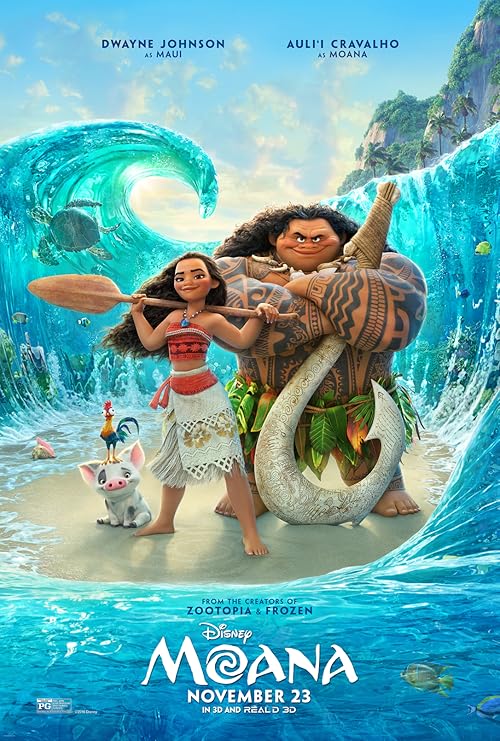
Not a woke trap. Moana's feminist framing is visible from the trailer. A strong-willed young woman who defies her father to pursue her calling is the entire pitch. Conservative families know what they're getting. The film does not conceal its perspective. What the marketing does not fully convey is how much traditional content sits alongside the girl-power framing — and that surprise runs in the traditional direction, not the woke one.
Moana is the Disney princess film that refuses to be about a princess, which is either the most Disney thing imaginable or a quiet act of subversion, depending on your perspective. Moana (Auli'i Cravalho) is the daughter of a Pacific Island chief. She's next in line to lead. She is also undeniably called to the sea, called to sail beyond the reef her father has forbidden them to cross, called to restore a stolen artifact to a goddess and save her people's dying island.
The film's central tension — girl defies father, follows calling, saves everyone — is structurally familiar. But Moana earns its premise in a way that matters: it respects both sides of the conflict. Chief Tui (Temuera Morrison) is not an idiot or a tyrant. He loves his daughter and his people. His fear of the ocean is rooted in genuine tragedy. Moana loves her father. The resolution is not 'Moana was right and dad was wrong' but something more honest: Moana finds what her people need, and her father is big enough to recognize it.
This is worth noting because it runs against the standard Disney template, where parental authority is simply an obstacle to be discarded. Moana does defy her father. But she also carries her community's wellbeing as her primary motivation. She isn't sailing toward individual fulfillment. She's sailing to save her people. That is a meaningfully different moral architecture from Frozen or The Little Mermaid.
The film's other lead is Maui (Dwayne Johnson), the legendary Polynesian demigod who stole the heart of the goddess Te Fiti and caused the world's slow decay. Maui is the film's most interesting character: a demigod who craves human approval, who performed great deeds for a people who eventually abandoned him, whose confidence masks a wound he can barely name. Johnson gives Maui more texture than the role strictly requires. 'You're Welcome' is genuinely one of the best comedic songs Disney has produced since The Lion King.
The Polynesian cultural specificity is real and rare. The film was developed in genuine consultation with Pacific Islander scholars, artists, and cultural practitioners (the Oceanic Story Trust). The result is a story that feels grounded in actual mythology and actual geography rather than Disney's typical 'vaguely ethnic backdrop for a universal story' approach. The ocean as a sentient, choosy force; the wayfinding tradition; the visual design of the islands and the character costumes — this is research-backed specificity that earns the setting rather than merely using it.
The animation is stunning. The ocean sequences in particular represent some of the finest water simulation ever rendered. The music — songs by Lin-Manuel Miranda and Opetaia Foa'i, score by Mark Mancina — integrates Polynesian musical traditions with big Broadway energy in ways that feel collaborative rather than colonial.
For the VVWS score, Moana comes in at essentially neutral: +1 TRAD. The feminist framing (girl defies father to pursue calling) is genuine and drives the plot. The absence of a love interest is a deliberate progressive choice. The film's cosmology is explicitly non-Christian and presents ancestor spirits and a sentient ocean as real forces. These are legitimate woke-adjacent elements that push the score left.
But the trad score is also real. Community identity is the film's moral engine — Moana sails not for herself but for her people. Intergenerational continuity is honored through her grandmother and through the film's climax, which reveals the whole community's wayfinding heritage. The father-daughter conflict resolves into mutual understanding rather than the father being defeated. Maui's arc is about accepting responsibility for harm done — accountability without victimhood. The film ultimately argues that knowing who you are, where you come from, and what your people need are the things worth sailing for.
Moana is a good film made with care, cultural respect, and genuine craft. Conservative families will find some of the progressive framing familiar and mild. They'll also find things they might not expect: a story that takes community seriously, that treats parental authority as something to be engaged rather than simply escaped, and that frames personal calling through the lens of responsibility to others. It's not a traditional film. But it's more honest than most.
Formula: Weighted Score = Severity × Authenticity Multiplier × Centrality Multiplier
🔴 Woke Tropes
| Trope | Severity | Authenticity | Centrality | Score |
|---|---|---|---|---|
| Chosen Girl / Female Hero Defies Father | 4 | 1 | 1.8 | 7.2 |
| No Love Interest / Romance Rejected as Plot Element | 3 | 0.7 | 1 | 2.1 |
| Non-Christian Cosmology as Real / Ancestor Spirits Active | 3 | 1 | 0.5 | 1.5 |
| Environmental Messaging / Ecological Balance as Sacred | 2 | 1 | 0.5 | 1 |
| TOTAL WOKE | 11.8 | |||
🟢 Traditional Tropes
| Trope | Severity | Authenticity | Centrality | Score |
|---|---|---|---|---|
| Community Over Self / Calling Framed as Service | 5 | 1 | 1.8 | 9 |
| Intergenerational Continuity / Ancestry Honored | 4 | 1 | 1 | 4 |
| Father-Daughter Conflict Resolved Through Respect | 4 | 1 | 0.5 | 2 |
| TOTAL TRADITIONAL | 15.0 | |||
Score Margin: +3 TRAD
Director: Ron Clements, John Musker
CENTER. Clements and Musker are old-school Disney animators who directed The Little Mermaid (1989), Aladdin (1992), Hercules (1997), and The Princess and the Frog (2009). Their instincts are rooted in classic Disney storytelling: strong characters, musical numbers that advance plot, and emotional arcs built around family and identity. They are not ideologues. Moana was their passion project, developed over years of research trips to Polynesia. The film's cultural rootedness reflects genuine artistic commitment, not political agenda.Ron Clements and John Musker are among the most important figures in the Disney Animation Renaissance. Their track record stretches from The Black Cauldron (1985, uncredited) through Moana, making them the last surviving link to the golden-age Disney storytelling tradition inside the modern studio. They were the obvious choices for Moana precisely because their filmmaking instincts are fundamentally story-first and character-first. The film's Polynesian cultural specificity was earned through genuine research partnerships with Pacific Islander consultants and artists.
Writer: Jared Bush, Ron Clements, John Musker, Pamela Ribon, Aaron Kandell, Jordan Kandell, Chris Williams
The screenplay went through many drafts and writers, which is typical of Disney Animation. The core story — a young person of destiny who must reclaim a stolen artifact and restore balance — is a classic hero's journey that Clements and Musker have always been drawn to. The cultural dimension was shaped in consultation with the Oceanic Story Trust, a group of Pacific Islander academics, artists, and cultural practitioners who advised throughout production. The result is a story that feels specific and grounded rather than generically exotic.
Adult Viewer Insight
Conservative adults who avoided Moana on ideological grounds missed a more complicated film than the marketing suggested. Yes, it's a girl-follows-her-calling story. But Moana's calling is explicitly framed as service to her community, not personal liberation. The absent love interest is a deliberate choice that actually strengthens the film's moral focus. And the father-daughter arc is resolved through mutual respect rather than the daughter simply defeating parental authority. Compare that to Brave, Tangled, or The Little Mermaid and Moana is noticeably more honest about what it costs to defy the people who raised you. Worth watching and discussing with teenagers.
Parental Guidance
PG. Appropriate for ages 5 and up. Main concerns: Te Ka's frightening visual design, Gramma Tala's death, and the non-Christian spiritual framework involving ancestor spirits and a sentient ocean. Parent-child conflict resolves positively. No romantic content. Clean language.
Find Moana on Amazon Prime Video, rent, or buy:
▶ Stream or Buy on AmazonAs an Amazon Associate, VirtueVigil earns from qualifying purchases.
Community Discussion 0
Subscribe to comment.
Join the VirtueVigil community to share your perspective on this review.