
Napoleon
Ridley Scott's Napoleon is a film at war with itself. The battle sequences are extraordinary. The portrait of Napoleon the man is deliberately, sometimes frustratingly, small. Whether that smallness is a feature or a flaw depends on what you came to see.
Full analysis below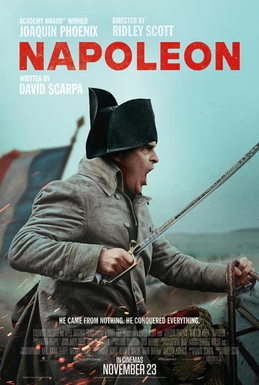
NOT A WOKE TRAP. Napoleon's revisionism is front-loaded. Scott has been publicly dismissive of Napoleon's greatness in interviews, and the film reflects that contempt. Conservative viewers may dislike what the film does with its subject, but they will not be ambushed by it. The ideological fingerprints are visible before you sit down.
Ridley Scott's Napoleon is a film at war with itself. The battle sequences are extraordinary. The portrait of Napoleon the man is deliberately, sometimes frustratingly, small. Whether that smallness is a feature or a flaw depends on what you came to see.
The film opens in 1793 with the young Napoleon watching Marie Antoinette go to the guillotine. (This did not happen historically, but Scott has stated he does not care what French historians think.) From there, the film traces Napoleon's rise through the Siege of Toulon, his courtship of the widowed Josephine de Beauharnais, his crowning as Emperor, and ultimately his defeat at Waterloo and exile to Saint Helena. The arc spans roughly three decades of history and 157 minutes of screen time.
The battle sequences are Scott at his best. Austerlitz is staged with genuine tactical intelligence and stunning scale. Waterloo is visceral and brutal in the way historical epics used to be before studios decided violence was only acceptable if it had a redemptive message attached. Scott shoots combat the way he always has: as something simultaneously magnificent and horrifying. The production design and cinematography (Dariusz Wolski, a long-time Scott collaborator) are impeccable throughout.
The problem is Napoleon himself, or rather, Scott's and Phoenix's version of him. The choice to portray Napoleon as a socially maladroit, emotionally stunted mama's boy who cannot function without the approval of a woman who barely loves him is a directorial statement about the nature of greatness: it is rooted in pathology rather than virtue. Phoenix commits fully to this interpretation. He is never conventionally heroic. He is anxious, petulant, sexually insecure, and prone to sulking. When he tells Josephine he discovered his love for her while she was in prison, it reads as neediness rather than devotion.
Vanessa Kirby's Josephine is the most fully realized character in the film. She understands her position. She uses Napoleon's obsession strategically. When he divorces her for failing to produce an heir and she responds with a devastating emotional performance, you realize she has more agency in this film than Napoleon does. The film seems aware of this, and at moments seems almost to endorse it.
This is where Napoleon earns its MIXED score. On the traditional side, the film presents war as genuinely costly, marriage as a serious institution (even when dysfunctional), and national ambition as something that demands real sacrifice. On the woke side, the film systematically deflates its masculine subject, treats his military genius as inseparable from psychological damage, and positions the woman as the smarter, more grounded partner in a relationship where the man is fundamentally dependent.
French historians were apoplectic about the historical liberties. There are real inaccuracies: Napoleon was not at Marie Antoinette's execution, the Battle of the Pyramids plays loose with geography and tactics, and several documented conversations are fabricated. Scott has responded with characteristic bluntness. His Napoleon is a portrait, not a textbook. That is fine as far as it goes. But the portrait he chose to paint is one where Europe's most consequential military commander reads as a petulant child dressed up in imperial costume.
For conservative viewers, the verdict depends on what you prioritize. The battle craft is extraordinary. The history is freely adapted. The ideological slant tilts toward viewing masculine ambition as psychological dysfunction. That is not a traditional reading of Napoleon Bonaparte.
The Director's Cut (205 minutes) on Apple TV+ reportedly deepens several subplots and may address some of the theatrical cut's pacing gaps, particularly around Napoleon's second marriage and his political consolidation after Austerlitz.
Formula: Weighted Score = Severity × Authenticity Multiplier × Centrality Multiplier
🔴 Woke Tropes
| Trope | Severity | Authenticity | Centrality | Score |
|---|---|---|---|---|
| Male Military Ambition Framed as Psychological Pathology | 3 | Moderate | Moderate | 3 |
| Marriage Depicted as Toxic Power Struggle | 3 | High | High | 3.78 |
| Historical Great Man Deflated | 2 | Moderate | Moderate | 2 |
| Female Character as De Facto Superior | 1 | High | Low | 0.7 |
| TOTAL WOKE | 9.5 | |||
🟢 Traditional Tropes
| Trope | Severity | Authenticity | Centrality | Score |
|---|---|---|---|---|
| Marriage as Consequential Institution | 3 | Moderate | High | 5.4 |
| Patriarchal Ambition and Empire-Building | 3 | High | High | 3.78 |
| Military Excellence Depicted with Craft | 2 | High | Moderate | 1.4 |
| TOTAL TRADITIONAL | 10.6 | |||
Score Margin: +1 TRAD
Director: Ridley Scott
MIXED. Scott is a complicated filmmaker ideologically. Gladiator (2000) and Black Hawk Down (2001) are the work of a man who respects duty and martial excellence. House of Gucci and The Last Duel reveal a more cynical late-career tendency to psychologize historical greatness into dysfunction. Napoleon lands in the cynical column.Scott is 86 and still making films at a pace that shames directors half his age. His late-career output is uneven but never boring. Gladiator is one of the great traditional epics of modern cinema. The Last Duel (2021) applied a revisionist feminist lens to medieval France with mixed results. Napoleon continues that revisionist thread, presenting a great conqueror as a petty, mother-fixated man whose battlefield victories are undercut by his personal absurdities. Scott's craft remains exceptional. His values, in this film at least, are not conservative ones.
Writer: David Scarpa
Scarpa also wrote Scott's All the Money in the World (2017), which handled its subject with similar coolness toward the idea of masculine greatness. His Napoleon script is deliberately deflationary, choosing to focus on Napoleon's obsession with Josephine and his political maneuvering rather than the sweep of his military genius. French historians were vocal in their criticism of the historical inaccuracies. Scarpa and Scott have been dismissive of those objections. The result is a script that feels more like psychological portrait than historical drama, and not necessarily a flattering one.
Producers
- Ridley Scott (Scott Free Productions)
- Kevin J. Walsh (Apple Studios)
- Mark Huffam (Scott Free Productions)
- Joaquin Phoenix (Untitled Entertainment)
Full Cast
Adult Viewer Insight
Adults who enjoy Ridley Scott's visual command will find Napoleon technically spectacular. The battle sequences rival anything in Gladiator. But the film's refusal to grant Napoleon even a moment of uncomplicated greatness, and its consistent framing of masculine military ambition as psychological pathology, will frustrate viewers who came for an epic. This is a smaller, stranger, more cynical film than its budget and subject suggest. Approach it as a character study by a filmmaker who does not particularly admire his subject.
Parental Guidance
Recommended age: 15 and up. Rated R for strong violence, some sexual content, and brief nudity. Battle sequences include brutal depictions of cannon fire, mass casualties, and horses being killed. The sexual content is brief but explicit enough for an R rating. Napoleon and Josephine's relationship includes frank depictions of marital dysfunction, infidelity, and emotional manipulation. Language is period-appropriate and not excessive. No drug use, no gender ideology. The historical content is presented with significant inaccuracies that parents of history students should be aware of.
Find Napoleon on Amazon Prime Video, rent, or buy:
▶ Stream or Buy on AmazonAs an Amazon Associate, VirtueVigil earns from qualifying purchases.
Community Discussion 0
Subscribe to comment.
Join the VirtueVigil community to share your perspective on this review.