
Paddington in Peru
Spoiler note: the film's villain twist is better experienced unspoiled. The review discusses it briefly but the mechanics are not a significant part of what makes the film work.
Full analysis below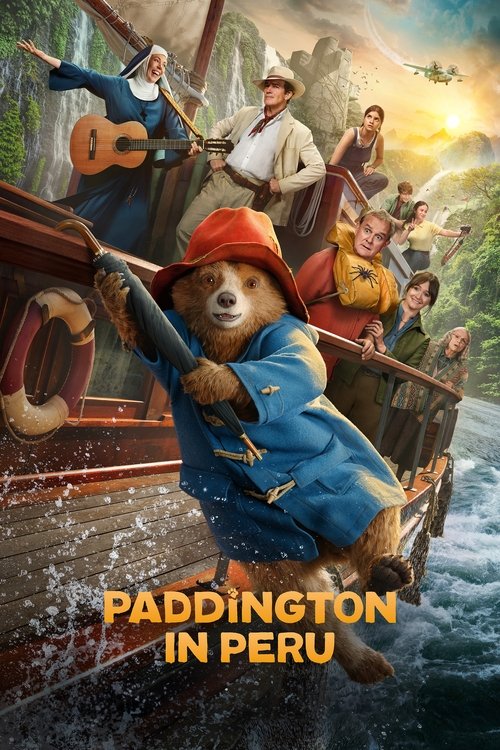
No bait-and-switch. The Paddington franchise under any director is gentleness, warmth, and traditional family values packaged in immaculate British production design. The third film is slightly less brilliant than Paul King's originals but maintains every value that made the franchise beloved.
Spoiler note: the film's villain twist is better experienced unspoiled. The review discusses it briefly but the mechanics are not a significant part of what makes the film work.
The Paddington films have always been about the same thing. A small creature of exceptional goodness arrives in a world that is frequently unkind, and through his unfailing courtesy, his genuine warmth, and his absolute refusal to become cynical, he makes the world a little better and finds a family that loves him. This is not a complicated formula. It is also not a formula you can easily fake. The first two films under Paul King achieved something genuinely rare: family films with no condescension toward children, no winking at adults, and no ideological agenda beyond the radical proposition that kindness is more powerful than cruelty and that home is worth more than treasure.
Paddington in Peru is the third film and the first without Paul King behind the camera. King is present as a story contributor and executive producer, which matters enormously. The structural heart of the film, the adventure about a bear looking for his aunt that turns into a meditation on choosing your family over your origins, is King's work. But the direction is by Dougal Wilson, a gifted British commercial filmmaker making his feature debut, and the difference in the final mile is occasionally visible. The film is slightly less magical than its predecessors. It is still very good.
The premise sends Paddington and the Browns to Peru, where Aunt Lucy has gone mysteriously missing near the Amazon jungle. This is a satisfying choice because it returns Paddington to the landscape of his origin while maintaining the Browns as the film's emotional anchor. What Paddington discovers at the journey's end is worth preserving for first-time viewers, but the thematic revelation is in keeping with everything the franchise has always believed: Paddington's real home is with the people who chose to love him.
The new characters are well-designed. Antonio Banderas plays Hunter Cabot, a riverboat captain driven by ancestral obsession with El Dorado. The Banderas character arc is the most traditionally satisfying in the film: a man who has allowed the ghosts of his ancestors to dictate his choices, making himself a worse father in the process, who ultimately chooses his living daughter Gina over his dead ancestors' ambitions. This is not a complicated moral. But it is a correct one, and the film presents it with the directness that family cinema used to consider appropriate and modern family cinema usually considers beneath it.
Olivia Colman is the film's surprise pleasure, playing the Reverend Mother of the Peruvian convent where the Browns make their initial inquiries. Colman's natural warmth is deployed with precision against the character's eventual revelation as Clarissa Cabot, Hunter's villainous cousin. The moment when her mask slips is genuinely funny because Colman plays the before and after with such commitment that the transition lands as a genuine surprise even when the film telegraphs it.
Ben Whishaw's voice continues to be the definitive Paddington, a feat that improves with each film simply because you cannot imagine anyone else in the role by now. His Paddington is curious without being naive, warm without being saccharine, and occasionally wounded in ways that are handled with care rather than milked for easy pathos. The scene where Paddington discovers what El Dorado actually is, and what it means for his understanding of himself and where he came from, is the film's emotional peak and Whishaw plays it beautifully.
Hugh Bonneville's Henry Brown deserves more credit than the franchise typically gives him. He is a wonderful comic performer operating in a register that looks effortless but requires real precision. His genuine, uncynical love for his family, including his adopted bear, is the emotional foundation on which everything else rests. Emily Mortimer as Mary is equally solid, her natural brightness and warmth exactly what the character needs. The Brown children, now played by the same actors from the first films grown into teenagers, contribute more to the adventure than in previous entries.
The film's production design is impeccable, as with the whole franchise. The transition from the immaculate greens of Notting Hill to the rich chaos of Peru is handled with the visual care that marks this series. Dario Marianelli's score is warm and occasionally stirring. The action sequences are inventive. The villain resolution, Clarissa dispatched to the North Pole to run the Home for Retired Polar Bears, is the kind of perfectly Paddington consequence that only this franchise knows how to execute.
The one genuine flaw is pacing in the middle act, where some sequences run slightly longer than they should. The commercial director's instinct to hit every beat thoroughly occasionally works against the film's need for narrative propulsion. Paul King's originals had a lightness of touch in the editing that Wilson has not quite replicated.
Conservative families should know that this is one of the safest franchises in cinema. The values on display, family loyalty, the worthlessness of greed, the virtue of courtesy and kindness, the choice of home over adventure, the redemption of even the most determined villain, are traditional to the bone. Paddington is a franchise built on Michael Bond's belief that a well-mannered bear with a kind heart can change the world. Three films in, nothing about that belief has been compromised.
| Trope | Category | Location | Authenticity |
|---|---|---|---|
| The Loving Family Unit | TRADITIONAL | Throughout - the Browns are an intact, loving family unit who make decisions together and support each other; Henry and Mary Brown's marriage is warm and uncomplicated | Authentic. The Paddington franchise has never introduced marital conflict or family dysfunction as dramatic tools. The Browns simply love each other and that love is the film's moral ground. |
| Adoption as Full Family | TRADITIONAL | Throughout, culminating in Paddington's choice to return to London - the adopted bear is fully a member of the family; his biological origins do not supersede his chosen home | Authentic. The franchise consistently treats Paddington as genuinely belonging to the Browns, not as a visitor or a project. His choice to return to London rather than remain among his kind is the film's most traditional moral statement. |
| Consequences of Greed | TRADITIONAL | Hunter Cabot's arc throughout - his obsession with El Dorado has driven away his daughter; when he relinquishes it and chooses Gina, he finds what he was actually missing | Authentic. The traditional moral that treasure is worthless compared to family is executed without irony or complication. |
| Paternal Redemption | TRADITIONAL | Hunter's arc - he has been a poor father because of his ancestral obsession; choosing to incapacitate Clarissa and reconcile with Gina is his redemption moment | Authentic. Father choosing living family over dead ambitions is one of the oldest and most important family values narratives. |
| Courtesy and Kindness as Power | TRADITIONAL | Paddington throughout - his response to hostility is always courtesy; he disarms antagonists through genuine warmth rather than force or cunning | Authentic. This is the franchise's central and most countercultural thesis: that being kind is not weakness. Michael Bond believed this. The films believe it. The third film has not abandoned it. |
| Home Over Adventure | TRADITIONAL | Final act - Paddington discovers El Dorado, finds Aunt Lucy, meets his kind, and chooses to return to London with the Browns rather than remain in paradise | Authentic. The franchise has always known that the most profound choice a person can make is where to plant themselves. Paddington plants himself with the Browns. Every film confirms this choice. |
| Earned Redemption | TRADITIONAL | Clarissa's consequence - she is not destroyed but sent to become a genuine nun, working at the Home for Retired Polar Bears; comic and appropriate | Authentic. The franchise never kills or permanently damages its villains. Consequences are proportional and occasionally merciful. This is a traditional understanding of justice as correction rather than destruction. |
| Heritage and Continuity | TRADITIONAL | El Dorado reveal - Paddington's origins are not random; El Dorado is the orangery where Peruvian bears have made marmalade for generations; heritage is real and worth knowing | Authentic. The film does not treat Paddington's origins as irrelevant. Knowing where you come from matters. Choosing where you belong matters more. |
| Immigrant Metaphor (Mild) | WOKE | The franchise's foundational premise - Paddington as a bear who arrived in England from foreign shores and was welcomed by a kind family; the metaphor of immigration-as-enrichment | Organic to Michael Bond's original books, written in the 1950s-60s when Bond was consciously thinking about post-war refugees. The metaphor is as old as the franchise and is present without political emphasis. |
| Inclusive Community | WOKE | London Notting Hill community at the franchise's core - diverse, mutually supportive neighborhood reflects the progressive ideal of multicultural community | Organic. Bond's Notting Hill setting was chosen specifically because it was London's most ethnically diverse neighborhood. This is faithful to the source material, not a modern imposition. |
Director: Dougal Wilson
NEUTRALBritish commercial and music video director making his feature film debut. His advertising work includes campaigns for John Lewis (the famous sentimental Christmas ads), Waitrose, and Lloyds Bank. He is known for visual warmth, emotional precision, and the ability to compress character into short durations. His commercial sensibility is evident throughout Paddington in Peru: the film moves cleanly, hits its emotional beats efficiently, and never overstays its welcome. He is not a political filmmaker and there is no political agenda visible in his work.
Writer: Mark Burton, Jon Foster & James Lamont; story by Paul King, Simon Farnaby & Mark Burton
Paul King, who directed the first two films, stepped back from directing to focus on producing and story. His fingerprints remain on the fundamental structure and heart of the narrative. Burton, Foster, and Lamont wrote the screenplay. Mark Burton's credits include the Wallace and Gromit films; his background is in British comedy animation of the most traditional kind. The screenplay maintains King's trademark balance of whimsy and genuine emotion.
Producers
- Rosie Alison (Marmalade Pictures) — Longtime Paddington producer who has shepherded the franchise from the start. Her commitment is to maintaining the quality and values of Michael Bond's creation. No independent ideological signal.
- Paul King (Executive Producer) — The creative architect of the Paddington film franchise. Stepped back from directing to focus on other projects (Wonka) but remains as producer and story contributor. His values, warmth over cynicism, family over adventure, home over treasure, are the bedrock of the franchise and remain fully intact in the third film.
- StudioCanal (StudioCanal) — French-owned European studio that has produced the Paddington franchise throughout. Commercial and prestige-oriented. No political agenda in their work on this franchise.
Full Cast
Fidelity Casting Analysis FAITHFUL
The core Brown family casting has been maintained from the first two films: Hugh Bonneville, Emily Mortimer, Julie Walters, and the Brown children. Ben Whishaw returns as the voice of Paddington. The film adds Antonio Banderas and Olivia Colman as new characters not drawn from specific Bond source material. No ideological casting decisions visible. The South American setting logically introduces Peruvian and Spanish-adjacent characters.
Michael Bond's Paddington books describe the Brown family as a conventional middle-class London family. The film cast has honored this since 2014 and continues to do so. The Brown household is recognizably British middle-class: Hugh Bonneville's Henry Brown is a working professional, Emily Mortimer's Mary is warm and adventurous, Julie Walters brings irreplaceable comic authority as Mrs. Bird. The new additions are appropriate: Antonio Banderas brings natural Spanish-inflected charisma to Hunter Cabot, a character of partly Peruvian ancestry. Olivia Colman is an inspired villain choice; her warmly deceptive Reverend Mother works precisely because Colman's persona generates immediate trust. No significant fidelity concerns across the entire cast.
Adult Viewer Insight
The Paddington franchise operates in a register that adults often claim to have outgrown and then discover they haven't. The films work on both levels simultaneously: as children's adventures and as genuinely thought-through meditations on what makes a family and why home matters. The third installment is no exception, though it lacks the specific brilliance of Paddington 2, which may be the finest family film of the decade. Conservative adult viewers will appreciate several things the film does that are genuinely rare in contemporary family entertainment. It takes the family unit seriously as a source of meaning rather than as a constraint to be overcome. It presents greed as something to be abandoned rather than something to be celebrated. It shows a father correcting a mistake by choosing his living daughter over his dead ancestors' ambitions. These are not merely pleasant values. They are countercultural ones in the context of modern family cinema, which tends to celebrate the child who leaves the family behind rather than the child who chooses to come home. The immigrant metaphor that has always underlaid the franchise is present but not overplayed. Paddington came from Peru to find a home in London. The film allows him to revisit his origins and choose London again. The message is that the home you choose matters more than the home you came from. This is a double-edged reading: progressive audiences see it as pro-immigration; conservative audiences can equally read it as a celebration of genuine assimilation, of choosing a culture and embracing it fully. The franchise has always been diplomatically ambiguous on this point, and the third film is no different.
Parental Guidance
Paddington in Peru is rated PG. This is a family film in the fullest sense of the term. Violence: Mild cartoon adventure peril. There are chase sequences, a boat wreck, and a confrontation at gunpoint (handled with appropriate comic defusion). Nothing remotely traumatic. Sexual Content: None. Zero. The franchise has always been exceptionally clean on this front. Language: None. The Paddington franchise maintains a standard of language that would have been considered normal in children's cinema before 1990 and is now extraordinarily rare. Scary Content: Mild peril appropriate for all ages. The villain's gun is played more for comedy than for genuine threat. Younger children may find some jungle sequences intense, but nothing is designed to be frightening. Age Recommendation: Suitable for all ages. Genuinely appropriate for children as young as three or four with a parent present. The humor operates on multiple registers, so adults and children both have material to enjoy simultaneously. Why This Film for Family Discussion: The Hunter Cabot arc offers an excellent conversation starter about whether the ambitions of people who came before us should define our lives. Paddington's choice to return to London rather than stay in El Dorado offers a gentle way into conversations about adoption, belonging, and the difference between where you came from and who you are.
Find Paddington in Peru on Amazon Prime Video, rent, or buy:
▶ Stream or Buy on AmazonAs an Amazon Associate, VirtueVigil earns from qualifying purchases.




Community Discussion 0
Subscribe to comment.
Join the VirtueVigil community to share your perspective on this review.