
Peaky Blinders: The Immortal Man
Peaky Blinders: The Immortal Man delivers exactly what its six seasons of television promised: a masculine, violent, morally complex crime drama about a deeply flawed man who comes out of hiding to save his son, fight fascists, and protect his family during Britain's darkest hour.…
Full analysis below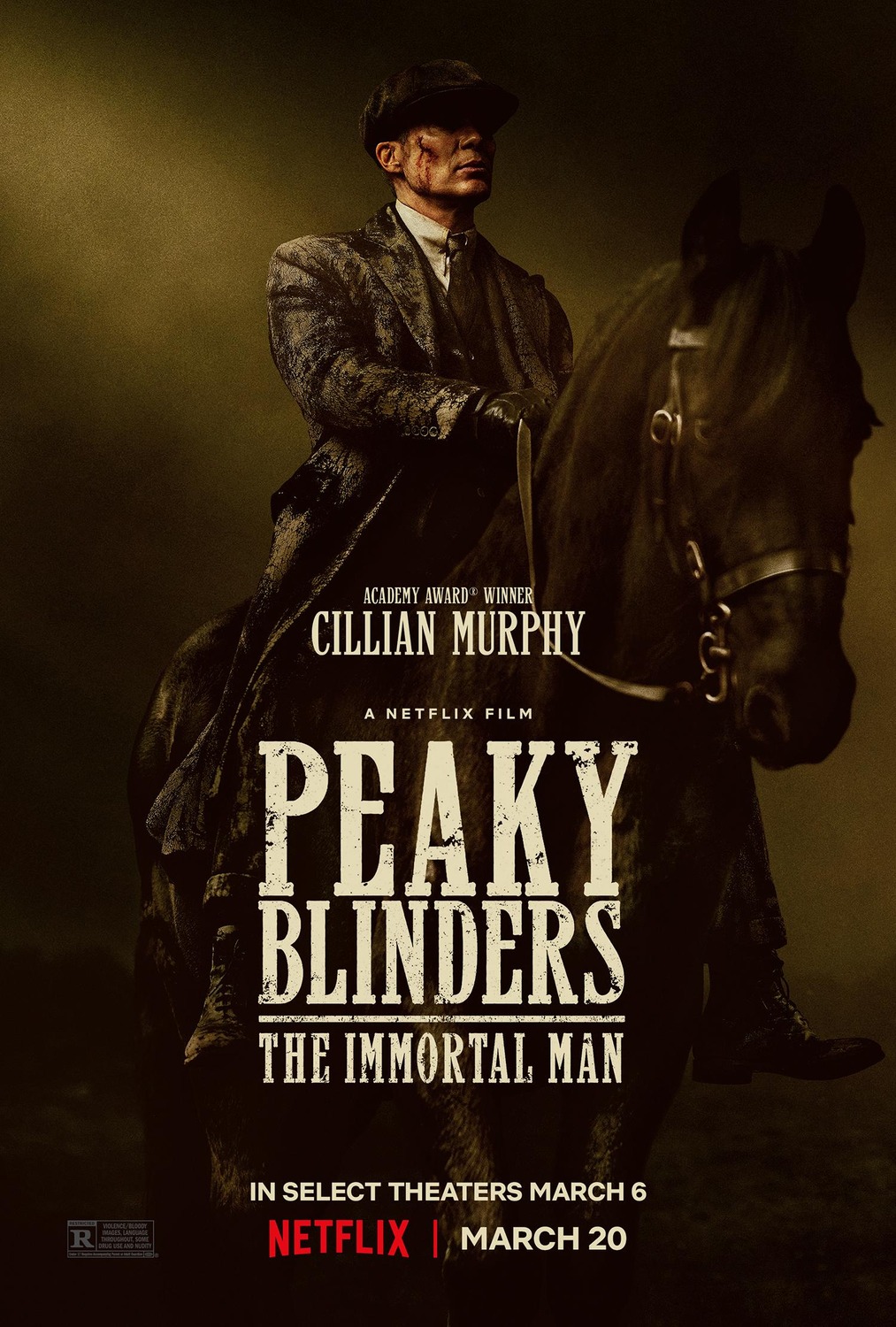
NOT A WOKE TRAP. The anti-fascist themes are the continuation of a storyline established across two full seasons of television. Tim Roth's fascist villain Beckett is a direct successor to Sam Claflin's Oswald Mosley. There is nothing smuggled in. The marketing, the trailers, and every interview with Steven Knight and Cillian Murphy have been transparent about the WWII setting and the fascist antagonist. Conservative viewers who enjoyed Seasons 5 and 6 will find familiar territory. Murphy himself has explicitly rejected preachy filmmaking.
Peaky Blinders: The Immortal Man delivers exactly what its six seasons of television promised: a masculine, violent, morally complex crime drama about a deeply flawed man who comes out of hiding to save his son, fight fascists, and protect his family during Britain's darkest hour. The film works both as a conclusion for longtime fans and as a standalone piece for newcomers, and it does so without a single moment of progressive preachiness.
The year is 1940. The Luftwaffe is bombing Birmingham. A BSA factory in Small Heath explodes, killing Agnes Shelby, a previously unseen family member. Tommy Shelby (Cillian Murphy) is living in rural exile, smoking opium and writing his memoir on a typewriter, haunted by the ghost of his dead daughter Ruby. He has abandoned everything - his empire, his family, his name. When his sister Ada (Sophie Rundle), now an MP, arrives to tell him that his illegitimate son Duke (Barry Keoghan) has reformed the Peaky Blinders and is 'running them like it is 1919 all over again,' Tommy refuses to engage.
Duke is the film's most compelling creation. Keoghan plays him with feral, unpredictable energy - a young man who inherited his father's ambition but not his discipline, raised without a father and now filling that void with violence and power. Tim Roth's Beckett, Treasurer of the British Union of Fascists, sees in Duke the perfect recruit. Beckett's plan is staggering in scope: smuggle 350 million pounds in Nazi counterfeit notes into Britain to collapse the economy, with Duke taking a 20% cut in exchange for assassinating his aunt Ada. The historical inspiration - Operation Bernhard, which actually produced counterfeit British notes using concentration camp labor - grounds the plot in reality.
Tommy is finally drawn back into the world by Rebecca Ferguson's Kaulo, a Romani woman with psychic abilities and the twin sister of Duke's dead mother. Kaulo connects Tommy to his Romani heritage and destiny in ways that Ada's political appeals could not. Ferguson plays the role with mysterious intensity, and her character serves the same function as the supernatural feminine figures who have appeared throughout the series - Polly Gray's visions, the fortune-tellers, the ghosts. This is not girl-boss feminism; it is the ancient archetype of the wise woman who sees what men cannot.
The reunion between father and son is the film's centerpiece. Deadline's review describes 'an impressive brawl in pig sh*t that ruins Tommy's fine tailoring' as the precursor to an uneasy truce. The Oedipal tension between Duke and Tommy drives the narrative toward a climax that hinges on whether Duke will betray his country or his father. Steven Knight structures this as a race against time - 'Everything is happening at midnight!' - but the real clock is ticking on a father's last chance to save his son.
The traditional values are embedded in every frame. Fatherhood as duty and obligation - Tommy abandoned Duke and the film treats this as a catastrophic failure with real consequences. Patriotism against genuine fascism - not contemporary political allegory but actual WWII-era treason and collaboration. Masculine competence restored through action - Tommy returns to form in what Deadline calls 'an exquisite moment' when the old Tommy resurfaces at the Garrison Tavern. Family loyalty as the organizing principle of morality - the Shelby clan reassembles around Tommy not because of ideology but because blood demands it.
Murphy brings an unexpectedly emotional flourish to a character he has played for 13 years. The memoir framing device is occasionally heavy-handed - Deadline notes that 'the sight of Tommy continuing to tap away at the keyboard while riding on a canal barge is borderline laughable' - but once he gets into gear, Murphy's Tommy is as magnetically dangerous as ever. He reportedly bulked up from his gaunt Oppenheimer frame, making Tommy feel physically imposing again.
The woke content is minimal and entirely organic to the source material. The anti-fascist theme is historically patriotic, not politically allegorical. Fighting actual Nazis in 1940 is what Churchill, Eisenhower, and every Allied soldier did. Ada's role as an MP reflects her six-season character arc. Ferguson's supernatural feminine character follows established Peaky Blinders tradition. Some progressive commentators have tried to claim the show as anti-capitalist, anti-masculine critique, but as Deadline notes, the film 'knows exactly what it is' - British pulp entertainment in the tradition of spaghetti Westerns and wartime adventure comics.
Cillian Murphy stated in a Telegraph interview: 'The last thing I want to be involved in is preachy or dogmatic work because films should never tell you how to feel.' In 2026 Hollywood, that philosophy is itself a traditional value.
Peaky Blinders: The Immortal Man is a rare beast: a prestige production that respects masculine archetypes, celebrates family loyalty, treats patriotism as an unquestioned good, and refuses to moralize. It is one of the most satisfying films of early 2026 for conservative audiences, and it earns its STRONGLY TRADITIONAL verdict without qualification.
Formula: Weighted Score = Severity × Authenticity Multiplier × Centrality Multiplier
🔴 Woke Tropes
| Trope | Severity | Authenticity | Centrality | Score |
|---|---|---|---|---|
| Anti-Fascism with Modern Resonance | 2 | 0.8 | 1.2 | 1.92 |
| Supernatural Feminine Power | 2 | 0.7 | 1.2 | 1.68 |
| Female Political Authority | 1 | 0.7 | 0.8 | 0.56 |
| TOTAL WOKE | 4.2 | |||
🟢 Traditional Tropes
| Trope | Severity | Authenticity | Centrality | Score |
|---|---|---|---|---|
| Father-Son Redemption | 5 | 0.9 | 1.8 | 8.1 |
| Wartime Patriotism and Duty | 5 | 0.9 | 1.6 | 7.2 |
| Family Loyalty as Highest Value | 4 | 0.9 | 1.6 | 5.76 |
| Masculine Competence Under Pressure | 4 | 0.8 | 1.4 | 4.48 |
| Consequences of Abandonment | 4 | 0.9 | 1.4 | 5.04 |
| TOTAL TRADITIONAL | 30.6 | |||
Score Margin: +23 TRAD
Director: Tom Harper
NEUTRAL. Harper grew up in a Quaker family and credits Quakerism with shaping his attitudes toward equality and fairness, but his filmography shows no consistent ideological pattern. Wild Rose (2018) is a working-class uplift story about a single mother pursuing her country music dream. The Aeronauts (2019) is a period adventure. War and Peace (2016) is a faithful Tolstoy adaptation. He directed the back half of Peaky Blinders Season 1, establishing the show's visual language alongside cinematographer George Steel. His return to the franchise is a creative homecoming, not an ideological appointment.British film and television director born January 7, 1980. Grew up in a Quaker household. Studied at the National Film and Television School. His early career included BBC television work before breaking through with Wild Rose, which earned Jessie Buckley a BAFTA nomination. The Aeronauts starred Eddie Redmayne and Felicity Jones. Harper directed episodes of Peaky Blinders Season 1 and returns to close the saga alongside cinematographer George Steel, who also shot Season 1. Murphy specifically requested Harper for the film, citing trust and their shared understanding of the Peaky Blinders visual world.
Writer: Steven Knight
Birmingham-born writer, producer, and creator of Peaky Blinders. Knight is one of British television's most prolific and commercially successful writers. He co-created Who Wants to Be a Millionaire?, wrote the screenplays for Dirty Pretty Things (2002), Eastern Promises (2007), Locke (2013), Spencer (2021), and See (Apple TV+). He created the series Taboo with Tom Hardy. Knight drew on his own family history for Peaky Blinders - his father worked in Digbeth, Birmingham, shoeing police horses, and his mother lived through the Birmingham Blitz that forms the backdrop of this film. He built Digbeth Loc. Studios in Birmingham specifically to house this production. Knight has written all 36 hours of Peaky Blinders television and the film screenplay solo. His storytelling sensibility is working-class, masculine, and rooted in the specific texture of Birmingham's industrial history.
Adult Viewer Insight
Conservative adults should approach The Immortal Man with high confidence. This is one of the most culturally satisfying prestige productions of 2026 for traditional audiences. The WWII anti-fascist framing is historically patriotic, not politically allegorical. Murphy's public rejection of preachy filmmaking is a reliable signal. The creative team is the same writer (Knight) and director (Harper from Season 1) who built the franchise. The cast is stacked with proven talent. The production shot practically with real explosions rather than relying on CGI. Tim Roth praised it: 'It properly feels like an old Second World War movie. It had ambition.' For viewers unfamiliar with the TV series: the film works as a standalone story. Deadline confirms that 'strangers won't be too overwhelmed by backstory.' The essential dynamics - father vs. son, loyalty vs. treason, family vs. fascism - are universal enough to land without six seasons of context. Netflix streaming release on March 20 if you prefer to skip the limited theatrical run on March 6.
Parental Guidance
Rated R for strong violence, pervasive language, and drug use. Recommended age: 16 and up. This is a continuation of a TV-MA series known for intense gang violence, strong language, and mature content. The film features WWII bombing sequences with civilian casualties, gang violence, a brutal fight in a pig pen, and the moral complexity the series is known for. Tommy's opium use is part of his self-destructive arc, not glamorized. Not appropriate for children or young teenagers. Mature teens who have watched the series will find familiar territory. Discussion-worthy topics include the consequences of absent fathers, how fascism recruits young men through appeals to power, and whether bad men can do good things.
Find Peaky Blinders: The Immortal Man on Amazon Prime Video, rent, or buy:
▶ Stream or Buy on AmazonAs an Amazon Associate, VirtueVigil earns from qualifying purchases.
Community Discussion 0
Subscribe to comment.
Join the VirtueVigil community to share your perspective on this review.