Poor Things
Hollywood has always loved a metaphor. But rarely has the industry deployed one this nakedly, or this aggressively, and then handed it four Oscars.…
Full analysis below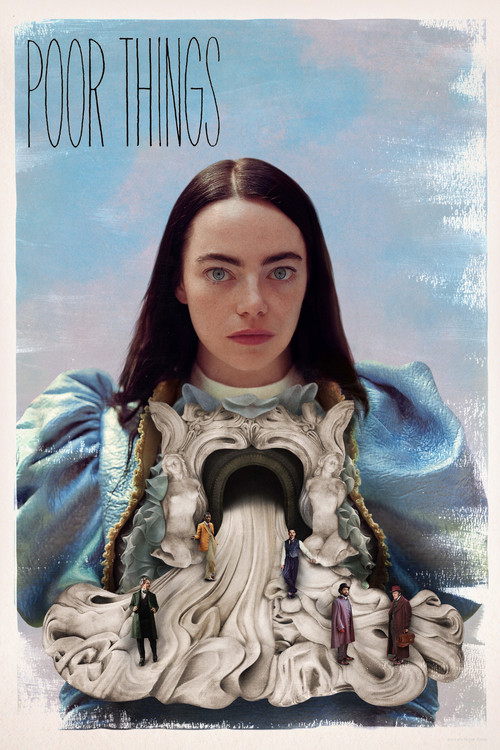
This film draws you in for a significant portion of its runtime with traditional or neutral content before springing its woke agenda. Know before you go!
NOT A WOKE TRAP. Poor Things is woke in the most transparent possible sense - a film whose feminist-liberation ideology is its entire premise, its marketing, and its awards narrative. Viewers were never misled. The film is exactly what it presents itself as: a surrealist feminist fable about a woman who discovers sexual pleasure, autonomy, philosophy, and socialism on a grand European journey, explicitly framed as liberation from patriarchal control. The trap, to the extent one exists, is cultural rather than individual - the film's Oscar sweep sends a signal about Hollywood's values that deserves scrutiny. But no family arrived expecting a Christmas movie and found an orgy. The content is exactly what the press coverage advertised.
⚠️ SPOILER ALERT: This review will contain detailed plot analysis and reveals key story elements including the film's ending.
Hollywood has always loved a metaphor. But rarely has the industry deployed one this nakedly, or this aggressively, and then handed it four Oscars. Poor Things is a film about a woman brought back to life with a baby's brain installed in her adult skull - and the film's central argument is that this, somehow, is what female liberation looks like. Bella Baxter doesn't know the rules of society because she literally cannot remember them. And Yorgos Lanthimos and screenwriter Tony McNamara treat this amnesia as a gift: she can discover sexuality, philosophy, and self-determination entirely unconstrained by the repressive Victorian world around her. The baby brain isn't a bug. It's the thesis.
What you're actually watching is a grown woman in a state of infantilized consciousness engaging in graphic, explicit sex - first for pleasure, then professionally as a sex worker - while the film frames every transaction as an act of feminist awakening. That this conceit won Best Actress at the Oscars, the Golden Globes, and the BAFTAs - and that the film itself won Best Picture at BAFTA - tells you everything you need to know about where Hollywood's values currently reside.
The film is visually extraordinary, narratively inventive, and performed with genuine commitment. It is also one of the most aggressively progressive films to sweep major awards in recent memory. These things are all simultaneously true. VirtueVigil will hold all of them in view.
In a heightened, fantastical version of Victorian London, medical student Max McCandles (Ramy Youssef) is recruited by the eccentric surgeon Dr. Godwin Baxter - "God," his friends call him - played with grotesque warmth by Willem Dafoe. Godwin's face is a map of surgical scars, his body the product of his own father's experiments. He has been conducting experiments of his own. Specifically: he found the body of a pregnant woman who jumped from Tower Bridge to her death, removed the fetal brain, and transplanted it into the mother's skull. The result is Bella Baxter (Emma Stone): a grown woman's body animated by an infant's developing mind.
Max is hired to observe Bella's development. He does, and promptly falls in love with her. Godwin - who insists he is a scientist, not a father, though the film treats him as both - encourages their engagement. But Bella, whose mind is growing rapidly, has other ideas. She discovers masturbation and sexual pleasure and, rather than wait for marriage, runs off to Lisbon with Duncan Wedderburn (Mark Ruffalo), a debauched lawyer whose every scene is a masterclass in rakish male ego. In Lisbon, they have near-constant sex because Bella has no framework for anything beyond physical sensation. She is, at this stage of the film, essentially a toddler with a libido.
As Bella's mind matures, she becomes more than Duncan can manage. He smuggles her onto a luxury cruise, where she befriends fellow passengers who introduce her to philosophy and political theory. Duncan sinks into gambling and drinking. In Alexandria, Bella witnesses devastating poverty for the first time and is emotionally destroyed by it - so much so that she hands Duncan's winnings to corrupt crew members who claim they'll distribute the money to the poor. Broke, Bella and Duncan wash up in Marseille and make their way to Paris, penniless. To support herself, Bella begins working at a brothel run by Madame Swiney (Kathryn Hunter). The film presents this choice as self-determined and fundamentally free. At the brothel, Bella befriends Toinette (Suzy Bemba), a fellow sex worker who introduces her to socialism. They become romantically involved.
Meanwhile, Godwin is dying. He summons Bella home through Max. Back in London, Bella reconciles with Godwin and agrees to marry Max - but the wedding is interrupted by the arrival of General Alfie Blessington (Christopher Abbott), who reveals that Bella's body belonged to his wife Victoria, who killed herself to escape him. Alfie plans to reclaim his "property." Bella goes with him briefly to understand her past, only to discover that Alfie is a sadistic, controlling monster who plans to have her clitoris surgically removed and to impregnate her against her will. When he produces a sedative and a gun, Bella throws the sedative in his face. He shoots himself in the foot. She escapes.
The film ends with Godwin dying peacefully surrounded by Bella and Max. In a darkly comic coda, Bella and Max transplant a goat's brain into Alfie's skull as poetic punishment for his planned cruelties. Alfie contentedly eats grass in the garden. Bella, Max, and Toinette begin their new life together in Godwin's house - a found family built outside the conventions of Victorian marriage, monogamy, or social propriety.
Trope Analysis - VVWS Weighted Scoring
Formula: Weighted Score = Severity × Authenticity Multiplier × Centrality Multiplier
Authenticity: High=0.7, Moderate=1.0, Low (injected/fabricated)=1.4 | Centrality: Low=0.5, Moderate=1.0, High=1.8
🔴 Woke Tropes
| Trope | Severity (1-5) | Authenticity | Centrality | Weighted Score |
|---|---|---|---|---|
| Female Sexual Liberation as Feminist Awakening (Central Thesis) | 5 | Low (1.4) | High (1.8) | 12.6 |
| Infantilized Woman Sexualized as Feminist Statement | 5 | Low (1.4) | High (1.8) | 12.6 |
| Men as Patriarchal Controllers and Antagonists | 4 | Moderate (1.0) | High (1.8) | 7.2 |
| Sex Work Framed as Empowering Self-Determination | 4 | Low (1.4) | Moderate (1.0) | 5.6 |
| Rejection of Traditional Marriage and Monogamy | 4 | Moderate (1.0) | Moderate (1.0) | 4.0 |
| Lesbianism/Bisexuality Normalized | 3 | Moderate (1.0) | Moderate (1.0) | 3.0 |
| Socialism Introduced as Intellectual Enlightenment | 3 | Moderate (1.0) | Low (0.5) | 1.5 |
| WOKE TOTAL | 46.5 |
🟢 Traditional Tropes
| Trope | Severity (1-5) | Authenticity | Centrality | Weighted Score |
|---|---|---|---|---|
| Self-Determination and Personal Sovereignty | 3 | High (0.7) | High (1.8) | 3.8 |
| Rejection of Abusive/Predatory Relationship | 4 | High (0.7) | Moderate (1.0) | 2.8 |
| Intellectual Curiosity and Pursuit of Knowledge | 3 | High (0.7) | Moderate (1.0) | 2.1 |
| Compassion for the Poor and Suffering | 2 | High (0.7) | Low (0.5) | 0.7 |
| TRAD TOTAL | 9.4 |
Score Margin: -38 WOKE
Woke Trap Assessment
✅ NOT A WOKE TRAP - This Film Announces Itself
Poor Things is not a woke trap. It is woke in the most transparent possible sense of the word - a film whose ideological commitments are tattooed on its skin in large, ornate Victorian lettering. The provocative premise alone - baby-brained woman navigates sexual liberation across Europe - is not the kind of thing that sneaks ideology past an unsuspecting audience. The Venetian Golden Lion, eleven Oscar nominations, and four wins all signaled exactly what kind of film this is to anyone paying attention.
The trap, to the extent one exists, is cultural rather than individual: Poor Things being celebrated as serious, important, and artistically significant sends a message to the next generation of filmmakers about what excellence looks like and what values deserve reward. That message is one-directional. But viewers who walked into a theater showing this film expecting something traditional or family-friendly had not done the minimum amount of research.
Informed adult viewers may engage freely, armed with the full context this review provides.
Creative Team at a Glance
- Director: Yorgos Lanthimos - Greek auteur of the "Weird Wave." Consistent progressive/anti-conformity framing across a decade of acclaimed English-language films. Predictably ideological. Undeniably talented.
- Writer: Tony McNamara - Australian playwright and TV creator (The Great, The Favourite). Has built a career on women who disrupt patriarchal power structures. Feminist framing is consistent across all major works.
- Lead Producer: Ed Guiney - Element Pictures (Ireland). Co-produced alongside Emma Stone's Fruit Tree banner. Emma Stone was also a producer on the film she starred in - institutional alignment between talent and message is complete.
- Distributor: Searchlight Pictures (Disney subsidiary)
- Top Cast: Emma Stone (Bella Baxter), Mark Ruffalo (Duncan Wedderburn), Willem Dafoe (Godwin Baxter), Ramy Youssef (Max McCandles), Christopher Abbott (Alfie Blessington)
- Pre-Viewing Prediction: WOKE - Lanthimos + McNamara + the premise was never ambiguous. Confirmed emphatically.
Director / Writer Ideological Track Record
Director: Yorgos Lanthimos
Yorgos Lanthimos is widely recognized as one of the most inventive filmmakers working today - a genuine auteur in the Greek "Weird Wave" tradition, whose work is defined by bizarre social rules, institutional power dynamics, and people struggling to resist systems of control. His films are never comfortable. They are rarely conservative.
Born in Athens in 1973, Lanthimos built his reputation in Greece with films like Dogtooth (2009), in which parents create an entirely false reality for their adult children, who have been raised in total isolation. The film is a grotesque portrait of authoritarian control and how it deforms the human beings subjected to it. The parallel to conservative social structures is not accidental.
His English-language career has amplified these themes with larger budgets and global recognition:
The Lobster (2015): In a dystopian society, single adults must find a romantic partner within 45 days or be transformed into an animal of their choosing. A ferocious satire of compulsory couplehood, social conformity, and the institutional pressure to organize human life around romantic partnership. The film's sympathies lie entirely with those who resist the system. Traditional institutions - particularly marriage - are presented as coercive rather than meaningful.
The Killing of a Sacred Deer (2017): A surgeon (Colin Farrell) must make an impossible moral choice after a disturbing young man begins to curse his family. The film is cold, clinical, and utterly unsentimental - a procedural in which the institutional competence of a successful man proves meaningless against forces he cannot control or explain. The patriarch is not celebrated; he is humiliated.
The Favourite (2018): Set in the court of Queen Anne (Olivia Colman), the film follows two women - Sarah Churchill (Rachel Weisz) and Abigail Masham (Emma Stone) - competing for the Queen's favor, which is both political power and physical intimacy. The lesbian relationship at the court's center is not incidental; it is the engine of all political intrigue. The film received 10 Oscar nominations and won one. Lanthimos and McNamara began their partnership here, with a film whose driving forces are women competing for female power through lesbian sexual dynamics.
Poor Things (2023): The logical endpoint of Lanthimos's trajectory. Sexual liberation, rejection of patriarchal control, and progressive politics aren't subtext in Poor Things - they're text. His most commercially successful film is also his most ideologically committed.
Pattern Assessment: Lanthimos does not make comfortable films for comfortable people. His consistent thematic interest is in how societies, institutions, and authority figures try to contain, control, and deform the humans under their power - and what it costs to resist. Whether that resistance takes the form of choosing animal transformation, murdering your way to court favor, or bedding your way across Europe with a baby's brain, the films celebrate those who refuse the box. The authority being rejected is invariably traditional, patriarchal, or institutional. The resistance is invariably transgressive, sexual, or socially marginal. This is not a coincidence. It is a worldview.
Ideological tendency: CONSISTENTLY PROGRESSIVE. Anti-authoritarian, anti-traditional, anti-patriarchal. Executed with extraordinary craft.
Writer: Tony McNamara
Tony McNamara is an Australian playwright, screenwriter, and television creator born in 1967, who has built one of the most distinctive careers in prestige content by consistently centering women who upend the systems designed to contain them - and doing it with more wit and less preachiness than most of his contemporaries.
His two major film collaborations with Lanthimos - The Favourite (2018) and Poor Things (2023) - share a structural DNA: a woman with limited conventional power finds ways to exercise unconventional power, usually through her sexuality, her intelligence, or both. In The Favourite, Abigail Masham claws her way from servant to courtier to royal intimate through ruthless social maneuvering. In Poor Things, Bella Baxter transcends every constraint placed on her - by biology, by marriage, by class, by Victorian propriety - through what the film frames as pure self-determination.
McNamara's television work underscores the pattern. The Great (2020-2023), his Hulu series, dramatizes Catherine the Great's rise to power in Russia with deliberate anachronism and dark comedy. The show's Catherine is explicitly feminist in modern terms - brilliant, sexually autonomous, perpetually underestimated, eventually triumphant. The men around her are largely obstacles, buffoons, or both.
McNamara's crucial narrative choice in adapting Alasdair Gray's 1992 novel was to reframe the story from Bella's perspective and to ensure, as he put it in interviews, that "the men, instead of controlling the narrative, will attempt to control her and fail dismally." He deliberately moved the story away from Gray's Scottish nationalist political allegory and toward what he understood as a feminist liberation narrative. The political framing he chose, rather than the one available, tells you everything about where his sympathies reside.
Ideological tendency: PROGRESSIVE-FEMINIST. Consistent. Sophisticated. Far more dangerous to unguarded audiences than a blunt ideologue precisely because his wit makes the medicine go down easily.
Adult Viewer Insight
Conservative adults who choose to watch Poor Things - and we don't suggest you avoid it, just that you arrive informed - should come equipped with some clarity about what they're actually watching.
The film is a masterwork of technical filmmaking. Robbie Ryan's cinematography - alternating between fisheye distorted widescreen and intimate standard ratios - is extraordinary. The production design of Shona Heath and James Price creates a genuinely surreal Victorian world that feels completely its own. Emma Stone's performance is a legitimate artistic achievement: tracking Bella's developmental arc from gurgling infant-consciousness through adolescent curiosity to full intellectual maturity without ever breaking the internal logic of a woman who learned everything fresh. The craft is real and deserves acknowledgment. Pretending otherwise would be dishonest, and dishonesty is not VirtueVigil's business.
What is equally real and equally deserving of clear-eyed acknowledgment: the film's central thesis is that female liberation is inseparable from sexual liberation - specifically, from the ability to pursue sexual pleasure, sex work, and non-monogamous relationships entirely free of guilt, shame, or social consequence. This isn't buried subtext. It's the explicit argument of every major narrative beat in the film.
There are genuinely traditional themes worth noting. Bella's pursuit of self-determination is a real value that doesn't belong exclusively to any political camp. Her escape from Alfie - a monster who planned surgical mutilation and forced pregnancy - is presented in terms any conservative can endorse: no one should have their bodily autonomy violated by a controlling abuser. Her intellectual curiosity, her growing empathy for the poor, her ultimate rejection of both the passive role Godwin designed for her and the controlling role Alfie demanded - these reflect real human dignity.
But here's the honest tension: the film's answer to the question of what a woman's self-determination looks like is, unambiguously and almost entirely, sex. Multiple explicit partners. Paid sex work. Lesbian relationship. Non-monogamous household. The film's version of Bella's journey from infant to fully realized human being is measured almost entirely in sexual experience. That the film won four Oscars for this specific version of female development - rather than, say, her intellectual awakening, her compassion for the suffering, or her courage in escaping genuine abuse - tells a story about Hollywood values that is worth sitting with.
One more thread worth pulling: the film raises, then evades, an uncomfortable question. A baby's mind in an adult body having graphic sex - is this feminist or is this something darker? The film insists it's feminist because Bella always consents and always chooses. But Bella cannot consent in any meaningful sense early in the film, precisely because she has an infant's cognitive framework. The film resolves this by having her mind develop rapidly and by treating her later choices as retroactively legitimizing earlier ones. Mick LaSalle of the San Francisco Chronicle put the critique bluntly in a widely-shared review: "It purports to be a feminist document, but it defines a woman's autonomy as the ability to be exploited and not care." That critique is fair and the film doesn't fully answer it.
Adult viewers who engage with Poor Things critically, rather than passively, will find a genuinely rich text - one whose tensions are at least partially productive. Those who watch uncritically will absorb a tightly packaged argument about sex, liberation, and what it means to be a free woman. Know which experience you're having.
Parental Guidance
⛔ NOT APPROPRIATE FOR ANY MINORS. NOT APPROPRIATE FOR TEENAGERS. EXPLICIT SEXUAL CONTENT THROUGHOUT.
Let us be completely unambiguous before the categories: Poor Things is one of the most sexually explicit films to receive wide theatrical release and major award recognition in modern Oscar history. This is not a film with a few suggestive scenes. Sexual content is constant, central, graphic, and deliberately provocative from approximately the thirty-minute mark through the final act. There is no "fast-forward through the bad parts" solution. The sexual content is the film.
MPAA Rating: R - for "strong and pervasive sexual content, graphic nudity, disturbing material, gore, and language." The word "pervasive" in that rating is doing important work.
Sexual Content - SEVERE:
- Multiple fully explicit sex scenes between Bella and Duncan Wedderburn, including extended sequences. These are not fade-to-black or implied. They are graphically depicted.
- Bella works as a sex worker in a Paris brothel across multiple scenes. Her clients are depicted. The transactions are depicted.
- An orgy sequence at the brothel is depicted.
- Bella explicitly masturbates in scenes early in the film, presented as her "discovery" of sexual pleasure.
- Bella and Toinette (a fellow sex worker) have a sexual relationship, depicted explicitly.
- Full-frontal female nudity is pervasive throughout the film. Male nudity also appears.
- Emma Stone's body double and Stone herself appear nude in numerous scenes.
- The film includes fetish content.
- Alfie Blessington threatens to have Bella's clitoris surgically removed (female genital mutilation) and to forcibly impregnate her - disturbing content even if not depicted.
Violence - MODERATE:
- Alfie is shot in the foot (accidental self-inflicted). Brief blood visible.
- In the darkly comic finale, a goat's brain is surgically transplanted into Alfie's skull. The surgery is not graphically depicted but the concept and result are shown.
- Willem Dafoe's character (Godwin) has an extensively scarred face and body from his father's surgical experiments - presented as normal within the film's visual world but potentially disturbing.
- Bella's backstory involves suicide by jumping from a bridge.
- Depictions of desperate poverty in Alexandria.
Language - MODERATE:
- Crude sexual language throughout. The f-word appears regularly. Sexual terms used explicitly in context.
- Period-appropriate language that may include racial terminology consistent with Victorian-era speech patterns.
Substance Use:
- Duncan Wedderburn drinks heavily across much of the film, depicted as both character flaw and comedy.
- Absinthe and period-appropriate alcohol consumption throughout.
- A character is given a sedative against their will (the attempt is foiled).
Ideological Content for Parental Awareness:
- Sexual liberation is explicitly equated with female liberation - this is the film's sustained argument.
- Socialism is introduced as an intellectual awakening and presented approvingly.
- Traditional marriage is presented as a patriarchal trap throughout.
- The film's conclusion is a non-monogamous household presented as the ideal arrangement.
- Victorian Christianity and social mores are uniformly portrayed as repressive and hypocritical.
Age Recommendation: ADULTS ONLY. No minors of any age.
This is not a close call. Poor Things contains more explicit sexual content than most mainstream films classified as adult entertainment. The fact that it was a prestige Oscar film rather than genre content does not change what is on screen. Parents who allow teenagers to watch this film - believing "it won Best Actress, it must be fine" - will find that Oscar recognition has no correlation with content appropriateness. In this case, it has an inverse correlation.
For adults who have watched the film and wish to discuss its themes with older teenagers (17+) in a guided context: the most productive conversations will center on the film's equating of sexual experience with self-knowledge, the question of whether Bella's "choices" early in the film are genuinely autonomous, and whether the film's vision of liberation is complete or reductive. These are real intellectual questions. The film raises them, even if its answers are predictable.
Review by VirtueVigil Editorial Team | February 18, 2026
Poor Things (2023) | Dir. Yorgos Lanthimos | Searchlight Pictures
VVWS Score: WOKE -38 | authIndex: 78
Formula: Weighted Score = Severity × Authenticity Multiplier × Centrality Multiplier
🔴 Woke Tropes
| Trope | Severity | Authenticity | Centrality | Score |
|---|---|---|---|---|
| Female Sexual Liberation as Feminist Awakening | 5 | Low | High | 12.6 |
| Infantilized Woman Sexualized as Feminist Statement | 5 | Low | High | 12.6 |
| Men as Patriarchal Controllers and Antagonists | 4 | Moderate | High | 7.2 |
| Sex Work Framed as Empowering Self-Determination | 4 | Low | Moderate | 5.6 |
| Rejection of Traditional Marriage and Monogamy | 4 | Moderate | Moderate | 4 |
| Lesbianism and Bisexuality Normalized | 3 | Moderate | Moderate | 3 |
| Socialism Introduced as Intellectual Enlightenment | 3 | Moderate | Low | 1.5 |
| TOTAL WOKE | 46.5 | |||
🟢 Traditional Tropes
| Trope | Severity | Authenticity | Centrality | Score |
|---|---|---|---|---|
| Self-Determination and Personal Sovereignty | 3 | High | High | 3.78 |
| Rejection of Abusive and Predatory Relationship | 4 | High | Moderate | 2.8 |
| Intellectual Curiosity and Pursuit of Knowledge | 3 | High | Moderate | 2.1 |
| Compassion for the Poor and Suffering | 2 | High | Low | 0.7 |
| TOTAL TRADITIONAL | 9.4 | |||
Score Margin: -38 WOKE
Director: Yorgos Lanthimos
CONSISTENTLY PROGRESSIVE - anti-authoritarian, anti-patriarchal, anti-conformity across entire career. Executed with extraordinary craft.Greek auteur of the 'Weird Wave' tradition, born 1973, whose entire filmography is organized around people trapped inside systems of control and the cost of resistance. The Lobster (2015) satirizes compulsory couplehood and social conformity with dystopian precision. The Killing of a Sacred Deer (2017) humiliates the competent patriarch. The Favourite (2018) centers lesbian court intrigue and female power dynamics in Queen Anne's court. Poor Things (2023) is the logical endpoint: sexual liberation, socialism, and the wholesale rejection of Victorian patriarchy, presented as the definition of female selfhood. His target is always authority. His sympathies are always with those who transgress. His craft is genuine and his ideology is consistent - both deserve acknowledgment.
Writer: Tony McNamara
Australian playwright, screenwriter, and television creator (born 1967) who has built a career on women who disrupt patriarchal systems - with more wit and less sanctimony than most of his contemporaries. His two Lanthimos collaborations (The Favourite, Poor Things) share DNA: a woman with limited conventional power exercises unconventional power through sexuality, intelligence, or both. His television work (The Great, 2020-2023) dramatizes Catherine the Great as an explicitly modern feminist who repeatedly outmaneuvers the men around her. His crucial creative choice in adapting Alasdair Gray's 1992 novel was to reframe the story through Bella's perspective and ensure that 'the men will attempt to control her and fail dismally.' He deliberately moved the story away from Gray's Scottish nationalist political allegory and toward a feminist liberation narrative. The substitution was deliberate and complete.
Adult Viewer Insight
Conservative adults who choose to watch Poor Things should arrive fully informed. The craft is genuine - Emma Stone's performance, Robbie Ryan's extraordinary cinematography, and the film's surrealist Victorian production design are legitimate artistic achievements. There are also traditionally resonant elements: Bella's intellectual curiosity, her righteous escape from the monstrous Alfie, her personal sovereignty. But the film's answer to what female selfhood looks like is, without ambiguity, almost entirely sexual - every developmental milestone is measured in sexual experience. The film won four Oscars for this specific vision of liberation. That tells a story about Hollywood values worth sitting with. The film also raises and evades an uncomfortable question: a baby's mind in an adult body engaging in graphic sex - is this feminist, or something darker? Critic Mick LaSalle put it plainly: it defines a woman's autonomy as the ability to be exploited and not care. That critique is fair and the film doesn't fully answer it. Watch with eyes open.
Parental Guidance
NOT APPROPRIATE FOR ANY MINORS. EXPLICIT SEXUAL CONTENT THROUGHOUT. Poor Things is one of the most sexually explicit films to receive wide theatrical release and major award recognition in modern Oscar history. Rated R for strong and PERVASIVE sexual content, graphic nudity, disturbing material, gore, and language. Content includes: multiple fully explicit sex scenes; prostitution sequences with clients depicted; an orgy sequence; explicit masturbation scenes; a lesbian sexual relationship explicitly depicted; pervasive full-frontal nudity; fetish content; a threat of female genital mutilation; a threat of forced pregnancy; suicide backstory; grotesque surgical scarring depicted throughout. Ideological content includes sustained equation of sexual liberation with female liberation, socialism presented as enlightenment, traditional marriage uniformly presented as patriarchal oppression, and a non-monogamous household as the film's ideal conclusion. Age recommendation: ADULTS ONLY. No minors of any age. The film's Oscar status (4 wins including Best Actress) has no bearing on content appropriateness.
Find Poor Things on Amazon Prime Video, rent, or buy:
▶ Stream or Buy on AmazonAs an Amazon Associate, VirtueVigil earns from qualifying purchases.

Community Discussion 0
Subscribe to comment.
Join the VirtueVigil community to share your perspective on this review.