
Queer
Daniel Craig gives the best performance of his career in a film that probably should not work as well as it does.
Full analysis below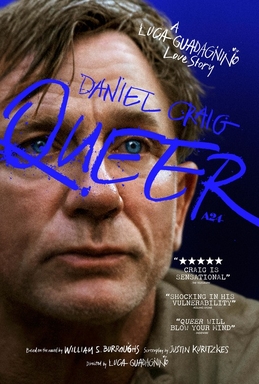
This film draws you in for a significant portion of its runtime with traditional or neutral content before springing its woke agenda. Know before you go!
Not a woke trap. Queer announces its subject matter in its title, its promotional materials, and every frame of its 137-minute runtime. Luca Guadagnino's adaptation of William S. Burroughs' novella is a film about a gay expatriate's obsessive, drug-fueled pursuit of a younger man in 1950s Mexico City. The title is not a bait and switch. A24's marketing made no attempt to position this as mainstream entertainment. Conservative audiences who see this film have actively sought it out, most likely out of curiosity about whether a film this celebrated by critics deserves the attention. The answer, for what it is worth, is complicated.
Daniel Craig gives the best performance of his career in a film that probably should not work as well as it does.
Queer is an adaptation of William S. Burroughs' autobiographical novella about his time in 1950s Mexico City, where he lived as an American expatriate, drank heavily, used heroin, and fell obsessively in love with a young GI named Allerton who did not love him back in the same way. Burroughs wrote the novella in the early 1950s and it was not published until 1985, after his reputation was established enough to publish something this nakedly personal. The story is about addiction, longing, and the particular hell of being in love with someone who finds your desire inconvenient rather than reciprocated.
Craig's William Lee is a man hollowed out by desire. He orbits Allerton (Drew Starkey, revelatory in a performance of calibrated emotional withholding) like a satellite that cannot achieve escape velocity. The scenes between them have the uncomfortable authenticity of real unequal wanting. Lee is fifty. Allerton is twenty-something. Lee wants everything. Allerton offers access but not connection, physical proximity but not presence.
Luca Guadagnino makes this material visually extraordinary. The 1950s Mexico City setting is rendered with a mix of actual location shooting and deliberate artificiality that is initially disorienting and eventually hypnotic. When the film shifts to its hallucinatory third chapter in the Amazon jungle, where Lee and Allerton search for a drug called Yage that supposedly grants telepathic connection, the formal choices become fully surreal. This section divides audiences sharply. It is either the film's most honest expression of its themes or a self-indulgent spiral. I find it the former.
The film's ideology is its subject matter and its subject matter is its ideology. Queer is not a political film in the conventional sense. It does not make arguments about policy or social structure. What it does is insist, with Guadagnino's full formal intelligence, that gay desire is as consuming, as valid, as worthy of cinematic treatment as any other form of human longing. This is not a message film. It is a film about specific people in a specific place feeling specific things.
That said, the score here reflects the reality that VirtueVigil's audience is primarily conservative, and conservative audiences have specific and legitimate reasons for approaching this material cautiously. The film contains graphic male homosexual content. The Burroughs persona is deeply transgressive. Drug use is depicted repeatedly and without moral condemnation. The film does not offer a critique of the lifestyle it portrays. It offers empathy for the loneliness underneath it.
Trent Reznor and Atticus Ross's score is exceptional, layering period-appropriate music (Nirvana, Sinead O'Connor, Prince used anachronistically in a choice that is either brilliant or irritating depending on your tolerance for Guadagnino's willful formal games) with original compositions that create the dream-memory texture the director is after.
For VirtueVigil readers: this is a WOKE film because its subject is LGBTQ identity treated as uncomplicated human good and because it was made by a director with a consistent ideological commitment to that framing. The craft is real, Craig is extraordinary, and the film earns its critical reputation. Whether any of that matters to conservative audiences depends on whether the craft can be separated from the content, and for most of our readers it cannot.
Formula: Weighted Score = Severity × Authenticity Multiplier × Centrality Multiplier
🔴 Woke Tropes
| Trope | Severity | Authenticity | Centrality | Score |
|---|---|---|---|---|
| Gay Desire as Primary, Uncomplicated Human Good | 5 | 0.7 | 1.8 | 6.3 |
| Drug Use Depicted Without Moral Condemnation | 4 | 0.7 | 1 | 2.8 |
| Conservative Era / Society as Cage for Authentic Identity | 4 | 0.7 | 1 | 2.8 |
| Non-Traditional Relationship Structures Normalized | 3 | 0.7 | 1 | 2.1 |
| Transgressive Counter-Cultural Figure as Hero | 3 | 0.7 | 1 | 2.1 |
| Explicit Male Homosexual Sex | 4 | 0.7 | 0.5 | 1.4 |
| TOTAL WOKE | 17.5 | |||
🟢 Traditional Tropes
| Trope | Severity | Authenticity | Centrality | Score |
|---|---|---|---|---|
| Unrequited Love as Consuming Tragedy | 4 | 0.7 | 1 | 2.8 |
| The Impossibility of Perfect Connection | 4 | 0.7 | 0.5 | 1.4 |
| TOTAL TRADITIONAL | 4.2 | |||
Score Margin: -13 WOKE
Director: Luca Guadagnino
WOKELuca Guadagnino is one of contemporary cinema's most formally gifted directors and one of its most consistent advocates for gay desire as primary subject matter. Call Me by Your Name (2017), Bones and All (2022), and Challengers (2024) all center desire as a consuming, identity-defining force. Queer is the most extreme version of this project to date. Guadagnino's aesthetic is unambiguously beautiful and his formal choices are consistently intelligent. The ideology is equally unambiguous: desire, particularly queer desire, is the most honest and important force in human experience. Conservative viewers should enter his films knowing this.
Writer: Justin Kuritzkes
Justin Kuritzkes also wrote Guadagnino's Challengers (2024), which was a film about desire, competition, and the way sexual attraction can outlast every other human bond. Queer is a more demanding project: Burroughs' source novella is fragmentary, autobiographical, and deliberately anti-narrative. Kuritzkes structures the film as three chapters plus an epilogue and makes the adaptation more emotionally coherent than the source material while preserving its dreamlike discontinuity. The screenplay is a serious piece of craft. Its ideology is an extension of Guadagnino's project: gay longing as universal human experience, isolation as the price of hiding desire.
Producers
- Lorenzo Mieli (The Apartment Pictures) — Italian producer with extensive European prestige film credits. His partnership with Guadagnino is ongoing and reflects a shared commitment to formally ambitious, adult-oriented cinema. No independent ideological profile beyond the collaboration.
- Luca Guadagnino (Frenesy Film Company) — Director-producer whose ideological profile is detailed above. Full creative control reflects in the film's uncompromising formal and thematic choices.
Full Cast
Adult Viewer Insight
William S. Burroughs was a genuinely complex figure in American cultural history and Queer is a film that takes that complexity seriously without endorsing it. Burroughs accidentally shot and killed his wife Joan Vollmer in 1951 in Mexico City, a year before the events depicted in this film. The film does not address this. Burroughs himself wrote about the incident obsessively for the rest of his life, saying it propelled his entire literary output. The absence of that context from a film that otherwise commits to biographical specificity is a choice that protects the film's sympathetic framing of Lee. Conservative audiences should be aware of it. The drug use in Queer is rendered without moral condemnation. Lee's heroin use is not presented as a problem to be solved or a moral failure to be judged. It is presented as part of his texture, as much an expression of his character as his wit or his loneliness. This is a consistent Burroughs-influenced aesthetic position: addiction is a condition, not a choice, and the addict's experience is as worthy of literary treatment as any other. Conservative audiences who believe drug use carries moral weight will find this framing troubling. The telepathy / Yage sequence in the Amazon is the film's most philosophically interesting section. Lee's pursuit of a drug that would allow him to feel what Allerton feels is the desperate act of a man who cannot accept that another person's interiority is genuinely separate from his own. The horror of the sequence is not the psychedelic imagery but the revelation it contains: even if Lee could get inside Allerton's head, Allerton is not who Lee imagined him to be. The fantasy of perfect connection turns out to contain its own emptiness. This is a traditional observation about desire dressed in very non-traditional clothing. For adult conservative viewers who can engage with formal cinema on its own terms, the Craig performance alone justifies attention. For everyone else, the rating and content are genuinely challenging and the film does not mitigate them.
Parental Guidance
Queer is rated R. Sexual Content: Graphic male homosexual sex scenes. Not merely suggestive. Explicit content throughout. Violence: Limited. One scene of significant disturbing imagery in the hallucinatory third act. Language: Strong throughout, consistent with the period and Burroughs' persona. Substance Use: Heroin use depicted repeatedly and without condemnation. Other drug use in the Amazon sequence. Thematic Weight: Obsessive desire, addiction, loneliness, identity, death, and the impossibility of perfect connection. Heavy adult themes throughout. Age Recommendation: Adults only. 18+ minimum. Explicit sexual content makes this inappropriate for younger viewers under any circumstances. Discussion Points: Does the film present drug addiction as neutral or positive? What does Lee's search for telepathic connection through Yage say about his relationship with Allerton? Is the film's anachronistic music choices (Nirvana, Prince) a distraction or a formal statement?
Find Queer on Amazon Prime Video, rent, or buy:
▶ Stream or Buy on AmazonAs an Amazon Associate, VirtueVigil earns from qualifying purchases.
Community Discussion 0
Subscribe to comment.
Join the VirtueVigil community to share your perspective on this review.