
Spider-Man: No Way Home
Spider-Man: No Way Home is not just the best Spider-Man film ever made. It is one of the most emotionally devastating blockbusters of the decade, and it earned every tear.
Full analysis below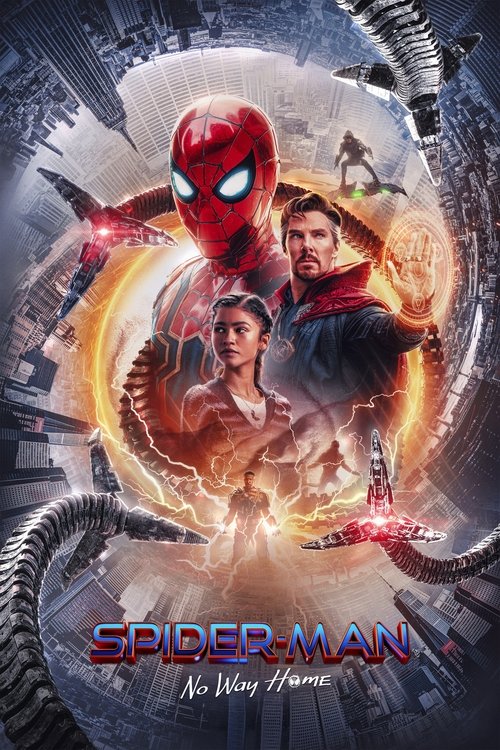
NOT A WOKE TRAP. Spider-Man: No Way Home is exactly what it advertises and more. It is a crowd-pleasing superhero spectacular that delivers genuine emotional weight alongside its fan-service fireworks. Conservative audiences have nothing to fear here. The film is built on the most traditional values in the Marvel canon: responsibility, sacrifice, and choosing to do the right thing even when it costs you everything. The only element that might raise an eyebrow is a brief reference to immigration status for one of the villains, which functions as a minor character detail rather than a political lecture. This is one of the most family-friendly and value-affirming films in the entire MCU. Go without reservation.
Spider-Man: No Way Home is not just the best Spider-Man film ever made. It is one of the most emotionally devastating blockbusters of the decade, and it earned every tear.
Jon Watts and writers McKenna and Sommers faced an impossible task: take a film already crammed with five returning villains from two legacy franchises, add two beloved actors making their first MCU appearances, satisfy the most demanding fanbase in cinema, and somehow make a movie that holds together emotionally. They pulled it off. Not by the skin of their teeth either. They pulled it off completely, with enough craft and nerve to make the ending gut-punch feel earned rather than manipulative.
The film opens at a sprint. Mysterio's posthumous reveal of Peter Parker's identity has detonated his life: his college applications are rejected, MJ and Ned are collateral damage, and the media has turned a teenage kid into a public villain. Peter asks Doctor Strange to make everyone forget he is Spider-Man. Strange, being Strange, attempts this before fully thinking through the parameters. The spell cracks the multiverse open and pulls in every villain who knew Spider-Man's secret identity from across the alternate Spidey universes.
This is either brilliant or insane as a premise, and the film knows it. It leans into the absurdity just enough to disarm criticism, then pivots to genuine character work. The scene where Willem Dafoe's Norman Osborn first appears in the lobby of the Department of Damage Control is the film finding its footing. Dafoe is doing something real here. Norman Osborn is genuinely broken: a good man trapped in a fractured psyche with a murderous split personality. Dafoe plays both halves with terrifying precision. His performance is the best villain work in the entire MCU post-Thanos.
The film's moral thesis arrives halfway through, delivered by Aunt May in a moment that hits harder in retrospect: 'With great power comes great responsibility.' May dies ten minutes later, killed by the Goblin, and Peter is left with that sentence echoing. It is not a new idea. It is the oldest idea in the Spider-Man canon. But No Way Home earns it by making it cost something real.
The arrival of Andrew Garfield and Tobey Maguire is the sequence audiences waited three years to see. It does not disappoint. The genius of the scene is how quiet it is: three men in the same suit, in the same attic, comparing notes on grief and loss. Tobey's Peter has found peace. Andrew's Peter is still carrying the wound of Gwen Stacy's death. Tom's Peter is in the middle of his worst night. The exchange is warm, funny, and quietly devastating. Garfield's moment, where he catches MJ's fall in a direct callback to his failure to save Gwen, is the emotional peak of the film. He needed that, and so did the audience.
The climax is spectacular in both senses: genuinely impressive visual filmmaking and emotionally overwhelming. But the ending is where the film separates itself from every other superhero movie of the last decade. Peter Parker gives up everything. Everyone who knew him and loved him forgets he exists. He walks away from his relationships, his college future, and any claim to the support system Tony Stark built around him. He does this because it is the only way to protect the people he loves. He does not get to keep anything.
This is not a triumph. It is a sacrifice. And it is absolutely the right ending.
Modern superhero cinema is addicted to the triumphant finish: the hero wins, gets the girl, saves the world, and everyone claps. No Way Home is the rare exception. It ends in loss, and it asks the audience to sit with that loss without offering easy comfort. Peter Parker ends the film alone, in a tiny apartment, ordering a GED workbook. That is the most traditional hero's ending imaginable: the good man who paid the price and kept going anyway.
This is Spider-Man at his core, distilled. And it is extraordinary.
Formula: Weighted Score = Severity × Authenticity Multiplier × Centrality Multiplier
🔴 Woke Tropes
| Trope | Severity | Authenticity | Centrality | Score |
|---|---|---|---|---|
| Race-Swapped Core Characters | 2 | 1 | 1 | 2 |
| Multiverse Black Spider-Man Reference | 2 | 1 | 0.5 | 1 |
| Immigration Status Reference | 1 | 1 | 0.5 | 0.5 |
| TOTAL WOKE | 3.5 | |||
🟢 Traditional Tropes
| Trope | Severity | Authenticity | Centrality | Score |
|---|---|---|---|---|
| Great Power, Great Responsibility | 5 | 0.7 | 1.8 | 6.3 |
| Total Self-Sacrifice Ending | 5 | 0.7 | 1.8 | 6.3 |
| Redemption Offered to the Villainous | 4 | 0.7 | 1 | 2.8 |
| Grief Carried with Dignity | 4 | 0.7 | 1 | 2.8 |
| Maternal Love as Moral Anchor | 4 | 0.7 | 1 | 2.8 |
| Starting Over with Integrity | 3 | 0.7 | 0.5 | 1.05 |
| TOTAL TRADITIONAL | 22.1 | |||
Score Margin: +19 TRAD
Director: Jon Watts
MAINSTREAM. Jon Watts is a competent, politically unobtrusive blockbuster director whose previous credits include Cop Car (2015) and the two earlier MCU Spider-Man films. He has no public ideological profile and no evident agenda in his filmmaking. He makes crowd-pleasing mainstream films with professionalism and technical skill. His Spider-Man trilogy is notable for avoiding the identity-politics messaging that has plagued other MCU properties. He simply tells the story.Jon Watts built his career in indie thriller filmmaking before Marvel hired him for Homecoming. He has since become one of the most commercially successful directors in the superhero space, with his three Spider-Man films collectively grossing over $4 billion worldwide. No Way Home, at $1.9 billion globally, became the sixth-highest-grossing film of all time and the highest-grossing film of the pandemic era. Watts' primary gift is pacing: he knows how to balance humor, action, and emotion without letting any element overwhelm the others. His work is technically excellent without being showy.
Writer: Chris McKenna, Erik Sommers
McKenna and Sommers are the writing team responsible for all three Watts Spider-Man films, plus Ant-Man and the Wasp. Their screenplay for No Way Home is their career best: structurally ambitious (managing three parallel Peter Parkers plus a multiverse's worth of villains), emotionally precise, and disciplined enough to subordinate the spectacle to the character moments that actually matter. The Aunt May death scene and Peter's final goodbye to MJ and Ned are written with genuine craft. These are craftsmen who understand that spectacle only means something if you care about the characters in it.
Adult Viewer Insight
Parental Guidance
Find Spider-Man: No Way Home on Amazon Prime Video, rent, or buy:
▶ Stream or Buy on AmazonAs an Amazon Associate, VirtueVigil earns from qualifying purchases.
Community Discussion 0
Subscribe to comment.
Join the VirtueVigil community to share your perspective on this review.