
Tenet
Tenet is the easiest film on this list to analyze from a conservative perspective: it has essentially no ideology.…
Full analysis below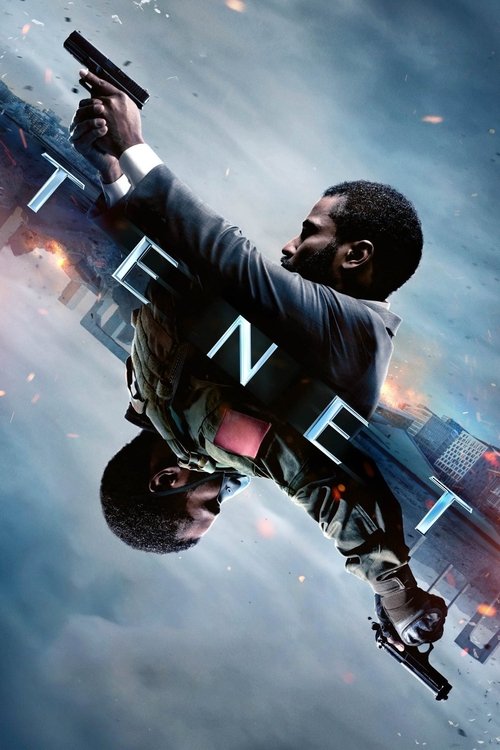
Not remotely a woke trap. Tenet is a Christopher Nolan spy thriller with a Black male protagonist, a story about saving the world from a Russian oligarch, and nearly zero political ideology. Nolan is one of the most politically agnostic major directors in Hollywood. His films have no progressive agenda. The film's concerns are entirely narrative and philosophical: time, identity, sacrifice, and the nature of free will. Conservative audiences can watch without concern.
Tenet is the easiest film on this list to analyze from a conservative perspective: it has essentially no ideology. Christopher Nolan is one of the most politically agnostic directors working at his budget level, and Tenet is his most purely mechanical film, almost entirely concerned with its own time-reversal concept at the expense of character and politics both.
The premise: a CIA operative known only as 'the Protagonist' (John David Washington) discovers a technology called 'inversion' that allows objects and people to move backward through time relative to the normal flow. He is recruited into a secret organization called Tenet to prevent Andrei Sator (Kenneth Branagh), a Russian oligarch, from triggering an algorithm that the future is using to destroy the past. The Protagonist must stop this not just for his own survival but for the survival of everyone who has ever lived.
This is a conservative premise at its core. The mission is to save civilization. The cost is personal: the Protagonist learns at the film's conclusion that Neil (Robert Pattinson) has been his friend and his operator for his entire mission, and that Neil is going backward through time to a death he has already chosen for the Protagonist's sake. The film's emotional resolution is about sacrifice: men choosing to give their lives for each other and for a world they will not live to enjoy.
Nolan's films consistently return to certain preoccupations: identity, time, memory, and the gap between what a person knows and what they can know. Memento, Inception, Interstellar, and Tenet all feature protagonists whose understanding of their own situation is fundamentally incomplete. In Tenet, the Protagonist does not even have a name. He is defined entirely by function: he is the person who saves the world. His interior life is largely inaccessible. This is a traditional heroic archetype: the soldier who suppresses personal identity in service of mission.
John David Washington's performance is the film's most underappreciated element. Washington plays the Protagonist with cool, contained intelligence: this is a man who processes information under pressure and acts without the self-doubt that Nolan's protagonists usually wear on their faces. He is more Connery-era Bond than Nolan-era Bruce Wayne, which suits the film's spy thriller genre. The performance does not get the credit it deserves partly because the film's mechanics leave little room for conventional character moments.
Robert Pattinson as Neil is the film's secret weapon. Pattinson plays Neil as a man who is entirely comfortable with his own situation in ways the Protagonist cannot understand, because Neil already knows how the story ends. His lightness, his perpetual slight smile, and his willingness to die for the Protagonist without explanation or complaint make Neil one of Nolan's most moving characters. The reveal at the end that Neil has been moving backward through the entire film, arranging his own death for the Protagonist's benefit, reframes every scene he is in and rewards immediate rewatching.
Kenneth Branagh's Sator is the film's weakest element. He is playing a Russian oligarch as a domestic abuser with apocalyptic nihilism: if I can't live, nobody does. This is thin villainy by Nolan standards. His Russian-accented performance is theatrical in ways that do not serve the film. The domestic violence subplot (Sator uses Kat as a trophy and weapon) gives Elizabeth Debicki little to do for most of the film beyond being endangered and rescued.
The action sequences are among the most technically complex ever filmed. The inversion mechanic, where people and objects move backward through time while others move forward, creates combat and chase sequences that have never been seen before. The Oslo airport sequence (a Boeing 747 crashes into a hangar while inverted figures fight forward-moving guards) is genuinely unprecedented. The Stalsk-12 climax is a massive practical set piece that runs simultaneously forward and backward in time.
Whether the film works as entertainment depends on whether you can tolerate the cognitive demand it places on viewers. Nolan's sound mixing decisions, which prioritized certain effects frequencies over dialogue clarity, generated genuine controversy: many viewers could not follow the plot because they could not hear the exposition. This is a craft failure that is separate from the film's ambition and is worth acknowledging.
For conservative viewers: Tenet is a safe watch. There is no progressive ideology, no identity politics, no social justice messaging. The protagonist is a Black man, which some on the right found noteworthy and some on the left used to project progressive intent onto the film. Nolan has confirmed that Washington was simply the best actor for the role. The film is not about race. It is not about anything political. It is about time and sacrifice.
The traditional score is strong because the film's moral framework is classically heroic: duty over self, sacrifice for others without guarantee of recognition, and men who choose to die for each other and for a world they will not live to see saved. These are ancient values in a sci-fi wrapper.
Formula: Weighted Score = Severity × Authenticity Multiplier × Centrality Multiplier
🔴 Woke Tropes
| Trope | Severity | Authenticity | Centrality | Score |
|---|---|---|---|---|
| Domestic Violence / Women in Peril Subplot | 2 | 1 | 0.5 | 1 |
| Future Generations / Ecological Villain Motivation | 1 | 1 | 0.5 | 0.5 |
| TOTAL WOKE | 1.5 | |||
🟢 Traditional Tropes
| Trope | Severity | Authenticity | Centrality | Score |
|---|---|---|---|---|
| Male Heroism and Sacrifice for Civilization | 4 | 0.7 | 1.8 | 5.04 |
| Duty to Protect Civilization Over Personal Interest | 4 | 0.7 | 1.8 | 5.04 |
| Brotherhood and Trust Between Men | 3 | 0.7 | 1 | 2.1 |
| Individual Excellence and Mastery | 3 | 1 | 1 | 3 |
| Self-Sacrifice: Protagonist Accepts Mission Without Guarantee | 3 | 0.7 | 0.5 | 1.05 |
| Protecting a Mother and Child | 2 | 1 | 0.5 | 1 |
| TOTAL TRADITIONAL | 17.2 | |||
Score Margin: +16 TRAD
Director: Christopher Nolan
APOLITICAL to CENTER. Nolan is among the most politically agnostic major directors in Hollywood. His films (Memento, The Dark Knight trilogy, Inception, Interstellar, Dunkirk, Oppenheimer) are ideologically diverse in their concerns but consistently avoid identity politics, social justice messaging, and progressive framing. The Dark Knight has been read as conservative (law and order, surveillance as necessary evil) by some and as liberal (civil liberties, overreach) by others. Nolan makes films about ideas, not about political sides. His personal politics are unknown and he has consistently avoided public political positions.Christopher Nolan is among the most technically ambitious and commercially successful directors working. His collaboration with cinematographer Hoyte van Hoytema and practical effects supervisor Scott Fisher produces films that use real locations, practical camera work, and physical effects to an unusual degree for big-budget filmmaking. Tenet was a personal passion project: Nolan had been developing the time-reversal concept for over a decade. He insisted on a theatrical release in 2020, becoming the first director to lead the reopening of major theaters during the COVID-19 pandemic, a decision that had significant implications for the film's commercial performance and for the industry's recovery.
Adult Viewer Insight
Conservative adults who enjoy demanding action films will find Tenet rewarding if they are patient with its complexity. Nolan demands more of his audience than any other director working at this budget level, and Tenet is his most demanding. The payoff: a film with genuine philosophical ambition about free will, sacrifice, and whether knowing the future changes your ability to choose. Neil's arc, moving backward through the film to a chosen death, is the most genuinely moving thing in the movie and repays careful attention. Ideologically: there is nothing here to concern traditional viewers. This is a film made by a craftsman who is interested in ideas, not politics.
Parental Guidance
PG-13. Appropriate for ages 13 and up from a content perspective. The complexity may lose younger teenagers. No sexual content, no progressive ideology, standard action violence. A good film for fathers and teenage children who enjoy puzzle films.
Find Tenet on Amazon Prime Video, rent, or buy:
▶ Stream or Buy on AmazonAs an Amazon Associate, VirtueVigil earns from qualifying purchases.
Community Discussion 0
Subscribe to comment.
Join the VirtueVigil community to share your perspective on this review.