The Electric State
The Electric State is a $320 million argument that money cannot buy a soul.
Full analysis below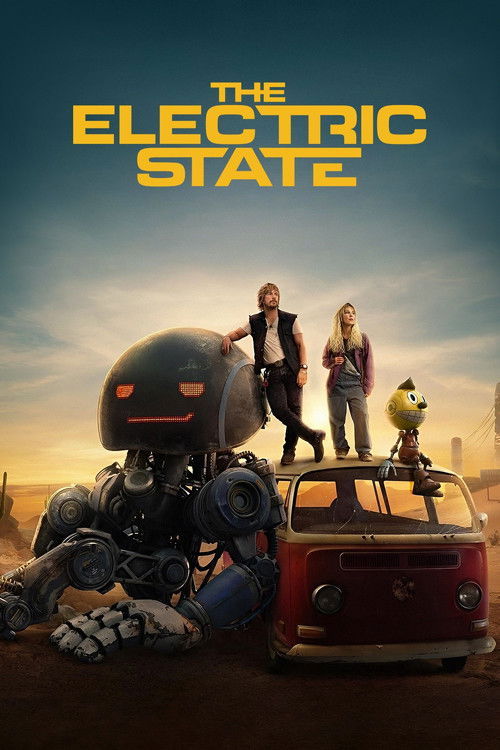
This film draws you in for a significant portion of its runtime with traditional or neutral content before springing its woke agenda. Know before you go!
NOT A WOKE TRAP. The Electric State does not disguise its ideological leanings behind a traditional marketing campaign. The trailers prominently feature Millie Bobby Brown as a defiant, independent teenage lead navigating a post-apocalyptic landscape with a band of misfit robots. The found-family structure, anti-corporate messaging, and girl-on-a-mission framing are all visible from the marketing. Conservative viewers who dislike these tropes can identify them before watching. The film is exactly what it looks like: a big-budget Netflix spectacle with mildly progressive themes wrapped in a CGI-heavy adventure. No bait-and-switch.
The Electric State is a $320 million argument that money cannot buy a soul.
The Russo Brothers, riding the lingering fumes of their Avengers: Endgame triumph, took Simon Stalenhag's hauntingly beautiful illustrated novel about a girl and her robot wandering a decaying alternate America and turned it into a bloated, quip-heavy adventure film that has more in common with a theme park ride than the melancholic art book that inspired it. The result is Netflix's most expensive original film ever made, and one of its most critically savaged: 14% on Rotten Tomatoes from 158 reviews, with a 3.7/10 average rating.
The film is set in an alternate 1994 where a war between humans and sentient robots has left the world fractured. Ethan Skate (Stanley Tucci), a tech CEO, developed Neurocaster technology that let humans upload their consciousness into drone robots, helping win the war but creating a society of screen-addicted zombies who live vicariously through their machines. Teenager Michelle Greene (Millie Bobby Brown) lost her family in a car crash years ago and lives with Ted (Jason Alexander), an incompetent foster father who spends his days in a Neurocaster stupor. When a small robot named Cosmo (voiced by Alan Tudyk) appears and convinces Michelle that her genius brother Christopher is still alive, she sets off across the country to find him.
Along the way, she reluctantly teams up with Keats (Chris Pratt), a smuggler and war veteran who exists primarily to deliver wisecracks and provide the audience a familiar Marvel-adjacent presence. Keats has a robot sidekick named Herman (voiced by Anthony Mackie) who transforms between various forms and serves as comic relief. Together, they reach the Exclusion Zone, a robot refugee settlement led by Mr. Peanut (Woody Harrelson voicing a sentient version of the Planters mascot, which is somehow a thing that happens in this film).
The plot eventually reveals that Christopher was found alive after the crash but exploited by Skate's corporation Sentre, his prodigious intellect harvested to power the Neurocaster system. Dr. Amherst (Ke Huy Quan), the scientist who certified Christopher's death, has been hiding in the Exclusion Zone out of guilt. The climax involves Michelle infiltrating Sentre headquarters, discovering her brother trapped in a comatose state, and making the gut-wrenching decision to disconnect him, knowing it will kill his body but free his consciousness.
The final act twist, where Christopher's death shuts down Skate's drone army and Michelle broadcasts a speech inviting the world to unplug and rebuild, is the kind of earnest, on-the-nose messaging that would feel powerful in a better film but lands with a thud here because the two hours preceding it have been so tonally inconsistent. The movie careens between slapstick robot comedy, generic action sequences, and moments of genuine emotional weight without ever finding a rhythm.
Millie Bobby Brown carries the film on sheer screen presence, though critics and audiences are divided on whether her performance is 'determined and emotionally grounded' or 'the same sassy, bossy archetype she plays in everything.' The truth is somewhere in between. Brown does her best work in the quieter scenes with Ke Huy Quan and Woody Norman (as Christopher), but the script never gives her enough vulnerability to make the emotional payoff land. Michelle is always in control, always right, always the smartest person in the room. She tells adults what to do. She outsmarts the villain. She saves the world. The character reads less like a traumatized teenager and more like a focus-grouped composite of what a $320 million film thinks its target audience wants to see.
Chris Pratt is fine. He is doing exactly what Chris Pratt does: charming, goofy, slightly roguish, fundamentally decent. The problem is that his character was invented for the film and feels like it. Keats exists to give the movie a bankable male lead and to provide the buddy-comedy dynamic the Russos clearly felt the source material lacked. Pratt and Brown have adequate chemistry, but the relationship never deepens beyond surface-level banter.
The CGI is simultaneously the film's greatest achievement and its most damning indictment. $320 million is visible on screen: the robots are detailed, the world-building is dense, and the Exclusion Zone sequences have a real sense of scale. But the sheer volume of digital artifice creates a numbing effect. When everything is CGI, nothing feels real. The practical-effects charm that made characters like Grogu or the original Terminator enduro-skeleton memorable is entirely absent. Every robot, every environment, every explosion exists in a digital soup that the eye eventually stops processing as tangible.
The 74% audience score on Rotten Tomatoes tells a different story than the 14% critic score. General audiences, particularly families, found the film entertaining enough. It drew 25.2 million views in its opening week and accumulated 74.2 million views in its first half-year on Netflix. Those are not catastrophic numbers in isolation. But against a $320 million budget, they represent a significant underperformance. Netflix expected this to be their Avengers. Instead, it performed below even The Gray Man, the Russos' previous Netflix misfire.
The culture war discourse around the film has been predictable. Progressive critics have focused on the film's failure as art, its derivative storytelling, and its wasteful budget. Conservative commentators have zeroed in on the 'girl-boss' lead, the found-family-over-blood-family themes, the incompetent foster father played for laughs, and the anti-corporate messaging as evidence of Hollywood's continued ideological drift. The truth, as usual, is more boring than either camp admits: The Electric State is not a culture war weapon. It is a mediocre film that cost too much money, failed to capture the spirit of its source material, and represents the diminishing returns of the Marvel formula when applied outside the MCU's carefully managed ecosystem.
The Russo Brothers' post-Marvel decline is now a three-film trend. Cherry (36% RT), The Gray Man (51% RT), The Electric State (14% RT). The trajectory suggests that their Avengers-era success was less about their directorial vision and more about the machinery of Marvel Studios, Kevin Feige's oversight, and the gravitational pull of beloved IP. Left to their own devices, the Russos make expensive, competent, soulless blockbusters that audiences consume and immediately forget.
The most damning thing about The Electric State is not that it is bad. It is that it is forgettable. $320 million spent to create a film that will be a Netflix thumbnail people scroll past by 2027.
Formula: Weighted Score = Severity × Authenticity Multiplier × Centrality Multiplier
🔴 Woke Tropes
| Trope | Severity | Authenticity | Centrality | Score |
|---|---|---|---|---|
| Girl-Boss Lead / Hyper-Competent Female Protagonist | 3 | 0.7 | 1.8 | 3.78 |
| Found Family Elevated Over Biological Family | 2 | 0.7 | 1 | 1.4 |
| Incompetent/Absent Father Figure | 3 | 0.7 | 0.5 | 1.05 |
| Anti-Corporate / Eat-the-Rich Villain | 3 | 1 | 1.8 | 5.4 |
| Anti-Technology / Screen Addiction Messaging | 2 | 1 | 1 | 2 |
| TOTAL WOKE | 13.6 | |||
🟢 Traditional Tropes
| Trope | Severity | Authenticity | Centrality | Score |
|---|---|---|---|---|
| Biological Family Bond as Emotional Core | 4 | 0.7 | 1.8 | 5.04 |
| Self-Sacrifice and Personal Responsibility | 3 | 0.7 | 1 | 2.1 |
| Anti-Screen / Return to Reality Message | 2 | 0.7 | 0.5 | 0.7 |
| Military Service Treated With Respect | 2 | 0.7 | 0.5 | 0.7 |
| Redemption Through Moral Choice | 2 | 0.7 | 0.7 | 0.98 |
| TOTAL TRADITIONAL | 9.5 | |||
Score Margin: -4 WOKE
Director: Anthony Russo, Joe Russo
CENTER-LEFT CORPORATE PROGRESSIVISM. The Russo Brothers rose to prominence directing Captain America: The Winter Soldier and Civil War, then peaked with Avengers: Infinity War and Endgame, the highest-grossing film of all time. Their post-Marvel work has been defined by massive budgets and diminishing returns: Cherry (2021, 36% RT), The Gray Man (2022, 51% RT), and now The Electric State (14% RT). They have publicly advocated for diversity in Hollywood, supported inclusive casting, and their production company AGBO has positioned itself as a progressive-leaning studio. Their ideological footprint is corporate Hollywood progressive: pro-diversity rhetoric, anti-corporate themes in their films, and a preference for found-family narratives over traditional family structures.Anthony and Joe Russo are American filmmakers who began their careers in television comedy (Arrested Development, Community) before transitioning to Marvel Studios blockbusters. Their MCU run (Captain America: The Winter Soldier, Captain America: Civil War, Avengers: Infinity War, Avengers: Endgame) grossed over $6.8 billion worldwide. Post-Marvel, they signed a massive deal with Netflix and founded AGBO Films. The Electric State represents the most expensive film of their career and arguably their most significant critical failure. The 14% RT score is their lowest ever, falling below even Cherry's 36%. Their screenplay collaborators Christopher Markus and Stephen McFeely co-wrote the script, maintaining the same creative team that produced their MCU work.
Writer: Christopher Markus, Stephen McFeely
Christopher Markus and Stephen McFeely are the screenwriting duo behind nearly every Russo Brothers film. Their credits include all three Captain America films, Avengers: Infinity War, Avengers: Endgame, and The Gray Man. They also wrote the Chronicles of Narnia trilogy. For The Electric State, they adapted Simon Stalenhag's 2018 illustrated novel, making significant changes to the source material: adding the Chris Pratt character entirely, transforming the tone from melancholic and atmospheric to action-adventure comedy, and restructuring the plot around a corporate villain and climactic battle sequence. Critics widely noted that the adaptation stripped the source material of its haunting, contemplative quality in favor of Marvel-style spectacle.
Adult Viewer Insight
Conservative adults will find mild irritants but no dealbreakers. Michelle is a competent female lead who drives the story, but she is not militantly feminist. The found-family theme is present (Michelle bonds with Keats, the robots, and her makeshift crew) but the film's actual emotional core is about biological family: Michelle's entire quest is to find her blood brother. The anti-corporate villain is a standard Hollywood trope rather than a pointed political statement. The foster father being useless is played for laughs but is not a systemic indictment of traditional family structures. The anti-technology message, ironically delivered through one of the most technology-dependent films ever made, is actually conservative in spirit: put down the screens, go outside, reconnect with real people. Progressive adults will appreciate the female-led adventure and diverse voice cast but will likely be disappointed by the film's superficiality. The anti-tech messaging is not as sophisticated as it thinks it is. The film never interrogates its own position as a streaming spectacle telling audiences to stop streaming. Overall, this is an ideologically mild film that leans slightly progressive through its casting and character dynamics but does not push any aggressive agenda. Its biggest crime is mediocrity, not ideology.
Parental Guidance
Rated PG-13 for sci-fi violence/action, language, and thematic material. Action violence is frequent but bloodless: robot battles, explosions, and drone combat dominate the final act. Language includes multiple uses of 'shit,' 'damn,' 'hell,' 'ass,' 'bitch,' and one near-use of 'motherfucker.' Several misuses of God's name and Jesus's name. No sexual content beyond one mild robot innuendo. The heaviest content is thematic: a child exploited by a corporation, a mercy killing of a sibling, grief and foster care. The anti-screen message is heavy-handed but appropriate for family discussion. Suitable for teens 13 and up. Younger children will enjoy the robot characters but may be disturbed by Christopher's fate.
Find The Electric State on Amazon Prime Video, rent, or buy:
▶ Stream or Buy on AmazonAs an Amazon Associate, VirtueVigil earns from qualifying purchases.
Community Discussion 0
Subscribe to comment.
Join the VirtueVigil community to share your perspective on this review.