
The Strangers: Chapter 3
The original The Strangers (2008) earned its place in horror history with a deceptively simple premise: three masked killers, a couple, an isolated house, no explanation offered and none needed.…
Full analysis below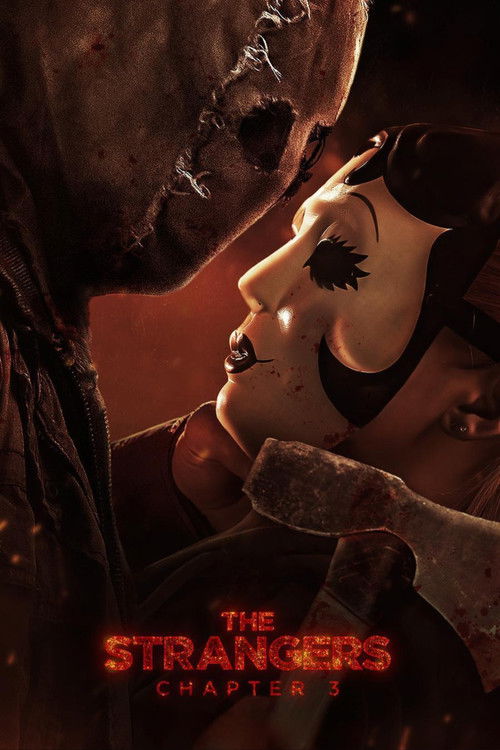
Not a woke trap. No discernible ideological agenda. A franchise completion exercise with standard genre conventions - survival horror mechanics only.
The original The Strangers (2008) earned its place in horror history with a deceptively simple premise: three masked killers, a couple, an isolated house, no explanation offered and none needed. "Because you were home," the most terrifying line in a generation of horror, worked precisely because it refused the comfort of motive. Seventeen years later, Lionsgate has commissioned a new trilogy from director Renny Harlin - the Finnish-American action vet responsible for Die Hard 2, Cliffhanger, and The Long Kiss Goodnight - to transform that spare nightmare into a franchise. Chapter 3 closes the book on the effort. The results are violent, occasionally frightening, and ultimately unsatisfying - a franchise that never found the terrifying restraint that made the original matter.
Chapter 3 picks up immediately after the events of Chapter 2, with Maya (Madelaine Petsch) still trapped in the small town of Venus, Oregon, hunting answers and trying to escape both the masked killers and a corrupt local establishment. The film expands the mythology of the Venus murder cult, revealing that the Scarecrow (Gregory) is the son of the town's Sheriff Rotter (Richard Brake), and that the murders have continued under the sheriff's protection - as long as no townspeople are targeted.
Maya is captured, branded with the smiley face tattoo that marks the killers' victims, and forced to wear a mask herself. The film's most interesting gambit is putting Maya inside the killers' world - not just fleeing but forced into their ritual. Gabriel Basso returns as Ryan, whose role in the resolution becomes central. The climax delivers brutal confrontations and, for the first time in the trilogy, answers.
The structure is more ambitious than the previous chapters, but the screenplay by Cohen and Freedland strains under the weight of mythology that was never designed to carry this much freight.
Renny Harlin is a Finnish-American genre director whose career is defined by commercial efficiency and action-forward filmmaking, not ideological messaging. His best work (Cliffhanger, The Long Kiss Goodnight, Die Hard 2) delivers pure genre craft with no apparent agenda beyond entertainment. The franchise underperformance ($8 million on this chapter) reflects an audience that found this trilogy underwhelming compared to the source material - not ideological rejection, but quality rejection.
| Trope | Category | Location | Authenticity |
|---|---|---|---|
| Lone Female Survivor as Narrative Anchor | WOKE | Core - Maya is the primary survival protagonist across the trilogy | Organic - genre convention, not advocacy; established in Chapter 1 |
| Corrupt Male Authority (Sheriff) as Villain | WOKE | Supporting - Sheriff Rotter revealed as complicit in the murder cult | Organic - narrative function, not political statement |
| Community Protecting Its Own - Corrupted Version | TRADITIONAL | Supporting - the corruption is shown to have devastating consequences | Mixed - the value of community is present but in corrupted form |
| Good vs. Evil Clarity - Killers as Pure Evil, No Sympathy | TRADITIONAL | Core - the masked killers are never given moral complexity or victim status | Authentic - franchise's fundamental moral clarity maintained |
| Survival Instinct and Human Resilience | TRADITIONAL | Core - Maya's persistence through three films of extreme horror | Authentic - fundamental human survival narrative |
Director: Renny Harlin
NEUTRALFinnish-American genre director. Career defined by commercial efficiency and action-forward filmmaking, not ideological messaging. Best work: Die Hard 2, Cliffhanger, The Long Kiss Goodnight. No progressive track record - instincts are commercial, not political.
Writer: Alan R. Cohen & Alan Freedland
Television writers known for comedy work; franchise script by the Alan-Alan duo. Functional screenplay that strains under the weight of mythology the original never intended to carry.
Fidelity Casting Analysis FAITHFUL
The trilogy maintains the visual identity of the masked killers - Dollface, Pin-Up Girl, Scarecrow - and the fundamental mythology. Core masked-killer franchise identity preserved.
The trilogy maintains the visual identity of the masked killers and the fundamental mythology (strangers who kill without personal motive). The decision to shift from random-violence into a community-mythology framework represents an expansion rather than a betrayal. The significant deviation from the original's spirit - explaining the killers, giving them backstory - dilutes effectiveness but does not misrepresent the core horror concept.
Adult Viewer Insight
If you saw Chapters 1 and 2, there is enough narrative payoff here to make Chapter 3 worthwhile as a completion exercise. Harlin wrings some effective set-pieces from the sawmill location, and the mythology expansion is more interesting than anything in Chapter 2. But the franchise has consistently diluted what made the original terrifying: the randomness. Once you explain the killers, the masks, the community, the corruption - you've traded dread for plot. The original didn't explain anything. That was the point. For franchise completionists: see it. For everyone else: revisit the 2008 original instead.
Parental Guidance
Standard R-rated horror with genre-appropriate violence - graphic slasher violence, branding scene, murder. No significant sexual content. No ideological concern for parents. The content is extreme horror violence - not appropriate for children - but not morally corrupting in terms of worldview. The killers are unambiguously evil; their victims are sympathetic. The film does not glorify or justify the violence. Recommended minimum age: 17+.
Find The Strangers: Chapter 3 on Amazon Prime Video, rent, or buy:
▶ Stream or Buy on AmazonAs an Amazon Associate, VirtueVigil earns from qualifying purchases.


Community Discussion 0
Subscribe to comment.
Join the VirtueVigil community to share your perspective on this review.