
Thor: Love and Thunder
Thor: Love and Thunder is a film at war with itself. It contains the raw materials for a genuinely powerful story about grief, faith, and the failure of the gods, but it buries that story under a relentless avalanche of jokes, self-aware comedy, and tonal chaos.…
Full analysis below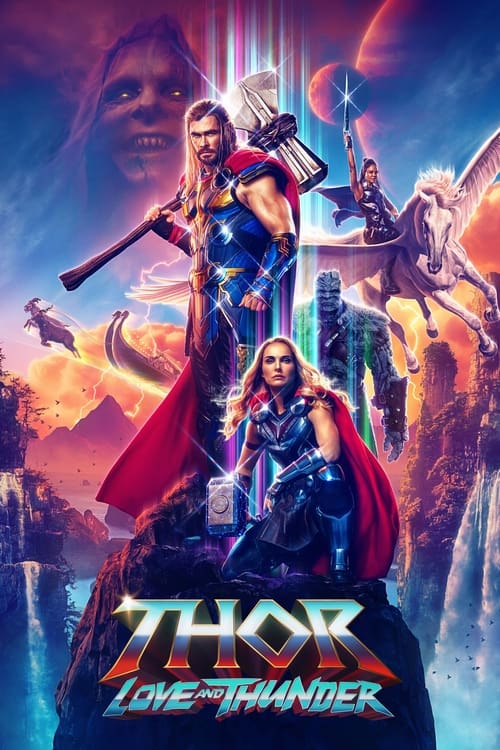
This film draws you in for a significant portion of its runtime with traditional or neutral content before springing its woke agenda. Know before you go!
NOT A WOKE TRAP. The marketing prominently featured Jane Foster as the Mighty Thor and Valkyrie in a leadership role. Taika Waititi openly discussed LGBTQ+ representation in pre-release interviews. The woke content was clearly advertised. There is no bait-and-switch. Audiences who tracked the marketing knew exactly what they were getting.
Thor: Love and Thunder is a film at war with itself. It contains the raw materials for a genuinely powerful story about grief, faith, and the failure of the gods, but it buries that story under a relentless avalanche of jokes, self-aware comedy, and tonal chaos. Christian Bale delivers a career-caliber performance as Gorr the God Butcher, a grieving father whose daughter starved to death while his god feasted in paradise. That premise alone could carry a great film. Instead, Taika Waititi treats nearly every serious moment as a setup for a punchline.
The plot follows Thor after his time with the Guardians of the Galaxy. He learns that Gorr, wielding the god-killing Necrosword, is systematically murdering deities across the universe. Meanwhile, Thor's ex-girlfriend Jane Foster has been diagnosed with terminal cancer and discovers that Thor's broken hammer Mjolnir has reformed itself and bonded to her, transforming her into the Mighty Thor. The hammer gives her strength but accelerates her cancer each time she uses it. Thor, Jane, Valkyrie, and Korg travel to Omnipotence City to warn the gods and recruit an army, but Zeus refuses to help, believing the gods can simply hide.
Gorr kidnaps the children of New Asgard and lures Thor to the Shadow Realm, planning to use the Bifrost at the center of the universe to reach Eternity and wish all gods dead. The climax involves Thor empowering the kidnapped children with his lightning to fight Gorr's shadow monsters, while Jane -- against medical advice -- wields Mjolnir one final time to shatter the Necrosword. Gorr reaches Eternity but, moved by Thor's compassion and Jane's sacrifice, wishes for his daughter Love to be resurrected instead of destroying the gods. Jane dies. Thor adopts Love.
The traditional elements are real. Gorr's story is fundamentally about faith betrayed by false gods, and his arc from devotion to rage to redemption is classically structured. Jane's sacrifice is genuinely moving: she chooses to die fighting rather than extend her life by abandoning the hammer. Thor's growth into a father figure, adopting Gorr's resurrected daughter, is a beautiful resolution. The film questions what gods owe their worshippers and arrives at a sincere answer: everything.
But the woke elements are also real and not subtle. Valkyrie is explicitly presented as interested in women, discussing past girlfriends and flirting with a woman in Omnipotence City. Korg reveals that Kronans reproduce when two males hold hands over lava, and the film ends with him in a same-sex partnership raising a child. These beats are brief but intentional and were heavily marketed. Thor is repeatedly emasculated for comedy: stripped naked by Zeus, jealous of his own hammer, upstaged by Jane. The film's comedic engine runs on deflating male heroism.
The tonal inconsistency is the real problem. Bale is acting in a prestige horror film while everyone around him is in a comedy sketch. Jane's cancer is treated with gravity in her close-ups and then undercut by a screaming goat joke. Gorr's kidnapping of children should be terrifying but the film can't resist lightening the mood. Hemsworth himself acknowledged the balance was off.
RT Critics: 63%. RT Audience: 77%. Metacritic: 57. IMDB: 6.2. Box office: $760.9M worldwide on $250M budget.
Formula: Weighted Score = Severity × Authenticity Multiplier × Centrality Multiplier
🔴 Woke Tropes
| Trope | Severity | Authenticity | Centrality | Score |
|---|---|---|---|---|
| LGBTQ+ Representation (Valkyrie) | 3 | Moderate | Moderate | 3 |
| LGBTQ+ Representation (Korg) | 2 | Low | Moderate | 2.8 |
| Male Hero Emasculation | 3 | Moderate | Moderate | 3 |
| Female Character Replaces Male Hero | 3 | High | Moderate | 2.1 |
| Gender Title Subversion (King Valkyrie) | 2 | Moderate | Low | 1 |
| Diverse / Progressive Casting Choices | 2 | High | Low | 0.7 |
| Children Armed as Warriors | 3 | Moderate | Moderate | 3.84 |
| TOTAL WOKE | 16.4 | |||
🟢 Traditional Tropes
| Trope | Severity | Authenticity | Centrality | Score |
|---|---|---|---|---|
| Faith, Grief, and Redemption (Gorr's Arc) | 4 | High | High | 5.04 |
| Self-Sacrifice (Jane Foster) | 3 | High | High | 3.78 |
| Fatherhood and Adoption | 3 | High | Moderate | 2.1 |
| Gods Owe Their Worshippers | 2 | High | Moderate | 1.34 |
| TOTAL TRADITIONAL | 12.3 | |||
Score Margin: -4 WOKE
Director: Taika Waititi
PROGRESSIVE. Waititi is openly progressive, vocally supportive of LGBTQ+ causes, Indigenous rights (he is Maori), and diversity in Hollywood. His humor frequently subverts traditional masculinity. He played Hitler as a buffoon in Jojo Rabbit, deconstructing fascism through absurdity.Taika Waititi is a New Zealand filmmaker of Maori and Jewish descent. He broke through with the mockumentary What We Do in the Shadows (2014) and revitalized the Thor franchise with Ragnarok (2017). He won the Academy Award for Best Adapted Screenplay for Jojo Rabbit (2019). He also directed episodes of The Mandalorian. His comedic style favors improvisation, irreverence, and deliberate subversion of genre conventions.
Writer: Taika Waititi & Jennifer Kaytin Robinson
Waititi co-wrote with Jennifer Kaytin Robinson, whose previous credits include the Netflix teen comedy Someone Great (2019) and the revenge thriller Do Revenge (2022). Robinson brought a romantic comedy sensibility to the script. The screenplay adapts Jason Aaron's Thor comic run, which introduced both Gorr the God Butcher and Jane Foster as the Mighty Thor.
Adult Viewer Insight
Conservative adults will find Thor: Love and Thunder frustrating. Christian Bale's Gorr and Natalie Portman's Jane Foster are giving genuinely moving performances about faith, sacrifice, and parenthood. But those performances are surrounded by constant jokes, progressive messaging about sexuality, and a general tone of irreverence toward masculinity and divinity. The LGBTQ+ content is brief but undeniable. If you can tolerate the comedy and the progressive elements, the core story has real emotional value. If those elements are dealbreakers, skip it.
Parental Guidance
Find Thor: Love and Thunder on Amazon Prime Video, rent, or buy:
▶ Stream or Buy on AmazonAs an Amazon Associate, VirtueVigil earns from qualifying purchases.
Community Discussion 0
Subscribe to comment.
Join the VirtueVigil community to share your perspective on this review.