
Weapons
Weapons is the rare horror film that conservatives do not need to apologize for enjoying. In fact, they may find themselves grinning through it.
Full analysis below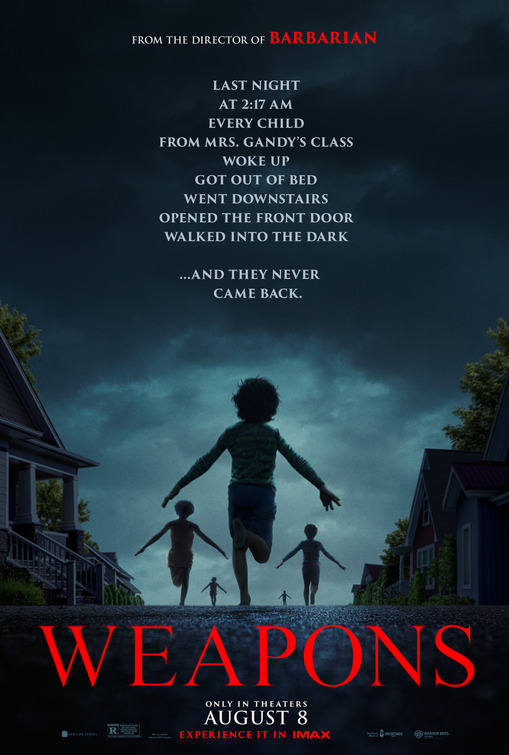
NOT A WOKE TRAP. This film has been explicitly claimed by conservative cultural commentators as validation of traditional values. The American Conservative published an article titled 'Weapons Is a Post-Woke Masterpiece.' The film's moral universe rewards sobriety, fidelity, and protective fatherhood while punishing addiction, adultery, and naive openness. If anything, progressive audiences expecting a standard horror-mystery may be surprised by the film's traditionally coded moral framework. Conservative viewers should feel at home here.
Weapons is the rare horror film that conservatives do not need to apologize for enjoying. In fact, they may find themselves grinning through it.
Zach Cregger's follow-up to Barbarian is a sprawling, multi-narrative mystery-horror that operates like Magnolia crossed with The Shining. When seventeen third-graders run out of their homes at exactly 2:17 AM and vanish, the small Pennsylvania town of Maybrook fractures into overlapping stories of parents, teachers, cops, and criminals all grasping for answers. At the center of each thread is a simple question: what happened to the children, and who is responsible?
The answer, when it arrives, is elemental. An elderly woman named Gladys, a distant relative invited into a family home by a well-meaning mother who overruled her husband's objections, has been practicing witchcraft. She has bewitched the parents into immobility. She has compelled their son Alex to collect personal belongings from his classmates. She has summoned the children to the basement, where she feeds off their life force. She is not misunderstood. She is not a sympathetic victim of circumstance. She is evil, and Amy Madigan plays her with a quiet menace that crawls under your skin and stays there.
Madigan's performance is the film's crown jewel. At 74, returning to the Oscar conversation after a 40-year absence (her first nomination was for Twice in a Lifetime in 1986), she creates a villain who is terrifying precisely because she is ordinary. Gladys does not cackle. She does not monologue. She cuts locks of hair. She sits in chairs. She speaks softly. The horror is in the banality: she could be anyone's aunt, anyone's neighbor, anyone's unexpected houseguest. That is the point.
The film's multi-narrative structure follows five interlocking storylines. Archer Graff (Josh Brolin) is a blue-collar construction contractor and desperate father who takes matters into his own hands when the police move too slowly. Julia Garner plays Justine Gandy, the teacher whose classroom was emptied, now suspended and spiraling into alcoholism. Alden Ehrenreich is Paul Morgan, a cop whose badge hides his own corruption. Austin Abrams plays James, a homeless addict whose petty burglary accidentally leads him to the missing children. Benedict Wong is Marcus Miller, the school principal whose decency makes him vulnerable to Gladys's manipulation.
Each character is defined by their vices and virtues, and the film's moral architecture is clear: the purer you are, the more resistant you are to Gladys's evil. Archer is the most virtuous character in the film. He is sober. He is faithful to his wife. He is relentlessly protective of his son. His only real flaw is an inability to say 'I love you.' He is also, critically, the most resistant to Gladys's bewitchment. Everyone else falls. The alcoholic teacher. The corrupt cop. The junkie burglar. The sympathetic principal who opens his door to a stranger. Each is enslaved by their vices, and each pays for it.
The American Conservative published an article titled 'Weapons Is a Post-Woke Masterpiece,' arguing that the film validates suspicion over openness, protective fatherhood over passive modernity, and moral clarity over relativism. That reading is not wrong, but it is not the whole story either. Cregger is making a horror film, not a political manifesto. The traditional values that structure the film's moral universe are deployed in service of genre tension, not ideological argument. The reason Archer survives is that his moral clarity makes for a better final-act hero, not because Cregger is trying to get you to vote Republican.
But here is what matters for the VirtueVigil audience: this is a film where a father's protective instincts are validated rather than mocked. Where opening your home to a stranger without proper vetting leads to catastrophe. Where addiction, adultery, and moral compromise make you vulnerable to destruction. Where evil is unambiguous and does not have a sympathetic backstory. Where children are worth fighting for. Where the final act rewards the character who held the line on personal integrity.
That is not how most Hollywood films work in 2025. Weapons works that way, and it grossed $270 million doing it.
Amy Madigan's 40-year gap between Oscar nominations is its own story. She was nominated for Twice in a Lifetime in 1986, then disappeared from the Academy's radar for four decades. She is married to Ed Harris. She is 74 years old. She walked into this role and owned every frame she occupied. The Critics' Choice, the SAG Award, the New York Film Critics Circle, the London Film Critics Circle, and now the Oscar nomination all speak to the same truth: this is one of the great villain performances in recent memory. If there is justice, she wins.
Weapons is not perfect. The multi-narrative structure occasionally loses momentum, particularly in the Paul/James thread, which takes longer than necessary to connect to the main mystery. The supernatural reveal, while effective, simplifies questions about institutional failure and community trauma that the first hour raised more provocatively. And Cregger's debt to Paul Thomas Anderson is obvious enough that the comparison sometimes flatters Anderson more than Cregger.
But these are the complaints of a film operating at a high level. Weapons is a blockbuster horror film that takes its audience seriously, rewards moral attention, and delivers a villain performance for the ages. For conservative viewers who have spent years feeling alienated by Hollywood's moral inversions, this is the film you have been waiting for.
Formula: Weighted Score = Severity × Authenticity Multiplier × Centrality Multiplier
🔴 Woke Tropes
| Trope | Severity | Authenticity | Centrality | Score |
|---|---|---|---|---|
| Same-Sex Marriage Depicted Matter-of-Factly | 2 | 0.7 | 0.5 | 0.7 |
| Female Teacher as Sympathetic Protagonist | 2 | 1 | 1 | 2 |
| Institutional Criticism (Police Corruption) | 2 | 1 | 0.5 | 1 |
| Community Suspicion of Teacher (Gendered Blame) | 2 | 1 | 0.5 | 1 |
| Sympathy for Marginalized Characters (Homeless Addict) | 2 | 1 | 0.5 | 1 |
| Karen/Longhouse Critique | 1 | 1 | 0.5 | 0.5 |
| TOTAL WOKE | 6.2 | |||
🟢 Traditional Tropes
| Trope | Severity | Authenticity | Centrality | Score |
|---|---|---|---|---|
| Protective Fatherhood Validated / Masculine Heroism | 5 | 0.7 | 1.8 | 6.3 |
| Moral Virtue as Protection / Vice as Vulnerability | 4 | 0.7 | 1.8 | 5.04 |
| Evil Is Unambiguous / No Sympathetic Villain Backstory | 4 | 0.7 | 1 | 2.8 |
| Consequences for Moral Compromise | 3 | 0.7 | 1 | 2.1 |
| Suspicion of Strangers Validated / Borders as Protection | 3 | 1 | 1 | 3 |
| Family Unit as Sacred / Children Worth Fighting For | 3 | 0.7 | 0.8 | 1.68 |
| Witchcraft/Supernatural Evil as Real Threat | 2 | 0.7 | 0.8 | 1.12 |
| TOTAL TRADITIONAL | 22.0 | |||
Score Margin: +16 TRAD
Director: Zach Cregger
CULTURALLY MODERATE / NON-POLITICAL. Cregger is a former member of the comedy troupe The Whitest Kids U' Know, a group known for irreverent, boundary-pushing sketch comedy rather than political commentary. His directorial debut Barbarian (2022) was a genre-bending horror film with no overt political messaging. He has not publicly aligned with any political movement. His films operate in genre frameworks that happen to reward traditional instincts (suspicion of strangers, protective parenting, moral consequences for vice) without explicitly announcing a political thesis. Conservative commentators have claimed Weapons as a traditional-values film, but Cregger himself has not confirmed or denied this reading.Zach Cregger is an American filmmaker, actor, and comedian who rose to prominence as a member of The Whitest Kids U' Know. After the group's dissolution, he pivoted to screenwriting and directing. Barbarian (2022) was a sleeper hit, earning $45 million against a $4.5 million budget and establishing Cregger as a major horror voice. He wrote the Weapons screenplay and sold it for $38 million to New Line Cinema, receiving a $10 million personal fee plus final cut privilege. He deferred $2 million of his fee in exchange for 50 backend points, a decision that has likely made him very wealthy given the film's $270 million gross. He cited Magnolia, Prisoners, and the novel A Visit from the Goon Squad as inspirations. The screenplay was inspired in part by the death of his close friend and collaborator Trevor Moore.
Writer: Zach Cregger
Cregger wrote the spec script that sparked a bidding war between Netflix, New Line Cinema, TriStar, and Universal. New Line CEO Michael De Luca closed the deal within 90 minutes of reading the script. Jordan Peele's Monkeypaw Productions participated in the bidding through Universal. The screenplay's multi-narrative structure, following intersecting characters across a single mystery, was compared to Paul Thomas Anderson's Magnolia.
Adult Viewer Insight
Conservative adults will find a lot to enjoy here. The film validates protective fatherhood, rewards personal integrity, and punishes moral compromise without preaching. The American Conservative was not wrong to call it a 'post-woke masterpiece,' though Cregger's intentions may be more genre-driven than political. Progressive adults may feel uneasy with the film's moral structure, which was the subject of lively debate on Letterboxd, where one reviewer asked whether Cregger 'set out to make a pro-family, anti-woman, anti-queer film.' The answer is probably no; he set out to make a scary movie with clear moral stakes. But the stakes he chose are traditionally coded, and that matters. Families with older teenagers who enjoy horror can use this film as a springboard for conversations about moral consequence, the nature of evil, and whether 'stranger danger' is prudent or prejudiced. The horror elements are intense but purposeful.
Parental Guidance
Rated R. Not for children. Contains violence (shootings, a character beaten to death, physical assault), sustained supernatural horror, child endangerment (the central premise involves missing children held captive), drug addiction and use, adultery, police brutality, and strong language. The film's moral clarity may actually make it easier to discuss with mature teenagers than many morally ambiguous horror films. Evil is evil. Good is good. Consequences are real. But the intensity is not for the faint of heart.
Find Weapons on Amazon Prime Video, rent, or buy:
▶ Stream or Buy on AmazonAs an Amazon Associate, VirtueVigil earns from qualifying purchases.
Community Discussion 0
Subscribe to comment.
Join the VirtueVigil community to share your perspective on this review.