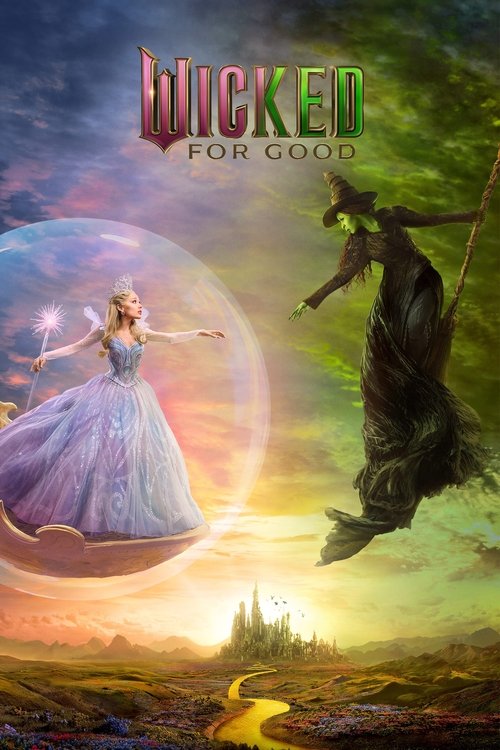
Wicked
Somewhere between the 400 brand partnerships, the Limited Edition pink-and-green Stanley cups, and the church-group holiday matinees, something got lost in translation.…
Full analysis belowThis film draws you in for a significant portion of its runtime with traditional or neutral content before springing its woke agenda. Know before you go!
WOKE TRAP WARNING — Degree: Moderate. Wicked is Hollywood's most effective ideological delivery mechanism of 2024 precisely because it doesn't feel like one. The source material — Gregory Maguire's 1995 novel, the 2003 Broadway smash — has been a progressive anthem for decades, beloved by the LGBTQ+ community as an allegory for the queer experience long before the cameras ever rolled. Jon M. Chu's adaptation preserves and sharpens that identity while wrapping it in the most aggressive mainstream marketing campaign in recent memory. Families who showed up expecting a colorful holiday musical about a green girl and her bubbly blonde roommate got all of that — and also a story that Cynthia Erivo describes as an allegory for racial discrimination, a bisexual prince (played by an openly gay actor who caresses a male extra's face), four queer lead actors, and a director who explicitly connected his film's charismatic gaslighting villain to the 2024 U.S. election. This is not a trap of the Barbie variety — there is no sustained feminist lecture, no matriarchal polemic. The trap is softer and older: a beloved story that arrived pre-loaded with decades of progressive meaning, delivered by an ideologically aligned team to an audience that didn't realize what they'd already agreed to before they bought the ticket.
Classification: WOKE TRAP
WOKE 31 | TRADITIONAL 16 | Composite -15 WOKE
⚠️ SPOILER ALERT: This review contains detailed plot analysis and reveals key story elements.
Opening Hook
Somewhere between the 400 brand partnerships, the Limited Edition pink-and-green Stanley cups, and the church-group holiday matinees, something got lost in translation. Universal sold Wicked as the feel-good movie event of 2024 — a splashy, joyful, family-safe musical spectacle perfect for Thanksgiving weekend. And on a surface level, that's what it is: two hours and forty minutes of lavish production design, powerhouse vocal performances, and enough glitter to fill a Macy's float. What the marketing did not mention — couldn't mention, without breaking the spell — is that this particular story has functioned as a progressive anthem for two decades, that the cast is stacked with openly queer performers, that its director publicly compared his villain to a 2024 presidential candidate, and that casting a Black woman as a character who faces institutionalized discrimination for the color of her skin was, by the filmmakers' own description, a deliberate and meaningful interpretive choice. Wicked is not trying to trick you — not exactly. The ideology is right there in the material, baked in for twenty years. But the packaging says something different. And that gap is worth understanding before the lights go down.
Plot Summary
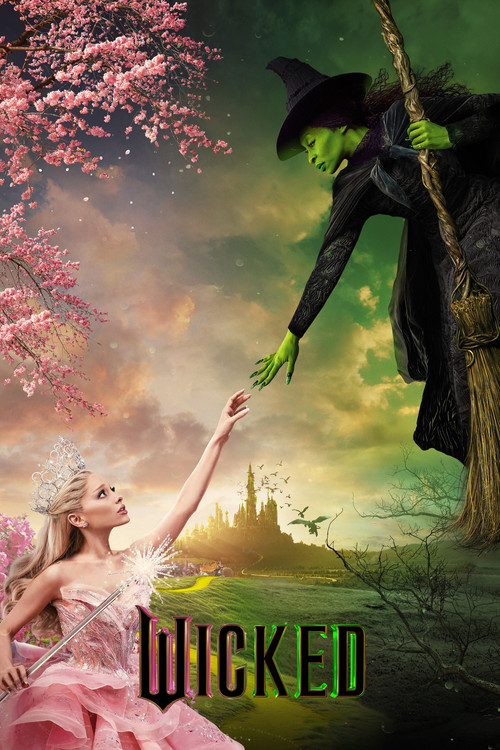
In the magical Land of Oz, the news is spreading: the Wicked Witch of the West is dead. The citizens celebrate. But before we join the celebration, the film pulls us back to where it all began — Shiz University, where two young women from entirely different worlds were thrown together as roommates and, somehow, became friends.
Elphaba (Cynthia Erivo) arrives at Shiz as an outsider twice over: green-skinned by birth, the object of lifelong mockery and discrimination, and fiercely brilliant in a world that isn't looking for brilliance from someone who looks like her. She's escorting her younger sister Nessarose (Marissa Bode), the family favorite, to school. Glinda (Ariana Grande, née Galinda) arrives as the opposite: pink, popular, socially omnipotent, and blissfully certain that the universe orbits around her. Their forced cohabitation begins with mutual hostility — "What Is This Feeling?" is their mutual anthem of loathing — and slowly transforms into something richer and more complicated.
At Shiz, Elphaba discovers two things: that her magic is extraordinary, and that the Land of Oz is rotting from the inside. Dr. Dillamond (voiced by Peter Dinklage), the gentle Goat professor who becomes her mentor, reveals that the Animals of Oz — sentient beings who once lived alongside humans as equals — are being systematically stripped of their civil rights and, horrifyingly, their ability to speak. Someone in power is orchestrating it. When Elphaba's exceptional gifts catch the attention of the formidable Madame Morrible (Michelle Yeoh), the headmistress arranges for her to meet the great and wonderful Wizard of Oz himself (Jeff Goldblum).
Elphaba arrives at the Emerald City believing she's found a powerful ally who shares her concern for the Animals. She's wrong. The Wizard is the architect of their oppression — a charming, charismatic fraud who uses fear and propaganda to maintain his grip on power, and who now wants Elphaba to join him and use her magic in his service. She refuses. In a breathtaking climax, Elphaba escapes the Emerald City on her broomstick, rising above it all while a city that once adored her turns against her — and "Defying Gravity" becomes one of the most electric moments in recent blockbuster filmmaking.
Glinda, caught between loyalty to her friend and the comfortable position the Wizard is offering her, watches Elphaba go. She cannot yet follow. The film ends there — mid-story, mid-fall, mid-flight — as Part One of two.
Trope Analysis — VVWS Weighted Scoring
Formula: Weighted Score = Severity × Authenticity Multiplier × Centrality Multiplier
Authenticity: High (organic to story)=0.7, Moderate=1.0, Low (injected)=1.4 | Centrality: Low=0.5, Moderate=1.0, High=1.8
🔴 Woke Tropes
| Trope | Severity (1–5) | Authenticity | Centrality | Weighted Score |
|---|---|---|---|---|
| Race Allegory / Race-Conscious Casting as Central Framing | 4 | Moderate (1.0) | High (1.8) | 7.2 |
| "Defying Gravity" as Feminist/LGBTQ+ Liberation Anthem | 3 | Moderate (1.0) | High (1.8) | 5.4 |
| Anti-Authority Ideology as Heroic Framework | 4 | High (0.7) | High (1.8) | 5.0 |
| Minority Rights Allegory (Animals losing civil rights) | 4 | High (0.7) | High (1.8) | 5.0 |
| Queer Ensemble Cast / Bisexual Fiyero / LGBTQ+ Subtext | 3 | Moderate (1.0) | Moderate (1.0) | 3.0 |
| Director's Public Progressive/Anti-Trump Political Framing | 2 | Low (1.4) | Moderate (1.0) | 2.8 |
| Oz as Fascism Allegory / Propaganda / Systemic Oppression | 3 | High (0.7) | Moderate (1.0) | 2.1 |
| WOKE TOTAL | 30.5 |
🟢 Traditional Tropes
| Trope | Severity (1–5) | Authenticity | Centrality | Weighted Score |
|---|---|---|---|---|
| Female Friendship as Narrative Anchor | 4 | High (0.7) | High (1.8) | 5.0 |
| Authenticity / Being True to Yourself Despite Social Cost | 4 | High (0.7) | High (1.8) | 5.0 |
| Moral Courage — Refusing to Collaborate with Injustice | 3 | High (0.7) | Moderate (1.0) | 2.1 |
| Classic Outsider / Coming-of-Age Arc | 3 | High (0.7) | Moderate (1.0) | 2.1 |
| Loyalty Tested and Honored | 2 | High (0.7) | Moderate (1.0) | 1.4 |
| Joy, Spectacle, and Delight as Film's Primary Mode | 2 | High (0.7) | Low (0.5) | 0.7 |
| TRAD TOTAL | 16.3 |
Score Margin: -14 WOKE
Woke Trap Assessment
⚠️ WOKE TRAP WARNING — Degree: Moderate
Universal's Wicked is a textbook woke trap — but not of the aggressive, manufactured variety. This is something subtler and in some ways more durable: a story that arrived pre-ideologized, wrapped in a century of Oz mythology and two decades of LGBTQ+ community ownership, and sold to mainstream America as a family musical.
The trap has a specific mechanism. Wicked the Broadway show has been one of the LGBTQ+ community's signature anthems since it opened in 2003. Elphaba — the green-skinned outsider who refuses to suppress her true self in order to be accepted — has resonated powerfully with queer audiences for whom "different" has always been weaponized as shame. "Defying Gravity" is not merely a show-stopping climax; it has functioned for years as a cultural battle cry for anyone who was ever told that who they are makes them unacceptable. The LGBTQ+ community didn't retroactively claim Wicked — the text invited them in from the beginning.
Jon M. Chu's film adaptation leans into this legacy while adding its own layer. Casting Cynthia Erivo — a Black, openly queer woman — as Elphaba was not incidental. Variety called Wicked "an allegory for the arbitrary nature of racism and discrimination," and noted that casting Erivo "particularly" amplified that meaning. The filmmakers knew exactly what they were doing: Elphaba's green skin had always been a stand-in for social otherness; casting a Black actress collapses the metaphor into something immediate and specific. Jonathan Bailey, openly gay, plays Fiyero with what reviewers enthusiastically described as "bisexual energy" — he flirts with men and women alike throughout the film. Bowen Yang (gay) plays a supporting role; Marissa Bode (queer) plays Nessarose. Four of the film's leads are openly queer performers, in a story the LGBTQ+ community has claimed for two decades, in a film the director publicly called prophetic in light of Donald Trump's 2024 re-election.
Conservative Christian group One Million Moms launched a boycott, calling the film "dark" and accusing Universal of trading "its usual subtlety for intentionality." For once, that assessment is not entirely unfair.
The degree is "moderate" rather than "severe" for two reasons. First, the LGBTQ+ subtext is subtext — the film contains no explicit gay relationship, no coming-out moment, no direct advocacy. Conservative families can watch it without encountering overt content their children won't be able to process. Second, the traditional elements — female friendship, moral courage, authenticity, the refusal to collaborate with injustice — are not window dressing. They are the story. Wicked works as well as it does emotionally because those themes are genuine, old, and true.
But knowing the full picture before you buy the ticket is exactly what this review is for.
Creative Team at a Glance
- Director: Jon M. Chu — Crazy Rich Asians, In the Heights, G.I. Joe: Retaliation. Consistent identity-politics-oriented filmography. Publicly connected Wicked to anti-Trump/anti-fascist sentiment.
- Writer: Winnie Holzman — Adapted her own Broadway book for the screen. Creator of My So-Called Life. The progressive themes in Wicked are hers; she wrote them twenty years ago.
- Lead Producer: Marc Platt (Universal Pictures) — Long-time Wicked producer, shepherded the property from stage to screen over nearly a decade. Commercially motivated; ideologically aligned with the material.
- Top Cast: Cynthia Erivo (Elphaba), Ariana Grande (Glinda), Jonathan Bailey (Fiyero), Jeff Goldblum (The Wizard), Michelle Yeoh (Madame Morrible), Ethan Slater (Boq), Bowen Yang (Pfannee), Marissa Bode (Nessarose). Notable: Erivo, Bailey, Yang, and Bode are all openly queer performers.
- Pre-Viewing Prediction: WOKE TRAP — Creative team's ideological alignment and source material's progressive pedigree made outcome highly predictable. Confirmed.
- Fidelity Casting Note: Wicked is an adaptation of a musical that already reimagined L. Frank Baum's Oz. Casting a Black actress as Elphaba is a meaningful interpretive departure from both the novel and original Broadway production — and by the filmmakers' own statements, a deliberate one intended to sharpen the racial allegory. Apply the fidelity standard accordingly: this is not colorblind casting; it is race-conscious casting with a specific ideological argument behind it.
Director / Writer Track Record
Director: Jon M. Chu
Jon M. Chu is, above all, a craftsman — his films are beautifully constructed, visually dazzling, and emotionally alive in ways that many of his more overtly political contemporaries are not. But his ideological alignment is consistent and increasingly public.
Filmography with ideological assessment:
- G.I. Joe: Retaliation (2013): Commercial franchise sequel. No meaningful ideological signal. The outlier in his filmography.
- Crazy Rich Asians (2018): A landmark moment for Asian-American representation in mainstream Hollywood. The film's identity politics are organic to its story — it's about a Chinese-American woman navigating the expectations of a wealthy Singaporean family — and executed with genuine warmth and artistry. It is openly a film about cultural identity and belonging, and makes no secret of it.
- In the Heights (2021): Lin-Manuel Miranda's love letter to the Washington Heights immigrant community. Celebrates Latino culture, family legacy, and the immigrant experience with exuberant sincerity. A film with politics baked into its DNA — and made with enough skill and love that even those who don't share its politics can find something real in it.
- Wicked (2024): His most commercially successful film and his most politically explicit act of public commentary. While the source material's ideology predates his involvement, his casting choices, his public statements connecting the film to the 2024 election, and his decision to film a bisexually flirtatious Fiyero are all directorial interpretations, not inherited facts.
Pattern: Chu consistently gravitates toward stories about people who don't fit the dominant social structure. His films celebrate cultural outsiders, challenge assimilationist pressures, and treat identity as something to be embraced rather than suppressed. This is not incidental — it is the organizing principle of his career. He is genuinely talented and genuinely ideological. Both things are true.
Ideological tendency: PROGRESSIVELY ALIGNED. Identity-politics-focused. Increasingly public about it.
Writer: Winnie Holzman
Winnie Holzman is the rare screenwriter who adapted her own work — she wrote the original Broadway book in 2003 and brought it to the screen herself, ensuring continuity of vision across two decades.
Her television pedigree is important context. My So-Called Life (ABC, 1994) was a critical landmark for its unflinching, progressive depiction of teenage identity, including one of television's first recurring gay teenage characters. The themes she returns to throughout her work — outsiders, authenticity, the cost of social conformity, the cruelty of institutions that demand people be less than they are — are consistent from her TV work to her stage work to this film.
Holzman did not retrofit progressive meaning onto a neutral text when she wrote Wicked: Part One for the screen. She wrote those meanings into the original musical. The film's ideological content is hers — and she stands behind it fully.
Ideological tendency: CONSISTENTLY PROGRESSIVE. Outsider narratives, identity themes, anti-conformity arc are her artistic signatures.
Adult Viewer Insight
Conservative adults watching Wicked for the first time should know that the movie they're watching has already been claimed, celebrated, and publicly identified by large portions of its creative team as an allegory for discrimination — specifically racial discrimination and LGBTQ+ persecution — for years before the cameras rolled.
What that means practically: The film does not insert a clumsy progressive monologue. It does not lecture you. It does not break the fourth wall to explain its politics. What it does instead is tell a story — beautifully, emotionally, with considerable craft — whose symbolic architecture was designed to resonate with people who have experienced social exclusion based on who they are. If you walk in understanding that, you can appreciate the film on its own terms while identifying where the ideology lives.
Where the ideology lives:
- In Elphaba's green skin, which the film — through its casting — explicitly connects to racial otherness. Variety's framing of the casting as sharpening "an allegory for the arbitrary nature of racism" is not a critic's interpretation. It's what the director said.
- In Fiyero's bisexual flirtation, which is deliberate and performed by an openly gay actor whose sexuality was part of the film's public conversation from the beginning.
- In the director's public statements connecting the Wizard — an authoritarian who uses propaganda to demonize a marginalized group — to the political moment of November 2024.
- In the film's entire anti-conformity thesis: the idea that institutions which demand suppression of authentic identity are unjust by definition.
What's genuinely worth honoring: Wicked works because its traditional themes are real. The friendship between Elphaba and Glinda is one of contemporary cinema's most affecting female friendships. The courage it takes to refuse collaboration with injustice — to say "no" to the powerful when yes would be so much easier — is a theme with ancient moral roots that no ideology owns. Elphaba is not a progressive hero; she is a moral hero, and those are not always the same thing. The film earns its climax. The performances are extraordinary. Cynthia Erivo's "Defying Gravity" is a genuine cinematic event.
The issue is not the quality of the film. The issue is knowing what you're walking into.
Parental Guidance
Recommended minimum age: 8+ (general family film; content warnings below)
Wicked is rated PG. For most families, the direct content concerns are mild — this is a big-budget musical fantasy, not an action film. There is no graphic violence, no sexuality, and no language. What parents should be aware of is more contextual than content-based.
Content notes:
- Witchcraft and magic: Elphaba is a powerful witch whose magic is central to the story. The film presents magic in a fantastical, fairy-tale register rather than occult context — but families with religious objections to witch narratives should be aware this is not a peripheral element.
- Themes of discrimination and injustice: The film's subplot about Animals losing their civil rights is a clear minority-rights allegory. Children will process this at the level of "unfairness to animals," which is appropriate. Older children may engage with the deeper allegory, which is intentional.
- Queer subtext: The LGBTQ+ subtext between Elphaba and Glinda, and in Fiyero's character, is real but not explicit. Younger children will not notice it. Older children and teenagers may, and parents should be prepared to discuss it.
- Anti-authority themes: The film's central argument is that sometimes the authority is wrong — that defying institutions in service of a higher moral principle is heroic. For most families this is an unremarkable and even admirable theme; for families with strong deference-to-authority values, it's worth knowing this is the story's engine.
- Emotionally intense moments: Elphaba's isolation, public humiliation, and betrayal by someone she trusted are emotionally heavy. Sensitive younger children may find the crowd-turning-against-her moments upsetting.
For parents watching with school-age children: The most powerful entry point is the friendship. What Elphaba and Glinda have — loyalty across difference, the courage to choose a friend over comfort — is genuinely beautiful and worth discussing. The film's message that being who you are is worth more than being liked is universally positive, even if the surrounding ideological architecture is more complicated.
For teenagers: use the film's explicit allegory as a teaching moment. The question of whether the Wizard's persecution of the Animals is analogous to racial discrimination, or LGBTQ+ persecution, or something else entirely, is worth having — and having critically, with eyes open about why filmmakers make the choices they make.
Formula: Weighted Score = Severity × Authenticity Multiplier × Centrality Multiplier
🔴 Woke Tropes
| Trope | Severity | Authenticity | Centrality | Score |
|---|---|---|---|---|
| Race Allegory / Race-Conscious Casting as Central Framing | 4 | Moderate | High | 7.2 |
| "Defying Gravity" as Feminist/LGBTQ+ Liberation Anthem | 3 | Moderate | High | 5.4 |
| Anti-Authority / Anti-Establishment as Heroic Framework | 4 | High | High | 5 |
| Minority Rights Allegory (Animals Losing Civil Rights and Voice) | 4 | High | High | 5 |
| Queer Ensemble Cast / Bisexual Fiyero / LGBTQ+ Subtext | 3 | Moderate | Moderate | 3 |
| Director's Public Progressive / Anti-Trump Political Framing | 2 | Low | Moderate | 2.8 |
| Oz as Fascism Allegory / Propaganda and Systemic Oppression | 3 | High | Moderate | 2.1 |
| TOTAL WOKE | 30.5 | |||
🟢 Traditional Tropes
| Trope | Severity | Authenticity | Centrality | Score |
|---|---|---|---|---|
| Female Friendship as Narrative Anchor | 4 | High | High | 5 |
| Authenticity / Being True to Yourself Despite Social Cost | 4 | High | High | 5 |
| Moral Courage — Refusing to Collaborate with Injustice | 3 | High | Moderate | 2.1 |
| Classic Outsider / Coming-of-Age Arc | 3 | High | Moderate | 2.1 |
| Loyalty Tested and Honored | 2 | High | Moderate | 1.4 |
| Joy, Spectacle, and Delight as Film's Primary Mode | 2 | High | Low | 0.7 |
| TOTAL TRADITIONAL | 16.3 | |||
Score Margin: -15 WOKE
Director: Jon M. Chu
PROGRESSIVELY ALIGNED — identity-politics-focused filmography, publicly connected Wicked to anti-Trump sentimentJon M. Chu is a gifted visual stylist and musical craftsman who has made a career out of stories about cultural outsiders finding their place in the world. His films consistently center on identity, belonging, and the tension between assimilation and authenticity. Crazy Rich Asians (2018) was a landmark for Asian-American representation in mainstream Hollywood; In the Heights (2021), his Lin-Manuel Miranda adaptation, centered the immigrant community of Washington Heights with warmth and political awareness. G.I. Joe: Retaliation (2013) was straightforwardly commercial. His public statements around Wicked left no ambiguity about his ideological alignment: he described the Wizard — a charismatic leader who gaslights a community into blaming a marginalized woman for its problems — as 'prophetic' in light of the 2024 presidential election, and explicitly connected the film's anti-fascist themes to the Trump era. He is a skilled filmmaker and an ideologically committed one, and with Wicked he found source material perfectly suited to both.
Writer: Winnie Holzman
Winnie Holzman wrote the original book for the Broadway musical (alongside lyricist/composer Stephen Schwartz) and adapted it herself for the screen — a rare act of authorial continuity in Hollywood. She is best known as the creator of the critically acclaimed ABC series My So-Called Life (1994), a show celebrated for its honest, progressive portrayal of teenage identity, sexuality, and outsider experience. Her screenplay for Wicked is largely faithful to her own stage work, which means the ideological content — the anti-oppression allegory, the feminist outsider arc, the queer undertones — was hers to begin with. She isn't retrofitting progressive themes onto a neutral text; she wrote those themes into the original musical two decades ago.
Adult Viewer Insight
Conservative adults should understand that Wicked arrived pre-ideologized — this is a story the LGBTQ+ community has claimed for twenty years, adapted by a director who publicly connected its villain to Donald Trump, cast with four openly queer leads, and framed by its creators as a deliberate allegory for racial and identity-based discrimination. The LGBTQ+ content is subtext, not explicit — no kiss, no declaration, no advocacy speech — but it's there, it's intentional, and it was reported on extensively. The film's traditional elements (female friendship, moral courage, authenticity, the heroic refusal of injustice) are genuine and powerful; they're also what makes the woke trap effective. The ideology is the architecture; the traditional themes are what make you feel it. Know both going in.
Parental Guidance
Rated PG. Appropriate for most children 8+. Direct content concerns are mild — no graphic violence, no sexuality, no language. Witchcraft and magic are central to the story and not peripheral (families with religious objections should note this). Minority-rights allegory runs through the subplot about Animals losing civil rights; children will read this as 'unfairness to animals,' which is fine. Queer subtext between leads is real but not explicit — younger children won't register it; older children might. Anti-authority theme is the film's engine: the heroes defy institutional power in service of a higher moral principle. Emotionally intense moments (public rejection, betrayal) may be upsetting for sensitive younger viewers. The friendship between Elphaba and Glinda is the film's warmest and most universally positive element — an excellent conversation starter for families.
Community Discussion 0
Subscribe to comment.
Join the VirtueVigil community to share your perspective on this review.