
The Wolf of Wall Street
The Wolf of Wall Street is a masterpiece about a man you should despise, made in a way that makes it hard to despise him. That tension is either Scorsese's greatest achievement or his most irresponsible act, depending on your tolerance for moral ambiguity in cinema.
Full analysis below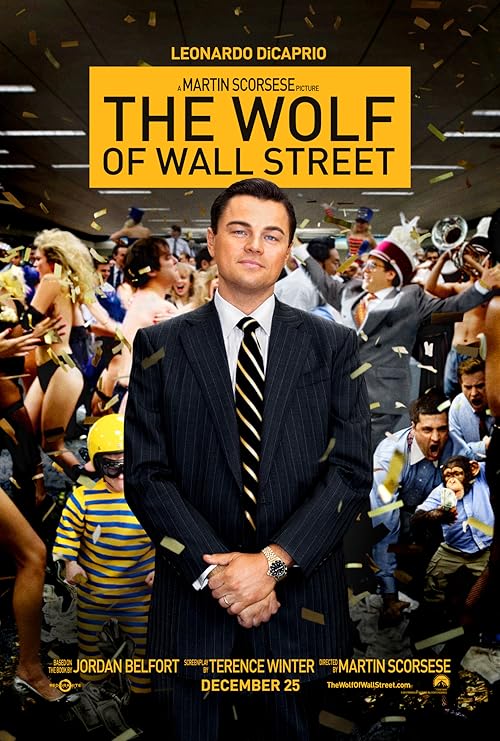
NOT A WOKE TRAP. The Wolf of Wall Street's debauchery is not hidden. Three hours of drugs, sex, fraud, and chest-thumping excess are right there in every trailer. Scorsese never pretended this was anything but a morally chaotic portrait of a man who treated everyone around him as a resource to consume. The film's sympathies are complicated and deliberately uncomfortable, but nobody walks in not knowing what they're getting. The anti-hero framing is visible from the opening scene.
The Wolf of Wall Street is a masterpiece about a man you should despise, made in a way that makes it hard to despise him. That tension is either Scorsese's greatest achievement or his most irresponsible act, depending on your tolerance for moral ambiguity in cinema.
Jordan Belfort (Leonardo DiCaprio) starts as a stockbroker trainee in 1987, gets his broker's license on the day of the Black Monday crash, loses his job, and reinvents himself selling penny stocks to working-class marks. He builds Stratton Oakmont from nothing into a Wall Street machine that generates obscene wealth through systematic fraud. He buys houses, yachts, helicopters, and people. He consumes drugs at quantities that should have killed him. He cheats on his first wife with Naomi (Margot Robbie) and then cheats on Naomi with everyone else. He tries to flee to Europe with millions in Swiss accounts and eventually cooperates with the FBI to reduce his sentence.
Scorsese shoots this at a pace that mimics Belfort's stimulant-fueled worldview. The film is three hours long and feels like ninety minutes. DiCaprio's performance is one for the ages: the chest-thumping speech to the Stratton floor, the Quaalude sequence where he crawls to his car like a dying insect, the phone call to his father while clearly high enough to be in another timezone. This is movie-star performance at its highest level. You understand exactly why people followed this man. And that understanding is the film's danger.
The Wolf of Wall Street is not a cautionary tale. Or rather: it is, but Scorsese refuses to make it feel like one. Belfort narrates in the first person and consistently frames himself as the hero of his own story. The film does not cut away from his perspective long enough to show the victims of his fraud as real people. One brief scene with Agent Denham (Kyle Chandler) on a yacht is the only extended sequence that offers an outside view of Belfort. And even Denham is played as an antagonist whose subway ride home is a small dignity next to Belfort's helicopter.
This is the film's most discussed ideological problem. Scorsese reportedly received letters from real investors who had been defrauded by Belfort praising the film as a celebration of the man who destroyed their savings. Whether the film's final shot, an audience of aspiring salespeople watching Belfort teach another seminar, is indictment or instruction manual is genuinely unclear.
Conservative viewers will find specific things worth engaging with. The film is absolutely a portrait of what happens when the acquisitive impulse is completely decoupled from any moral framework. Belfort has no loyalty to anyone or anything except his next high. He destroys his first wife, destroys Naomi, drives a sober employee back to drink, and cooperates with federal investigators to shorten his own sentence at the expense of everyone around him. The movie shows all of this. It does not look away.
The consequences are also real, if not sufficient. Belfort goes to prison. Stratton Oakmont collapses. Naomi divorces him. Donnie's marriage implodes. The Swiss banker goes to prison. The FBI wins. These are traditional outcomes for traditional failings: greed, infidelity, and the betrayal of the people who trusted you.
But Scorsese doesn't let consequence feel final. The real Belfort, after 22 months in a minimum-security prison, rebuilt his career as a motivational speaker and made more money telling the story of his crimes than he ever made from the crimes themselves. The film ends on that reality. Unresolved and uncomfortable.
Margot Robbie's Naomi is the film's most underwritten major character, and that's intentional. She exists in Belfort's POV, which means she exists as object first and person second. The few moments where she pushes back carry genuine weight precisely because they're rare. Her confrontation with Belfort about the Quaalude-impaired car crash is the clearest window the film offers into what it cost to love this man. Robbie does more with less than anyone else in the cast.
This is not a film for everyone, and it is not a film that will make you feel good about the world. But it is a film made with extraordinary craft about a subject that rewards attention. The depravity is the point. And so is the fact that it's entertaining.
Formula: Weighted Score = Severity × Authenticity Multiplier × Centrality Multiplier
🔴 Woke Tropes
| Trope | Severity | Authenticity | Centrality | Score |
|---|---|---|---|---|
| Glorification of Hedonism and Degeneracy | 4 | 0.7 | 1.8 | 5.04 |
| Sympathetic Anti-Hero Framing (Criminal as Protagonist) | 3 | 1 | 1 | 3 |
| Women as Objects/Props in Male Fantasy | 3 | 0.7 | 1 | 2.1 |
| TOTAL WOKE | 10.1 | |||
🟢 Traditional Tropes
| Trope | Severity | Authenticity | Centrality | Score |
|---|---|---|---|---|
| Consequences of Moral Failure | 3 | 0.7 | 1 | 2.1 |
| American Entrepreneurial Drive (Corrupted) | 3 | 0.7 | 1 | 2.1 |
| TOTAL TRADITIONAL | 4.2 | |||
Score Margin: -6 WOKE
Director: Martin Scorsese
CENTER-LEFT AUTEUR. Scorsese is a Catholic filmmaker whose moral universe is shaped by sin, guilt, and consequence. Politically center-left by Hollywood standards, but his filmmaking is driven by storytelling and craft rather than ideology. His crime films have never been simple morality plays, and this one is his most morally ambiguous.Martin Scorsese is arguably the greatest living American filmmaker. Goodfellas, Raging Bull, Taxi Driver, The Departed, Gangs of New York, Killers of the Flower Moon. His career is defined by immersive portraits of American excess, violence, and moral failure. Wolf of Wall Street is his Caligula: a film so committed to depicting depravity that some audiences enjoyed it as a fantasy rather than a critique. Scorsese was 71 when he made it and brought the same kinetic energy he had at 35. Whether the film condemns Belfort or celebrates him is the central critical debate, and Scorsese has said the ambiguity is intentional. He wants you uncomfortable.
Adult Viewer Insight
This is a film for adults who can hold two things in their heads simultaneously: this man is a villain, and this man is magnetic. If you need movies to moralize clearly, Wolf of Wall Street will frustrate you. It refuses to make Belfort ugly enough to dismiss or sympathetic enough to forgive. What it offers is a precise autopsy of unconstrained ambition, a three-hour demonstration of what happens when a person with real talent and real charisma has no moral architecture to channel it. Conservative adults will recognize the critique underneath the entertainment, because the critique is there. It just doesn't shout. The victims of Belfort's fraud are absent from the film, and that absence is its own kind of comment. DiCaprio deserved the Oscar he didn't win.
Parental Guidance
Rated R. Adults only. This is one of the most aggressively adult films ever to receive wide theatrical release. It contains: over 500 uses of profanity (including 544 uses of a specific expletive, a then-record). Extensive drug use depicted in graphic, sometimes comedic detail. Extreme sexual content throughout, including nudity, orgies, and a scene of marital sexual coercion. Graphic depiction of cocaine addiction. A character snorts cocaine through a rolled-up tube while performing oral sex. A chimpanzee is brought into an office. A midget is thrown at a Velcro dartboard. None of this is appropriate for viewers under 17. The film is not recommended for anyone who struggles with substance use disorder, as the depictions are visceral and sometimes glamorizing.
Find The Wolf of Wall Street on Amazon Prime Video, rent, or buy:
▶ Stream or Buy on AmazonAs an Amazon Associate, VirtueVigil earns from qualifying purchases.
Community Discussion 0
Subscribe to comment.
Join the VirtueVigil community to share your perspective on this review.