Yellowstone
Yellowstone is the most culturally significant conservative television show of the 21st century.…
Full analysis below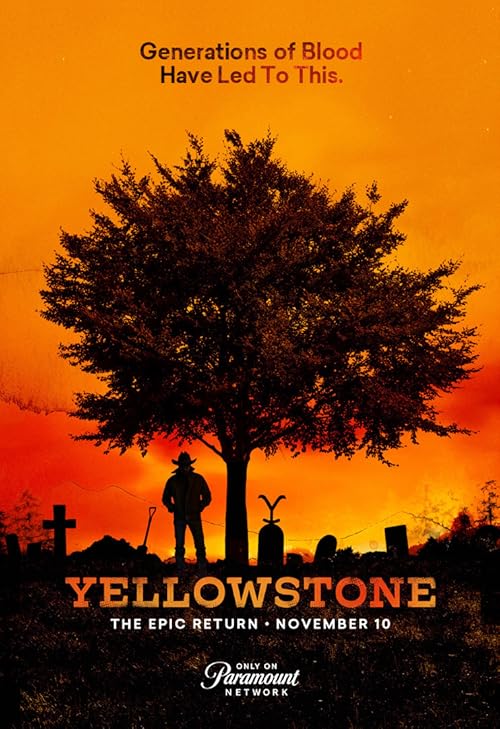
NOT A WOKE TRAP. Yellowstone's progressive elements, including the Native American grievance narrative and Beth's forced-sterilization backstory, are woven into the series from early episodes. No conservative viewer is ambushed. The show is sold and consumed as a culturally right-leaning property, and that read is largely accurate. The woke content is present but clearly secondary to the show's overwhelming traditional framework.
Yellowstone is the most culturally significant conservative television show of the 21st century. Not because Taylor Sheridan set out to make a political statement, but because he made a serious drama about the things that conservative Americans care about, treated those things with genuine respect, and 12 million people showed up every week to watch.
The premise is elemental. John Dutton (Kevin Costner) runs the largest contiguous ranch in Montana. His children, Beth, Jamie, and Kayce, are each brilliant and broken in different ways. His foreman Rip Wheeler is a killer who loves Beth with every molecule of his being. The ranch borders a Native American reservation led by the politically shrewd Chief Rainwater, and land developers keep trying to buy or steal the Duttons' land by any means necessary. Everyone is fighting for the same square miles of Montana, and everyone is willing to go further than the law allows to hold it.
What makes Yellowstone work, and it really works, is that Sheridan takes all of his characters seriously. John Dutton is not a noble patriarch above moral reproach. He orders people killed. He manipulates his children. He uses his connections in state government for private gain. But the show also shows you what he loves: the land, the horses, the sunrise over his pastures, his children even when they infuriate him. Kevin Costner plays all of it with a stillness that only an actor who has spent his career in Westerns can bring. This is one of the great television performances of the era.
Beth Dutton became a cultural phenomenon, and she earns it. Kelly Reilly plays her as a woman formed entirely by trauma, weaponizing her intellect and her cruelty because genuine vulnerability nearly destroyed her once. The forced-sterilization storyline from Season 2 is genuinely harrowing, and it clarifies everything about her. Beth was turned into someone who cannot be a mother by people who wanted to control her family, and she never forgave the world for it. She is also wickedly funny, tender with Rip in ways that feel hard-won, and capable of genuine sacrifice. The show does not let her be a caricature.
The traditional values on display here are the real thing. Property as sacred. Family loyalty over legal obligation. A man's word meaning something. Work as identity. The land as character. These are not affectations or nostalgia. Sheridan grew up on a ranch, and he writes ranch culture from the inside. The scenes with the wranglers, the rodeo riders, the branding and the calving, feel authentic because they are. The show treats rural working people as protagonists of their own stories for maybe the first time in American prestige television.
The traditional masculinity is also treated seriously without becoming parody. Rip Wheeler does not explain himself. He does not process his feelings in therapy-speak. He shows his love through action: by protecting Beth, by breaking the people who hurt her, by building things on the ranch with his own hands. Cole Hauser plays him with an economy of expression that feels genuinely masculine rather than performed. Men in Yellowstone are judged by what they do under pressure, not what they say about themselves. That is a value system many Americans recognize and almost never see on television.
Now for the honest accounting of the show's woke elements.
The Native American storyline is the main one. Chief Rainwater and his counsel Mo use every political and legal tool available to reclaim land stolen from their ancestors. The show treats this as legitimate. It does not portray Rainwater as a villain; it portrays him as a sophisticated operator with genuinely valid grievances playing the same game as the Duttons, just from a different position. Whether you read this as moral relativism or as honest complexity depends on your starting position. The show never pretends the Duttons' ancestors were innocent.
Beth's forced sterilization, while treated as a crime and a tragedy, is also used to frame one of the few scenes in the show involving abortion. Young Beth did not know she was consenting to sterilization when Jamie took her to a Native clinic that performed abortions. This is narratively complex: the crime was not the abortion but the lack of informed consent. The show does not take a position on abortion itself, but it does frame the sterilization as a violation of Beth's bodily autonomy, which is progressive language. It also frames it as a crime against motherhood and family, which is traditional language. The ambiguity is probably intentional.
The corporate villain framework, in which land developers and real estate interests are portrayed as the primary threat to traditional ways of life, is not inherently progressive, but it maps onto a critique of capitalism that is more associated with the left than the right. Sheridan has explicitly said the show is about 'corporate greed and the gentrification of the West.' Libertarian conservatives who see property rights and free markets as aligned should be aware that Yellowstone is skeptical of unfettered development capital.
None of this overwhelms the show's traditional core. The Dutton family fights to preserve what their ancestors built. The show treats land ownership, family loyalty, and masculine virtue as worth fighting for, literally. The woke elements are context and texture, not thesis. The traditional elements are the spine.
The final season's production drama, Kevin Costner's departure after Season 5A due to conflicts with Sheridan over scheduling and creative direction, is worth noting. Season 5B managed Dutton's exit without Costner and wrapped the Dutton saga. Whether the conclusion satisfies will depend on the viewer. The show's ending is more elegiac than triumphant, which fits the elegiac quality of the best Westerns.
Yellowstone is not perfect television. The plotting in middle seasons is sometimes muddy. Some storylines, particularly Jamie's political career in Seasons 3 and 4, drag. The show is at its best in its visceral, almost wordless scenes of men and women working land they love and fighting to keep it.
But it is honest television. It respects its characters, its setting, and its audience. In an era when rural Americans are usually either invisible or mocked in popular culture, Yellowstone made them the center of the story. That matters.
Formula: Weighted Score = Severity × Authenticity Multiplier × Centrality Multiplier
🔴 Woke Tropes
| Trope | Severity | Authenticity | Centrality | Score |
|---|---|---|---|---|
| Forced Sterilization / Bodily Autonomy Framing | 4 | 1 | 1 | 4 |
| Indigenous Grievance Narrative | 3 | 0.7 | 1 | 2.1 |
| Development Capital as Villain | 2 | 0.7 | 1 | 1.4 |
| Anti-Development Environmentalism | 2 | 0.7 | 0.5 | 0.7 |
| TOTAL WOKE | 8.2 | |||
🟢 Traditional Tropes
| Trope | Severity | Authenticity | Centrality | Score |
|---|---|---|---|---|
| Family Legacy as Supreme Value | 5 | 0.7 | 1.8 | 6.3 |
| Traditional Masculinity as Virtue | 4 | 0.7 | 1.8 | 5.04 |
| Land Ownership and Property Rights as Sacred | 4 | 0.7 | 1.8 | 5.04 |
| Loyalty and Duty Over Personal Desire | 4 | 0.7 | 1 | 2.8 |
| Consequences for Moral Failure | 3 | 0.7 | 1 | 2.1 |
| Stable Marriage and Family Unit | 3 | 0.7 | 1 | 2.1 |
| TOTAL TRADITIONAL | 23.4 | |||
Score Margin: +15 TRAD
Director: Taylor Sheridan (Creator/Writer/Director)
CENTER-RIGHT with libertarian streaks. Sheridan grew up on a ranch, worked as an actor for years before switching to writing, and has said he came from poverty before making his fortune. He's described Yellowstone as 'The Godfather in Montana' and consistently defends the show against both conservative and progressive attempts to claim it. He has pushed back on the 'anti-woke' branding, saying the show is about corporate greed, Native displacement, and the gentrification of the West. But his storytelling instincts are deeply old-school: family, land, loyalty, and earned respect.Taylor Sheridan grew up on a cattle ranch in Texas and spent years as a working actor before writing Sicario (2015), which launched his career. He created Yellowstone with producer John Linson in 2017, pitching it to HBO first (they passed) before landing at Paramount Network. Sheridan writes the majority of the episodes himself, shoots the action sequences, and is deeply involved in every production decision. He is one of the most prolific writer-producers in television history, simultaneously running Yellowstone, 1883, 1923, Tulsa King, Mayor of Kingstown, and multiple other Paramount+ series. He films on real Montana ranches and is obsessive about authenticity in horsemanship, ranch work, and Western geography. Sheridan is resistant to reductive political labels on the show, but his sympathies are clearly with rural working people, property rights, and self-reliance.
Adult Viewer Insight
Conservative viewers are right that Yellowstone is their show. It treats rural culture, property rights, traditional masculinity, and family loyalty as legitimate and worth defending in a media environment that usually condescends to all four. The show earns its conservative audience honestly. Progressive critics who dismiss it as 'cowboy propaganda' are missing the genuine craft at work. The Beth Dutton character alone is more psychologically complex than anything in most prestige drama. Taylor Sheridan is not a propagandist. He is a storyteller who happens to find the material of rural Western America more interesting than urban liberal professionals. That is a radical act in 2024 Hollywood, which is exactly why 12 million people watched it every week.
Parental Guidance
Find Yellowstone on Amazon Prime Video, rent, or buy:
▶ Stream or Buy on AmazonAs an Amazon Associate, VirtueVigil earns from qualifying purchases.
Community Discussion 0
Subscribe to comment.
Join the VirtueVigil community to share your perspective on this review.