Civil War
Alex Garland spent years watching political tribalism eat the American conversation, and his response was to make a movie that would give everyone something to hate and something to love.…
Full analysis below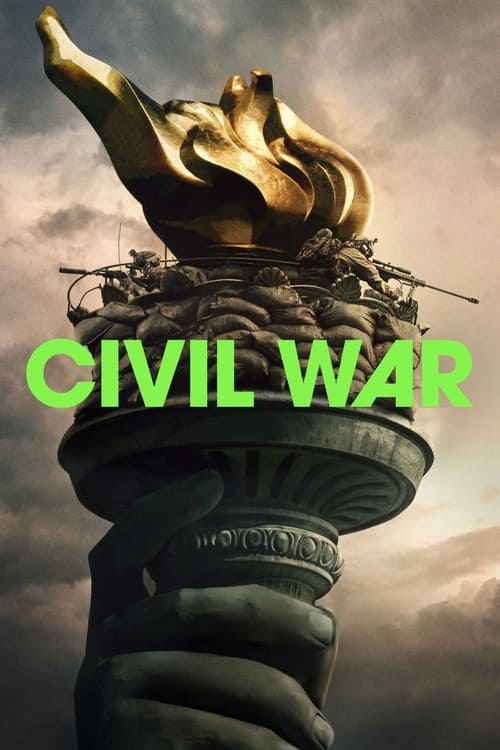
This film draws you in for a significant portion of its runtime with traditional or neutral content before springing its woke agenda. Know before you go!
SIGNIFICANT WOKE TRAP. Civil War sold itself as apolitical, and the marketing worked on conservatives who were exhausted by overtly preachy cinema. The film's political ambiguity is genuine on the surface - Garland refused to name the President's party - but the underlying architecture is progressive: the press is heroic, government is tyrannical, and the most morally righteous characters are female photojournalists bearing witness to state violence. The Texas+California alliance was designed to confuse, not to represent. The film's fascist President is coded to be read as a Trump-era warning. Many conservatives walked in expecting validation and received a carefully constructed press-freedom parable instead.
Alex Garland spent years watching political tribalism eat the American conversation, and his response was to make a movie that would give everyone something to hate and something to love. Civil War arrived in April 2024 as one of A24's highest-grossing films ever, and it set off a culture-war fight about what it was actually saying. That fight, it turns out, was the whole point.
Classification: MIXED
Confidence: MEDIUM
Woke Trap Assessment
SIGNIFICANT WOKE TRAP. Civil War is the most successful woke trap of 2024 - a film that sold itself as apolitically terrifying and collected enthusiastic reviews from conservative viewers who had grown starved for action cinema that didn't lecture them. The political mapping Garland constructed - Texas and California as unlikely allies against a fascist three-term President - was specifically designed to resist easy interpretation. It worked. But the film's underlying architecture is not neutral. It is a press-freedom parable, the photojournalist as hero, government as executer of its own citizens, truth-telling as the last defense against tyranny. These are not conservative values in the 2024 sense of the word. The trap is real and it caught a lot of people.
Creative Team at a Glance
- Director / Writer: Alex Garland - British auteur, Ex Machina, Annihilation. Consistently places female protagonists against male institutional threat. Marketably apolitical. Ideologically legible.
- Lead Producer: Andrew Macdonald, DNA Films
- Distributor: A24
- Top Cast: Kirsten Dunst (Lee), Wagner Moura (Joel), Cailee Spaeny (Jessie), Stephen McKinley Henderson (Sammy), Jesse Plemons (Soldier)
- Pre-Viewing Prediction: MIXED - Garland's track record of female-moral-authority narratives plus the press-freedom subject matter suggested a left-leaning lean, but the deliberate political camouflage complicated the call. Prediction: Confirmed.
- Fidelity Casting: ACCURATE - Near-future setting with no historical baseline to violate.
The year is unspecified. America is at war with itself. A coalition called the Western Forces - improbably comprising Texas and California - has been fighting to remove the President, who has suspended FBI, ordered drone strikes on American citizens, and is now making his last stand as WF troops close in on Washington, D.C.
Lee Smith (Kirsten Dunst) is a legendary war photographer who has spent her career in international combat zones. She is tired. She drinks alone. She photographs with mechanical precision the thing that used to move her. Joel (Wagner Moura) is a reporter for Reuters. He is determined to get to D.C. and interview the President before the end - the last presidential interview in American history. It's a scoop that could define a career or get them both killed.
Jessie (Cailee Spaeny) is a young aspiring photographer who idolizes Lee. She falls in with their convoy after Lee saves her life during a street attack. Sammy (Stephen McKinley Henderson) is a veteran print journalist, gentle and mordant, who joins as the fourth member.
The film is a road trip across a shattered America. The group travels from New York through Pennsylvania, into the rural Mid-Atlantic, navigating checkpoints, snipers, guerrilla skirmishes, and civilian massacres. They stop at a Charlottesville-adjacent township whose residents enforce a murderous racial hierarchy with no apparent political affiliation. They photograph mass graves. They listen to American soldiers shoot American prisoners.
Along the way, Jessie learns to photograph. Lee learns that she still cares. Joel barely survives. Sammy does not survive.
They make it to D.C. The Western Forces breach the White House. The President - shown only briefly, sweating, pathetic - begs for his life, promises deals, promises anything. Lee photographs him being shot dead by WF soldiers. Jessie photographs Lee. The film ends on Jessie's face, transformed by what she has witnessed into the thing Lee already was: a war photographer. The cycle continues.
Trope Analysis - VVWS Weighted Scoring
Formula: Weighted Score = Severity x Authenticity Multiplier x Centrality Multiplier
Authenticity: High=0.7, Moderate=1.0, Low/Injected=1.4 | Centrality: Low=0.5, Moderate=1.0, High=1.8
Red Woke Tropes
| Trope | Severity (1-5) | Auth | Centrality | Weighted Score |
|---|---|---|---|---|
| Press Freedom as Absolute Heroism | 4 | 1.0 | 1.8 | 7.2 |
| Government as Irredeemable Tyranny | 3 | 0.7 | 1.8 | 3.78 |
| Female Photojournalist as Moral Anchor | 3 | 1.0 | 1.8 | 5.4 |
| Racial Violence Coding (Jesse Plemons scene) | 3 | 1.4 | 1.0 | 4.2 |
| Youth Ascending / Mentor Declining | 2 | 1.0 | 1.0 | 2.0 |
| WOKE TOTAL | 22.58 |
Green Traditional Tropes
| Trope | Severity (1-5) | Auth | Centrality | Weighted Score |
|---|---|---|---|---|
| War's Horror Depicted Without Glorification | 4 | 0.7 | 1.8 | 5.04 |
| No Political Heroes - Both Sides Corrupt | 4 | 0.7 | 1.8 | 5.04 |
| Cost of Violence on Those Who Document It | 3 | 0.7 | 1.0 | 2.1 |
| Sacrifice and Death Have Weight and Consequence | 3 | 0.7 | 1.0 | 2.1 |
| Journalistic Cynicism / No Easy Answers | 3 | 1.0 | 1.0 | 3.0 |
| TRAD TOTAL | 17.28 |
Score Margin: -4 WOKE
Director Track Record
Alex Garland began as the novelist who wrote The Beach, a travel fantasy that the film industry turned into a Leonardo DiCaprio vehicle. He spent years as a screenwriter - 28 Days Later, Sunshine, Never Let Me Go, the Dredd reboot - before directing Ex Machina in 2014. The directorial career since then has been consistent in theme even when inconsistent in genre.
Ex Machina (2014) is a Frankenstein story about a tech billionaire who builds a female AI in order to exploit it. The male characters are vain, deluded, and dangerous. The female AI survives by understanding them better than they understand themselves. The film is brilliant and its feminist reading is not a stretch - it is the film's premise.
Annihilation (2018) sends an all-female team of scientists into a government quarantine zone called the Shimmer. The government is lying to them. The expedition is a suicide mission. The men who sent them in are bureaucrats and cowards. The women who go in have more curiosity, more courage, and more honest reckoning with themselves. The film is genuinely strange and genuinely great and its gender politics are unmistakable.
Men (2022) is the most explicitly ideological entry - a horror film about a woman on a solo retreat after her husband's suicide, set upon by a single actor playing every threatening male figure in the village. The film literalizes male violence as a single, repeating, regenerating threat. Critics were divided. The politics were not ambiguous.
Civil War (2024) is the most commercially ambitious and politically calibrated entry. Garland knew exactly what he was doing with the Texas-California alliance. He knew it would read as apolitical. He built that into the marketing. The film still has his signature DNA: female moral authority at its center, institutional power as threat, violence depicted without glory.
Pattern Assessment: 4 directorial features. All feature female protagonists in environments of institutional or male threat. All are ideologically consistent. Garland is not right-wing. His brand of apolitical framing is commercially savvy and ideologically sincere at the same time. Civil War is his most successful deployment of that strategy. Ideological tendency: PROGRESSIVE-LIBERAL, anti-authoritarian, press-freedom advocate. Consistent across career.
Full Cast
| Actor | Role |
|---|---|
| Kirsten Dunst | Lee Smith |
| Wagner Moura | Joel |
| Cailee Spaeny | Jessie |
| Stephen McKinley Henderson | Sammy |
| Jesse Plemons | Soldier |
| Sonoya Mizuno | Anya (Journalist) |
| Nick Offerman | The President |
| Jefferson White | Dave |
| Nelson Lee | Tony |
| Evan Lai | Bohai |
| Karl Glusman | Reuters Journalist |
Adult Viewer Insight
Conservative viewers who have already seen Civil War will likely recall feeling caught off-guard - perhaps pleasantly, perhaps not. The film does not lecture. It does not have a single character explain the right political position. The violence lands on all sides. Soldiers from the Western Forces execute prisoners. The President begs for his life before being shot by his own liberation. Nobody wins in a clean or moral sense.
That experience is real and worth acknowledging. But there are three things worth thinking about on reflection.
First, the press freedom argument is the film's moral spine. Lee and Joel are risking their lives to document the truth - and in the film's moral architecture, that act of documentation is sacred. The photojournalist as secular saint is a very specific ideological position in 2024 America, where the press-trust relationship between conservatives and mainstream media has been shattered. A film that places heroic, truth-seeking, morally serious journalists at its center is not making a neutral statement.
Second, the Jesse Plemons scene. A white man with a rifle asks a captured journalist where they are from. "American," Joel answers. "What kind of American?" the soldier presses. He shoots the Americans he decides are the wrong kind. This is the film's most terrifying scene, and it is coded in a very specific way. The soldier is not given political affiliation, but the racial sorting - deciding who counts as American based on origin - is a pointed invocation of contemporary white nationalist rhetoric. This was not an accident.
Third, the female moral authority structure. Lee is the film's emotional and ethical compass. She saves Jessie. She makes the calls. She photographs the President's death with professional detachment that the male characters cannot achieve. Garland has done this in every film he has made. It is a pattern, not a coincidence.
None of this makes Civil War a bad film. It is in fact an exceptional film - one of the best-crafted American action movies in years, with a final assault on the White House that is as viscerally convincing as anything in recent cinema. But it is not the apolitical film its marketing suggested. Understanding what it is actually doing makes the experience richer, not poorer.
Parental Guidance
Rated R for strong violent content, bloody/disturbing images, and language.
Violence - SEVERE:
- Mass execution of prisoners. People shot at close range. Bodies in mass graves.
- Sniper warfare depicted with sudden, graphic realism. Main characters die without warning.
- The Jesse Plemons scene: a prisoner is shot in the face at close range.
- The White House assault: automatic weapon fire, hand-to-hand combat, sustained urban warfare.
- Wounded characters depicted with realistic injury - blood, shock, visible wounds.
- Corpses throughout, including decomposing bodies in the open.
Language - MODERATE:
- F-word used regularly. No slurs except in context of the Plemons scene.
Sexual Content:
- None.
Substance Use:
- Lee drinks heavily. Joel drinks. No explicit substance abuse subplot.
Ideological Content for Parental Awareness:
- The film presents press freedom as a supreme value.
- Government is depicted as willing to murder its own citizens.
- The racial sorting scene raises pointed questions about American identity and who "counts."
- The film deliberately refuses resolution - no political side is validated.
Age Recommendation: 16+. Not appropriate for younger teens. The violence is realistic and psychological as well as physical. The Plemons scene in particular is deeply disturbing and has upset adult viewers at screenings. The film's political ambiguity makes it genuinely valuable for older teenagers as a conversation starter about war, journalism, and American identity - but that conversation requires adult facilitation.
Review by VirtueVigil Editorial Team | February 19, 2026
Civil War (2024) | Dir. Alex Garland | A24 / Amazon
VVWS Score: MIXED -4 | authIndex: 60
Formula: Weighted Score = Severity × Authenticity Multiplier × Centrality Multiplier
🔴 Woke Tropes
| Trope | Severity | Authenticity | Centrality | Score |
|---|---|---|---|---|
| Press Freedom as Absolute Heroism | 4 | Moderate | High | 7.2 |
| Government as Irredeemable Tyranny | 3 | High | High | 3.78 |
| Female Photojournalist as Moral Anchor | 3 | Moderate | High | 5.4 |
| Racial Violence Coding in the Plemons Scene | 3 | Low | Moderate | 4.2 |
| TOTAL WOKE | 20.6 | |||
🟢 Traditional Tropes
| Trope | Severity | Authenticity | Centrality | Score |
|---|---|---|---|---|
| War's Horror Depicted Without Glorification | 4 | High | High | 5.04 |
| No Political Heroes - Both Sides Are Corrupt | 4 | High | High | 5.04 |
| Cost of Violence on Those Who Document It | 3 | High | Moderate | 2.1 |
| Journalistic Cynicism / No Easy Answers | 3 | Moderate | Moderate | 3 |
| TOTAL TRADITIONAL | 15.2 | |||
Score Margin: -4 WOKE
Director: Alex Garland
PROGRESSIVE-LIBERAL - consistently anti-authoritarian from a left-press-freedom perspective. His work critiques surveillance, institutional power, and government control. Apolitical in marketing, ideologically legible in execution.British writer-director born 1970 in London. Began as a novelist (The Beach, 1996) before pivoting to screenwriting (28 Days Later, Sunshine, Never Let Me Go, Dredd) and directing. His directorial work - Ex Machina (2014), Annihilation (2018), Men (2022), Civil War (2024) - consistently places female protagonists in environments of male-controlled institutional threat. Ex Machina is explicitly about male technology and its exploitation of female AI. Annihilation features an all-female expedition into a mysterious government zone. Men is a folk-horror film about male violence. Civil War places a female photojournalist as the moral center of a story about government brutality. The pattern is consistent. Garland does not describe himself as political but his filmography has an unmistakable ideological gravity: institutions are dangerous, women operate with moral clarity men lack, and the state's claim to legitimacy is always suspect.
Writer: Alex Garland
Sole credited writer, as on all his directorial projects. Garland's screenplays are structurally sophisticated and deliberately ambiguous in political detail while being ideologically pointed in theme. He calibrated Civil War's political ambiguity carefully - the Texas-California alliance, the unnamed party affiliation of the President - to make the film sellable across the political spectrum while keeping its press-freedom thesis intact. He has said he wanted viewers to 'project their own fears' onto the film. This is either artistic humility or a very sophisticated marketing decision. Probably both.
Producers
- Andrew Macdonald (DNA Films) — Long-time Garland collaborator. Co-produced Trainspotting, 28 Days Later, Never Let Me Go, and Garland's full directorial run. Follows creative vision; no independent ideological signal.
- A24 (A24) — The prestige indie distributor whose brand is critical acclaim and cinematic ambition. A24's output skews progressive (Everything Everywhere, Moonlight, Midsommar) but they will back any film with awards potential and cultural heat. Their involvement signals serious cinematic intent, not a specific political agenda.
Fidelity Casting Analysis ACCURATE
The casting reflects realistic diversity for a near-future American road trip through contested territory. No significant fidelity issues.
Civil War is set in a near-future fictional America, not based on historical events, so fidelity casting applies loosely. The photojournalism world is diverse and the cast reflects that. Lee Smith (Kirsten Dunst) and Joel (Wagner Moura) are plausible as veteran war correspondents. Jesse Plemons' unnamed soldier - one of the film's most disturbing scenes - is a white man executing prisoners based on accent and stated origin. This detail has been noted as pointed: a white nationalist soldier who separates acceptable Americans from those who should die. The racial coding of this scene is not accidental.
Adult Viewer Insight
Civil War is the most successful woke trap A24 has produced. The film's genuine political ambiguity - the Texas-California alliance, no named party for the President, violence on all sides - is real and earned, not manufactured. Garland genuinely believes that showing horror without political labels is more powerful than choosing sides. He is right, artistically. But the film's moral architecture is not neutral. The photojournalist as hero is a very 2024 progressive position. The press-freedom thesis runs through every scene. The Jesse Plemons scene - a white soldier racially sorting who counts as a real American - is coded with unmistakable contemporary precision. And Lee (Dunst) is Garland's signature female moral authority, the clear-eyed woman navigating a world of dangerous, confused men. Conservative viewers who felt Civil War was different from the usual Hollywood output were not wrong - it is formally exceptional, restrained in its politics, and genuinely terrifying. But they should understand what they were absorbing: a press-freedom parable dressed in action-movie clothing.
Parental Guidance
Rated R. Strong violent content throughout - mass executions, sniper kills, urban warfare, close-range shootings. The Jesse Plemons scene (a soldier racially sorting captured journalists and shooting the wrong kind at close range) is deeply disturbing and has upset adult viewers. Bodies appear throughout in various states of decomposition. The White House assault is realistically violent. No sexual content. Moderate language. The film's political ambiguity makes it valuable as a conversation starter for older teenagers (16+) but requires adult context. Not appropriate for younger audiences.
Find Civil War on Amazon Prime Video, rent, or buy:
▶ Stream or Buy on AmazonAs an Amazon Associate, VirtueVigil earns from qualifying purchases.




Community Discussion 0
Subscribe to comment.
Join the VirtueVigil community to share your perspective on this review.