
Flow
Here is the thing about Flow: it should not be this good. A Latvian animated film made by one person over five years, using free software, with no dialogue, no human characters, and a $3.5 million budget going up against Disney, Pixar, and DreamWorks at the Academy Awards. It won.…
Full analysis below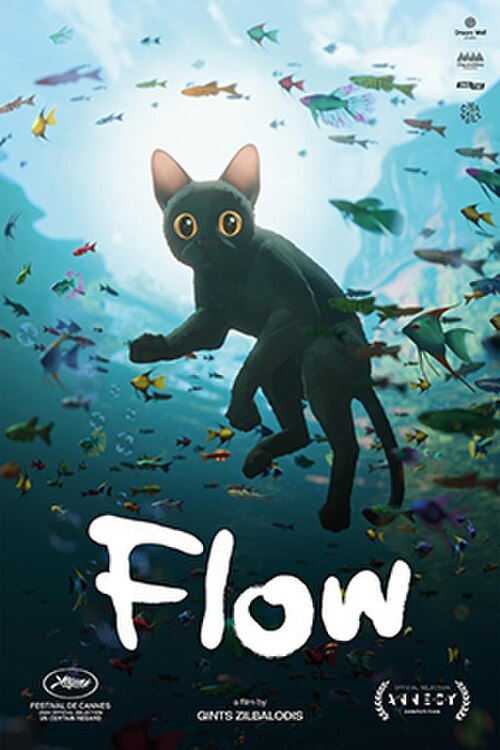
Not a woke trap. Flow's environmental allegory is present in the premise from the first frame: humans are gone, the world is flooded. This is not hidden. Critics and the filmmaker himself have described it as an ecological fable. Conservative viewers who have concerns about climate change messaging will see it coming immediately. The film has no dialogue, no political lectures, and no human characters to serve as progressive mouthpieces. The ecological subtext is visible but not belligerent.
Here is the thing about Flow: it should not be this good. A Latvian animated film made by one person over five years, using free software, with no dialogue, no human characters, and a $3.5 million budget going up against Disney, Pixar, and DreamWorks at the Academy Awards. It won. Latvia's first Oscar ever. And it earned it.
Gints Zilbalodis made Flow the way a craftsman makes a chair: alone, slowly, paying attention to every joint. The director wrote it, animated it, shot it, edited it, and composed its score. The result is something that looks nothing like what a film made this way should look like. The animation is genuinely beautiful. The camera work is inventive. The sound design does the work that dialogue usually does. This is legitimate artistry.
The story is simple enough. A cat, solitary and self-sufficient, gets swept up in a massive flood. The world's humans are gone. The cat climbs aboard a sailboat with a capybara, eventually joined by a Labrador, a ring-tailed lemur, and a secretary bird with an injured wing. They navigate a drowned world together. There are no names. There is no spoken language. The relationships develop through behavior alone. The cat learns that its instinct toward isolation is not survival; cooperation is. This is the whole movie.
Let me be direct about the ideological layer, because that's what VirtueVigil is for. Critics call Flow an 'ecological fable.' The director himself has described it in those terms. The missing humans are the film's central mystery, and the implication, which Zilbalodis doesn't belabor but doesn't hide either, is that humanity's relationship with nature led to this flood. This is climate messaging. It is not aggressive or preachy. It is more in the tradition of a fable than a protest sign. But it is present, and honest viewers should acknowledge it.
Here is where I part ways with the reflexive conservative dismissal of anything with environmental themes. Flow is not An Inconvenient Truth with cats. The film is not interested in assigning blame. It is interested in what survives. And what survives is the same thing that has always survived: creatures who stop fighting each other and start building something together. The cat's character arc is about learning to trust, to contribute, to accept help. The lemur hoards trinkets and starts fights. The secretary bird's pride gets the boat stuck. The Labrador gives freely and receives freely. The film's moral universe sorts characters by virtue, not by species or demographic. That is a conservative moral framework, even if the setting involves a climate-coded catastrophe.
The tension in the film is between the cat's deep instinct for independence and the reality that independence alone gets you drowned. There is no progressive condemnation of individualism here. The cat never stops being a cat. But it learns that a self-sufficient creature can also choose to help a capybara down from a tree without losing anything essential. This is not the progressive 'rugged individualism is toxic' message. It is something closer to the conservative 'community is what individuals build together' message.
The film's spirituality is worth discussing. The climax involves a portal of light that the secretary bird, having developed real bonds with the group, chooses to fly toward. It is explicitly transcendent: gravity disappears, light opens above them, the bird ascends. Zilbalodis has not explained this scene in theological terms. It reads as an acknowledgment that some things exist beyond the material, and that loyalty and sacrifice might be connected to something beyond survival. Some Christian viewers have found this genuinely moving. Others will find it aesthetically spiritual without doctrinal content, which is accurate.
For traditional families, Flow is an unusually safe choice in a year when family animation has been less safe. There is no LGBTQ content. There is no political advocacy. There are no human characters to serve as progressive mouthpieces. The film's values are cooperation, loyalty, sacrifice, and the willingness to set aside selfishness for the sake of others. These are values that map comfortably onto a traditional worldview, onto Christian teaching, onto the moral intuitions of most parents regardless of politics.
The only meaningful concern for conservative viewers is the ecological allegory's premise: humans are gone because something went wrong with their relationship to nature. If you want your children to take a simple 'the environment is fine' message from their entertainment, Flow will complicate that. If you want your children to understand that creation is worth respecting and that selfishness has costs, Flow illustrates that point beautifully.
Zilbalodis made this film alone in the most literal sense. One person, five years, Blender software, $3.5 million. The result won Latvia its first Oscar. That story is, itself, a conservative parable: individual effort, sustained patience, mastery of craft, the refusal to wait for permission or resources to do the work you believe in. Whatever its ecological subtext, Flow is the product of a person who sat down and made something without waiting for a studio to validate the idea. That should resonate.
Formula: Weighted Score = Severity × Authenticity Multiplier × Centrality Multiplier
🔴 Woke Tropes
| Trope | Severity | Authenticity | Centrality | Score |
|---|---|---|---|---|
| Environmental Catastrophe Allegory (Climate Fable) | 3 | 0.7 | 1.8 | 3.78 |
| Absence of Human Civilization / Anti-Anthropocentric Framing | 2 | 1 | 1 | 2 |
| TOTAL WOKE | 5.8 | |||
🟢 Traditional Tropes
| Trope | Severity | Authenticity | Centrality | Score |
|---|---|---|---|---|
| Community Over Isolation (Cooperation as Survival) | 4 | 0.7 | 1.8 | 5.04 |
| Selfishness Has Costs / Virtue Rewarded | 3 | 0.7 | 1 | 2.1 |
| Absence of Progressive Ideology (No Dialogue, No Lectures) | 2 | 0.7 | 1 | 1.4 |
| Sacrifice and Transcendence (The Secretary Bird's Arc) | 3 | 0.7 | 1 | 2.1 |
| TOTAL TRADITIONAL | 10.6 | |||
Score Margin: +5 TRAD
Director: Gints Zilbalodis
CENTER-LEFT. Zilbalodis has described Flow as an ecological fable and has expressed concern for the natural world in interviews. His previous film Away (2019) was similarly solo-animated and environmentally conscious. He is not a culture warrior; he is a craftsman with a particular sensitivity to the natural world. His politics, insofar as they appear in his work, manifest as care for non-human creatures rather than as progressive identity politics.Gints Zilbalodis is a Latvian filmmaker who began his career making solo animations as a teenager. Away (2019), his feature debut, was created entirely by himself and earned international distribution and festival acclaim. Flow took five years, cost 3.5 million euros, and was produced using Blender, a free open-source animation program. At the 97th Academy Awards, Flow won Best Animated Feature, becoming Latvia's first-ever Oscar winner. Both statuettes (Flow was also nominated for Best International Feature Film) are displayed at the Latvian National Museum of Art. Zilbalodis is 29 years old.
Adult Viewer Insight
Conservative adults who have written off 'eco films' will miss something real if they skip Flow. The environmental allegory is present but not hectoring. What the film actually cares about is character. The cat's journey from isolation to cooperation is a classical moral arc dressed in ecological clothing. The craft itself is worth your attention: one person made this over five years, in free software, with no studio backing, and it won the most prestigious animated film award in the world. That is not an ideological achievement. That is a craft achievement. Watch it on the biggest screen you can find.
Parental Guidance
Not rated in the US. Generally suitable for ages 5 and up. There is no dialogue, no profanity, no sexual content, no LGBTQ content. The film's tension comes from survival peril rather than violence. Animals are sometimes in danger of drowning. One character sacrifices himself in a transcendent sequence that some young children may find confusing or sad. The flood imagery is visually striking but not traumatizing. The ecological premise (humans are absent from a flooded world) may prompt questions about climate change that parents should be prepared to address according to their values. The film does not answer these questions; it simply raises them through its setting.
Find Flow on Amazon Prime Video, rent, or buy:
▶ Stream or Buy on AmazonAs an Amazon Associate, VirtueVigil earns from qualifying purchases.
Community Discussion 0
Subscribe to comment.
Join the VirtueVigil community to share your perspective on this review.