
Greenland 2: Migration
Greenland 2: Migration is a deeply traditional film wearing the clothes of a post-apocalyptic thriller. Strip away the CGI meteor showers and the frozen English Channel, and what remains is the oldest story in the book: a dying father walks his family to the promised land.
Full analysis below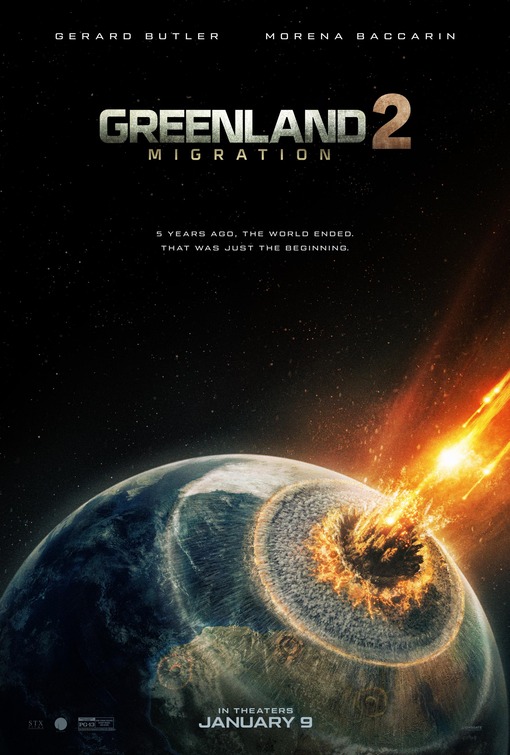
NOT A WOKE TRAP. The Migration subtitle raised eyebrows given real-world political debates around immigration, but the film earns the word honestly. The Garrity family is literally migrating across a destroyed continent to find habitable land. There is no lecture about open borders or refugee policy. The parallels exist, but the story never weaponizes them. What you see in the trailer is what you get in the theater.
Greenland 2: Migration is a deeply traditional film wearing the clothes of a post-apocalyptic thriller. Strip away the CGI meteor showers and the frozen English Channel, and what remains is the oldest story in the book: a dying father walks his family to the promised land.
Five years after the Clarke comet obliterated civilization, the Garrity family has been surviving in an underground bunker near Thule Air Base in Greenland. John (Gerard Butler) scouts the radioactive surface. Allison (Morena Baccarin) has become a community leader underground. Their son Nathan (Roman Griffin Davis, replacing Roger Dale Floyd) is now a teenager desperate to contribute. When an earthquake destroys the bunker and kills most of its inhabitants, the family is forced onto the surface with a handful of survivors, aiming for a rumored oasis in the Mediterranean crater where the comet struck.
What follows is an episodic, sometimes grinding journey across the ruins of Liverpool, London, the English Channel (now a dry canyon), and France. They encounter marauders, a woman caring for abandoned Alzheimer's patients, a French family willing to share their shelter, and a military front line defending the crater region. Along the way, their companion Dr. Amina is shot and killed by bandits, and John's radiation sickness from years of surface scouting progresses to the point of terminal certainty.
The film's core strength is also what critics have attacked it for: it is relentlessly sincere. This is not a movie interested in irony, subversion, or post-modern commentary. John Garrity is a man who protects his family. That is his purpose. When he dies within sight of the crater's fertile green valley, having taken a bullet defending the group from an ambush, it is not played for shock. It is played as the completion of a promise. Butler, bearded and visibly deteriorating throughout the film, gives his best performance in years. He does not oversell it. He lets the physical toll speak.
Baccarin is notably improved from the first film. Allison is not a passive spouse here. She runs the bunker community, makes hard triage decisions about resources, and becomes the family's leader as John weakens. Importantly, this is not framed as feminist empowerment. It is framed as a wife stepping into the breach because her husband is dying. The film respects both roles without politicizing either.
The migration metaphor is present but handled with restraint. Yes, the Garritys are refugees. Yes, they are dependent on the kindness of strangers. But the film never lectures about immigration policy or draws explicit parallels to contemporary debates. The word migration describes what is literally happening. People are moving across a destroyed continent to survive. Variety's Owen Gleiberman noted the political themes but also observed that the film is 'so dull it makes you want to migrate out of the theater.' That's unfair. The pacing is deliberate, and the middle section does sag, but calling a film about a father dying to save his family dull says more about the critic than the movie.
The environmental allegory is similarly organic. A comet destroyed the world. Radiation, electromagnetic storms, and earthquakes are the consequences. A scientist mentions the Cretaceous extinction event in passing. None of this is weaponized into a climate lecture. It is simply the setting.
Where the film stumbles is in its secondary characters. Dr. Amina is introduced as a significant presence and then killed off abruptly to raise stakes. The French family appears and disappears. The Nigerian driver has one scene of genuine warmth and then vanishes. These are the marks of a script that needed another draft, not of ideological malpractice.
The ending, where the family reaches the crater and finds green farmland, fresh water, and clear skies, is unabashedly hopeful. John dies having delivered his family to safety. Nathan and Allison step into a new world. The traditional Irish blessing recited at an earlier burial is echoed in the final moments. It is corny. It is also earned.
Greenland 2: Migration is not a great film. It is a PG-13 action sequel with a $90 million budget that made $41 million and got a B-minus CinemaScore. But it is an honest film. Its values are family, sacrifice, perseverance, and hope. It does not apologize for any of them.
Formula: Weighted Score = Severity × Authenticity Multiplier × Centrality Multiplier
🔴 Woke Tropes
| Trope | Severity | Authenticity | Centrality | Score |
|---|---|---|---|---|
| Environmental Catastrophe as Moral Allegory | 2 | Moderate | Moderate | 2 |
| Migration and Refugee Parallel | 2 | Moderate | Moderate | 2 |
| Female Leadership Elevation | 2 | High | Low | 0.7 |
| Secular Worldview (Old Earth Reference) | 1 | High | Low | 0.35 |
| TOTAL WOKE | 5.0 | |||
🟢 Traditional Tropes
| Trope | Severity | Authenticity | Centrality | Score |
|---|---|---|---|---|
| Father's Ultimate Sacrifice | 5 | High | High | 6.3 |
| Nuclear Family as Survival Unit | 4 | High | High | 5.04 |
| Traditional Masculinity as Protector | 3 | High | High | 3.78 |
| Community Through Hospitality and Generosity | 2 | High | Moderate | 1.4 |
| Death Faced with Dignity and Purpose | 3 | High | Moderate | 2.1 |
| TOTAL TRADITIONAL | 18.6 | |||
Score Margin: +14 TRAD
Director: Ric Roman Waugh
NEUTRAL to TRADITIONAL LEAN. Waugh makes muscular, straightforward action films centered on male protagonists facing physical and moral tests. No visible ideological agenda.Waugh is a former stuntman turned director whose filmography includes Shot Caller (2017), Angel Has Fallen (2019), and the original Greenland (2020). His films consistently feature blue-collar or military protagonists, traditional masculine virtues, and narratives built around family duty and personal sacrifice. He is Gerard Butler's go-to director for a reason: both favor meat-and-potatoes genre filmmaking without ideological embellishment. Migration is his most emotionally ambitious film, though critics are divided on whether the ambition is matched by execution.
Writer: Chris Sparling & Mitchell LaFortune
Sparling wrote the original Greenland and returns here with co-writer LaFortune. Sparling's credits include Buried (2010) and Intrusion (2021). His style favors contained survival scenarios with ordinary protagonists under extreme duress. The Migration script is structurally simple, a point-A-to-point-B journey, but the emotional content focuses almost entirely on family bonds, sacrifice, and the cost of hope. No ideological sermonizing is present in the screenplay.
Producers
- Gerard Butler (G-BASE Film Production)
- Basil Iwanyk (Thunder Road Films)
- Ric Roman Waugh
- Sebastien Raybaud (Anton)
Full Cast
Adult Viewer Insight
Conservative adults will find Greenland 2: Migration refreshingly earnest. Gerard Butler plays a traditional patriarch who works, scouts, protects, and ultimately dies for his family without a single scene questioning whether that role is valid. Morena Baccarin's Allison is a strong female character in the original sense of the phrase: competent, loving, and courageous, not weaponized against masculinity. The film's biggest weakness, its episodic pacing and thin supporting characters, is a craft problem, not an ideological one. The migration metaphor exists but is never lectured about. Worth a matinee if you enjoy disaster films with actual emotional stakes.
Parental Guidance
Recommended age: 12 and up with parental presence. PG-13 rated for some strong violence, bloody images, and action. Violence includes earthquake destruction, tsunami, meteor showers, gunfights with marauders, and several on-screen deaths of sympathetic characters. John coughs blood from radiation sickness and is visibly deteriorating. A companion is shot and killed. The father dies in the final act, which could be upsetting for younger viewers. Language includes five uses of the s-word and roughly a dozen misuses of God's name. No sexual content beyond a kiss and mild teen flirting. No nudity. No drug use beyond characters drinking in one scene. A scientist references the Cretaceous extinction from a secular perspective. One street preacher references a god. Overall, the content is standard PG-13 disaster-movie fare. The emotional weight of a father dying for his family is the element most likely to affect sensitive viewers.
Find Greenland 2: Migration on Amazon Prime Video, rent, or buy:
▶ Stream or Buy on AmazonAs an Amazon Associate, VirtueVigil earns from qualifying purchases.
Community Discussion 0
Subscribe to comment.
Join the VirtueVigil community to share your perspective on this review.