
It Ends with Us
It Ends with Us arrives as two films at war with each other, and the battle behind the camera turned out to be far more interesting than what ended up on screen.
Full analysis below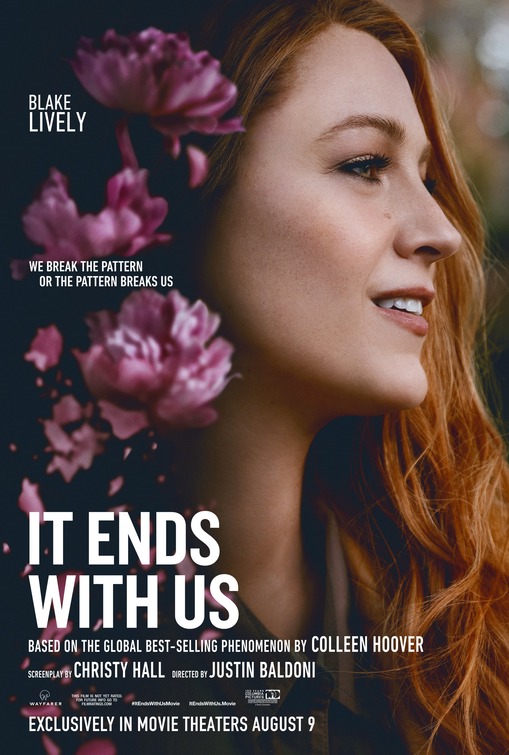
NOT A WOKE TRAP. The film's feminist and empowerment themes are front and center from the opening act. The source material is one of the most widely discussed BookTok novels in history, with its domestic violence subject matter being the primary reason for its fame. Marketing materials, trailers, and press coverage all make the film's thematic territory obvious. There is no delayed ideological pivot. The traditional elements, particularly the maternal protection arc and the moral seriousness of the intergenerational abuse cycle, are equally present throughout.
It Ends with Us arrives as two films at war with each other, and the battle behind the camera turned out to be far more interesting than what ended up on screen.
The story is straightforward. Lily Bloom (Blake Lively) is a florist in Boston who falls for Ryle Kincaid (Justin Baldoni), a charismatic neurosurgeon. Their romance accelerates quickly. Then Ryle hits her. Then he apologizes. Then it happens again. Meanwhile, Lily's first love, Atlas Corrigan (Brandon Sklenar), reappears in her life, offering a reminder of what love looks like without violence. Flashbacks reveal that Lily's father abused her mother throughout her childhood. The question the film poses is whether Lily will repeat her mother's pattern or break it.
She breaks it. And here is where the film's ideological scorecard gets interesting.
The feminist reading is obvious and the marketing leaned into it: Lily's decision to leave Ryle is framed as empowerment, self-actualization, a woman refusing to accept the narrative that love requires suffering. The title itself is a declaration of agency. The divorce is presented as liberation. The flower shop is financial independence made literal. The reunion with Atlas is the reward for choosing yourself.
But underneath the empowerment gloss, the film's actual moral engine runs on deeply traditional fuel. Lily does not leave Ryle because she discovers her authentic self or because a therapist tells her she deserves better. She leaves because she has a daughter. The moment that breaks the cycle is not feminist consciousness-raising. It is maternal instinct. Lily looks at baby Emerson and sees the future: either her daughter grows up watching her mother get hit, or she doesn't. The decisive scene, where Lily asks Ryle to imagine their daughter being abused by a future partner, is an appeal to parental responsibility, not feminist theory. It is a profoundly conservative argument dressed in progressive clothing.
The film also takes marriage seriously, which is not something empowerment narratives typically do. Lily does not leave Ryle casually. She agonizes. She gives him chances. She hopes therapy will work. The divorce is not gleeful or triumphant. It is treated as a necessary and painful last resort, which is exactly how traditional moral frameworks understand the dissolution of marriage: permissible when all other options are exhausted, especially when children are at risk.
The intergenerational cycle is the film's most powerful theme and its most conservative one. Lily's mother stayed with an abusive husband. Lily nearly does the same thing. The film argues that personal choices echo across generations, that children inherit their parents' failures unless someone has the courage to absorb the cost of change. This is not systemic analysis. This is personal moral responsibility, which is the bedrock of conservative ethical thought.
But the film undercuts its own seriousness in ways that are hard to ignore. Blake Lively's Lily is aspirational to the point of fantasy. She runs a gorgeous flower shop that apparently generates enough revenue to support a Boston lifestyle. Her wardrobe is immaculate. Her apartment looks like a Pinterest board. The domestic violence scenes feel like interruptions in a lifestyle commercial rather than the central reality of the character's life. This is partly a directorial choice (or an editorial one, given the behind-the-scenes conflict), and partly a star-power problem: Lively brings such effortless glamour to the role that the ugliness of abuse never fully penetrates the surface.
Baldoni's performance as Ryle is the film's most underrated element. He plays the abuser not as a monster but as a damaged man who genuinely loves Lily and genuinely cannot control his rage. The film's refusal to offer Ryle a redemption arc is brave. The revelation that his childhood trauma (accidentally killing his brother) fuels his violence does not excuse it, and crucially, the film knows this. Allysa's warning to Lily, that she should not take Ryle back despite his trauma, is the most morally clear-eyed moment in the script.
Brandon Sklenar's Atlas is warm and appealing but underwritten. He exists primarily as a contrast to Ryle: proof that male tenderness is possible, that Lily's first instinct about love was correct. Jenny Slate provides welcome comic relief as Allysa but is also saddled with the film's most emotionally complex secondary role, and she handles both registers well.
The controversy surrounding the film dwarfed the film itself. Lively's promotional tour, in which she sold haircare products, encouraged floral dress codes, and treated the press junket like a party rather than a conversation about domestic violence, became a defining cultural moment of 2024. Baldoni's more somber approach to discussing the material earned him public sympathy, which then shifted when Lively filed her sexual harassment complaint, which then shifted again when Baldoni filed his countersuit. The whole spectacle became a Rorschach test: feminists saw a woman being smeared for speaking up, conservatives saw celebrity entitlement weaponizing victimhood. Neither reading is entirely wrong.
As a piece of filmmaking, It Ends with Us is competent but unexceptional. The direction is workmanlike. The pacing drags in the second act. The flashback structure creates emotional distance rather than deepening it. The score is forgettable. The cinematography is pretty in a way that works against the material.
But the core story, stripped of the celebrity drama and the marketing mishaps, lands. A woman looks at her daughter, looks at her mother's life, and decides that the cycle stops here. That decision is dressed in the language of empowerment, but its roots are in sacrifice, maternal duty, and the belief that your choices matter across generations. It is, despite everything, a film that believes in personal responsibility more than systemic critique. That is worth noting.
Formula: Weighted Score = Severity × Authenticity Multiplier × Centrality Multiplier
🔴 Woke Tropes
| Trope | Severity | Authenticity | Centrality | Score |
|---|---|---|---|---|
| Female Empowerment as Central Narrative Arc | 4 | 0.8 | 1 | 3.8 |
| Divorce Presented as Liberation | 3 | 0.7 | 0.8 | 2.63 |
| Male Abuser Without Redemption Arc | 3 | 0.7 | 0.9 | 2.7 |
| Female Independence Over Marriage | 2 | 0.6 | 0.6 | 1.6 |
| Girlboss Entrepreneur Fantasy | 2 | 0.5 | 0.4 | 1.45 |
| TOTAL WOKE | 12.2 | |||
🟢 Traditional Tropes
| Trope | Severity | Authenticity | Centrality | Score |
|---|---|---|---|---|
| Maternal Protection as Moral Imperative | 5 | 1 | 1 | 5 |
| Intergenerational Moral Responsibility | 4 | 0.9 | 0.9 | 3.8 |
| Consequences of Choices Treated with Gravity | 4 | 0.9 | 0.8 | 3.7 |
| Marriage Treated with Moral Seriousness | 3 | 0.7 | 0.6 | 2.48 |
| Sacrificial Motherhood / Mother-Daughter Bond | 3 | 0.8 | 0.7 | 2.63 |
| TOTAL TRADITIONAL | 17.6 | |||
Score Margin: +5 TRAD
Director: Justin Baldoni
MODERATE/FAITH-BASED. Baldoni is a practicing Baha'i whose previous directorial work includes faith-adjacent tearjerkers like Five Feet Apart (2019) and Clouds (2020). His worldview leans toward spiritual universalism, service to others, and emotional sincerity rather than partisan ideology.Justin Baldoni first became known as Rafael Solano on Jane the Virgin (2014-2019). His directorial career has focused on emotionally earnest dramas, often centered on illness or loss. Five Feet Apart (2019) was a cystic fibrosis romance. Clouds (2020) was a Disney+ biographical drama about a teenager with cancer. Both films were sincere, conventional, and commercially viable without being politically charged. Baldoni is an outspoken member of the Baha'i faith, which emphasizes the unity of humanity, gender equality, and service. He has given TED talks about redefining masculinity, though from a spiritual rather than progressive-activist framework. His approach to It Ends with Us was reportedly more grounded and serious than what the final theatrical cut reflects, as Lively's editorial influence shifted the tone toward a glossier, more romanticized aesthetic. The behind-the-scenes conflict between Baldoni and Lively became a bigger cultural event than the film itself, resulting in dueling lawsuits and a PR war that became a proxy battle for broader culture-war grievances about feminism, MeToo, and celebrity accountability.
Writer: Christy Hall
Hall is a screenwriter and producer whose prior credit is Daddio (2023), a chamber-piece drama starring Sean Penn and Dakota Johnson set entirely inside a taxi. She also served as a producer on It Ends with Us. Hall adapted Colleen Hoover's novel with a focus on the emotional interiority of Lily Bloom, and her script reportedly served as the foundation that both Baldoni's original cut and Lively's preferred edit worked from. Ryan Reynolds also contributed uncredited dialogue to a rooftop scene, allegedly written before the WGA strike. Hall's sensibility leans toward intimate character drama rather than overt ideology.
Adult Viewer Insight
Conservative adults will find more to appreciate here than they might expect from a BookTok romance adaptation starring Blake Lively. The film's central argument is that a mother's primary obligation is to protect her children, even at enormous personal cost. The divorce is not celebrated as liberation; it is presented as the only moral option when all alternatives have been exhausted. The intergenerational abuse cycle is treated as a matter of personal moral courage, not systemic analysis. The film never blames society, institutions, or patriarchy for Ryle's violence. It blames Ryle. And it shows Lily taking responsibility for her own future rather than waiting for someone else to rescue her. The girlboss entrepreneur elements are present but relatively muted. The real engine is maternal love and the willingness to sacrifice comfort for your child's safety. Where the film may frustrate conservative viewers is in its glossy, aspirational tone, which sometimes trivializes the seriousness of its own subject matter, and in its refusal to engage with the possibility of reconciliation or redemption for the abuser.
Parental Guidance
Rated PG-13 for domestic violence, sexual content, and some strong language. Recommended for viewers 15 and older. Multiple scenes depict domestic violence including slapping, shoving, being pushed down stairs, and an attempted sexual assault. Childhood flashbacks show a father beating a mother. Several implied sex scenes with partial nudity. The film's glossy romantic aesthetic may make it attractive to younger teens who are not prepared for the abuse content. No content warning is provided at the start of the film. Parents should preview this before allowing younger teens to watch, and should be prepared for a conversation about domestic violence, healthy relationships, and the cycle of abuse.
Find It Ends with Us on Amazon Prime Video, rent, or buy:
▶ Stream or Buy on AmazonAs an Amazon Associate, VirtueVigil earns from qualifying purchases.
Community Discussion 0
Subscribe to comment.
Join the VirtueVigil community to share your perspective on this review.