The Order
The Order is about as complicated as VirtueVigil gets, and I want to be honest about that before I score it.
Full analysis below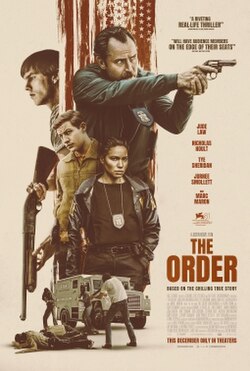
Not a woke trap. The Order's subject matter (white supremacist domestic terror group, 1980s Pacific Northwest) is evident from the trailer, the poster, and the first fifteen minutes. The film's ideological posture, law enforcement heroism against far-right extremism, is consistent throughout. There is no bait-and-switch. Conservative viewers who object to white supremacy being portrayed as evil will not find the film hiding this. Conservative viewers who agree that white supremacy is evil will find the film shares their view.
The Order is about as complicated as VirtueVigil gets, and I want to be honest about that before I score it.
The film is based on true events. In the 1980s, a white supremacist group called The Order, founded by Robert Jay Mathews in the Pacific Northwest, conducted a campaign of bank robberies, armored car heists, and assassinations to fund what they believed would be a race war leading to a white separatist state. They murdered Denver talk radio host Alan Berg in his driveway. They robbed Brinks trucks for millions. FBI agent Terry Husk tracked them down. Mathews died in a fire on Whidbey Island in 1984 after a standoff. The film depicts this accurately.
This creates a genuine tension for a VirtueVigil review. The film portrays white supremacists as villains. The FBI is the hero. For some conservative viewers, both of those facts are comfortable. For others, the FBI-as-hero framing is complicated by contemporary concerns about federal overreach. And the white supremacist subject matter raises the question of whether the film is primarily interested in historical truth or in a contemporary political message about 'domestic terror.'
Having watched the film carefully, my answer is that Justin Kurzel is primarily interested in historical truth. The Order is not a lecture. It is a thriller. Kurzel (Macbeth, True History of the Kelly Gang) is an Australian director who makes austere, masculine crime films in the tradition of Michael Mann. He is not interested in making a film about how dangerous the current right is. He is interested in making a film about a specific group of people who did specific things in a specific time and place.
Jude Law's Terry Husk is the kind of FBI agent that films used to make routinely before the agency became a political football: exhausted, dogged, morally serious, willing to sacrifice his personal life for the job. Law plays him as a man running on fumes and conviction. His estranged wife, his estranged daughter, the long-vacant field office he reopens in Coeur d'Alene, all of these set him up as someone who has nothing left but the case. It is a classical investigative hero arc, and Law executes it with quiet authority.
Nicholas Hoult as Robert Jay Mathews is the film's most unsettling achievement. Hoult plays Mathews not as a cartoon monster but as a man with a vision, a community, and a fatal certainty that he is right. The film does not endorse his views. It also does not reduce him to a hissing villain. It shows how a man who believed in something, however monstrous, attracted followers and built something that the FBI had to work hard to dismantle. This is the correct approach to depicting real historical evil: take it seriously enough to understand it, not seriously enough to excuse it.
The film's pacing is a patient thriller's pacing. This is not action cinema. Kurzel and cinematographer Adam Arkapaw (True Detective season one) build dread through atmosphere rather than spectacle. The Pacific Northwest landscape, grey skies, dense forest, isolated compounds, works as both setting and metaphor. These are people who have retreated from the American mainstream into geography that matches their alienation.
Where the film creates tension for conservative viewers: The Order (the real organization) used The Turner Diaries as their operational blueprint. The Turner Diaries is a white supremacist novel about a race war. The film depicts this document as the enemy's playbook. It also depicts Richard Butler's Aryan Nations compound in Hayden Lake, Idaho as a real place where real people believed real things. The film does not editorialize about contemporary politics, but a viewer determined to find contemporary relevance will not struggle to find it.
Here is my honest assessment: The Order is a well-made, morally serious crime film about a real FBI investigation that successfully stopped a real domestic terrorist organization that committed real murders. Law enforcement is the hero. The rule of law is upheld. Evil is identified, confronted, and defeated. A man who committed treason and murder died for it. These are not progressive values. These are traditional American values.
The complication is that the evil being confronted wore a particular ideological label. If you believe, as I do, that white supremacy is an actual evil and not a useful boogeyman, The Order's moral framework is coherent and even conservative in its essentials. If you believe the domestic terror frame is primarily a contemporary political weapon, you will find this film suspicious regardless of its historical accuracy.
I scored it as MIXED because that is what it is: a film where the traditional values (law enforcement heroism, rule of law, masculine competence, consequences for evil) nearly cancel out the woke-adjacent elements (federal government as hero against far-right extremism, anti-nationalist framing). Neither side dominates. The film is too good a thriller to be dismissed and too politically pointed to be ignored.
Formula: Weighted Score = Severity × Authenticity Multiplier × Centrality Multiplier
🔴 Woke Tropes
| Trope | Severity | Authenticity | Centrality | Score |
|---|---|---|---|---|
| White Supremacy as Primary Antagonist Force | 4 | 0.7 | 1.8 | 5.04 |
| Federal Law Enforcement as Moral Hero | 3 | 0.7 | 1 | 2.1 |
| Anti-Nationalist / Anti-Separatist Framing | 3 | 1 | 1 | 3 |
| TOTAL WOKE | 10.1 | |||
🟢 Traditional Tropes
| Trope | Severity | Authenticity | Centrality | Score |
|---|---|---|---|---|
| Law Enforcement Heroism / Masculine Competence | 4 | 0.7 | 1.8 | 5.04 |
| Rule of Law as Social Foundation | 4 | 0.7 | 1 | 2.8 |
| Evil Has Consequences / Criminal Justice Vindicated | 3 | 0.7 | 1 | 2.1 |
| Personal Sacrifice for Duty | 3 | 0.7 | 0.5 | 1.05 |
| TOTAL TRADITIONAL | 11.0 | |||
Score Margin: +1 TRAD
Director: Justin Kurzel
CENTER-LEFT with strong craft emphasis. Kurzel (Macbeth, Snowtown, Assassin's Creed, True History of the Kelly Gang) makes austere, violent crime films and period dramas that prioritize atmosphere over message. He is not known as a political filmmaker. His films deal with real-world evil without editorializing. The Order fits this pattern.Australian director Justin Kurzel has built a reputation for adaptation: Cormac McCarthy-adjacent darkness, historical violence depicted with unflinching attention to detail. Macbeth (2015) was widely considered one of the best Shakespeare adaptations in decades. True History of the Kelly Gang (2019) reframed Australian outlaw mythology. The Order is his most commercial film in scope while remaining his characteristically spare and unshowy in style. He produced the film alongside Jude Law.
Adult Viewer Insight
Conservative adults who care about historical truth should watch The Order. This is what the far-right domestic terrorism of the 1980s actually looked like, and it is not flattering. Mathews and his followers were not patriots. They were criminals who murdered people, robbed banks, and planned a race war. The film depicts this accurately. The question of whether portraying FBI heroism in 1984 maps onto contemporary concerns about federal overreach is a legitimate one, but it is also worth separating historical fact from contemporary political anxieties. Terry Husk tracking down Robert Mathews is not the same as any current controversy. The performances, particularly Hoult, are worth the watch.
Parental Guidance
Rated R. Not appropriate for children. Adults only. The film contains significant violence including shootings, a murder depicted in chilling detail, and a tense standoff sequence. The subject matter (white supremacy, domestic terrorism, murder of a Jewish radio host) requires adult context. No sexual content. Language throughout. The ideological content, depicting a real white supremacist organization and their beliefs, requires adult perspective to process responsibly.
Find The Order on Amazon Prime Video, rent, or buy:
▶ Stream or Buy on AmazonAs an Amazon Associate, VirtueVigil earns from qualifying purchases.
Community Discussion 0
Subscribe to comment.
Join the VirtueVigil community to share your perspective on this review.