The Patriot
The Patriot is the kind of film Hollywood stopped making around the time it started worrying about how America looked to foreign markets. It is unabashedly pro-American, pro-family, and pro-violent-resistance-to-tyranny. Benjamin Martin doesn't want to fight.…
Full analysis below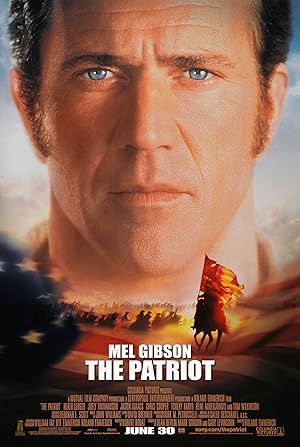
Not a woke trap. The Patriot is exactly what the title promises: a film about an American founding-era father who takes up arms to protect his family and his country's freedom. Mel Gibson, director Roland Emmerich, a cast of American and British actors, and a story set during the Revolutionary War. Conservative audiences will have zero surprises within the first ten minutes. The film's emotional pitch is unapologetically patriotic from frame one.
The Patriot is the kind of film Hollywood stopped making around the time it started worrying about how America looked to foreign markets. It is unabashedly pro-American, pro-family, and pro-violent-resistance-to-tyranny. Benjamin Martin doesn't want to fight. He has seven children, a farm, and memories of what he did in the French and Indian War that keep him up at night. He votes against South Carolina joining the Revolution. Then a British colonel murders his fourteen-year-old son in front of the family and burns his house down.
That's when the movie starts.
Roland Emmerich is not a subtle director, and The Patriot is not a subtle film. It knows exactly what it is: an emotional engine designed to make you root for American irregulars killing British redcoats in the Carolina backcountry. It executes that premise with tremendous skill. The battle sequences are staged with clarity and visceral force. The ambush sequences, where Martin's militia fights from cover using rifles while the British form into their rigid lines, capture the tactical asymmetry that made the Revolution possible. The personal revenge subplot, Martin hunting the colonel who killed his son, is handled with the kind of moral seriousness that lesser films skip. Martin knows exactly how dark the thing he's doing is. He does it anyway.
Mel Gibson is ideally cast. He brings the physical presence of a man who was genuinely dangerous in his younger days and the weary eyes of a man who wishes he wasn't. The scene where he ambushes a British patrol to rescue Gabriel, screaming and hatcheting soldiers in a frenzy while his ten-year-old son watches and joins in, is one of the most disturbing father-son moments in mainstream American cinema. And it's presented as completely understandable. That's the film's real accomplishment: it makes you understand exactly why a good man might do terrible things.
Heath Ledger as Gabriel is the film's emotional heartbeat. His arc, from idealistic young patriot to a man who has seen what war actually is, mirrors the Revolution itself: noble in conception, brutal in execution, necessary in outcome. His death near the end is genuinely devastating. Ledger was 21 during production and already had the charisma that would define his later career.
Jason Isaacs as Colonel Tavington is one of cinema's great villains. Not because he's cartoonish, but because he isn't. Tavington is a professional. He is efficient. He understands counterinsurgency in ways that his superiors don't. His strategy of burning houses, executing civilians who harbor rebels, and eliminating entire communities to deny the rebels support is historically grounded and morally monstrous. When he locks a church full of people and burns it down, the sequence lands with the weight of atrocity, not action movie spectacle.
The film's treatment of race requires honest engagement. Mel Gibson's Martin character is a former slave owner, though the film somewhat soft-pedals this. A freed slave named Occam (Jay Arlen Jones) fights alongside Martin's militia, earning his freedom through battlefield service. Some critics have attacked this portrayal as historically dishonest and a form of racial wish fulfillment. There's truth in that critique. The film wants its hero morally uncomplicated in this area, which he wasn't historically. At the same time, the film does acknowledge the contradiction directly: Gabriel refuses to sign up a unit that excludes Black men. Occam is treated with dignity and given a genuine arc. The film tries to have it both ways, and it mostly succeeds, though the historical conscience is left partly unsatisfied.
For the VirtueVigil audience, The Patriot scores as Strongly Traditional for reasons that are obvious and earned. The film's central values, family over ideology, liberty worth dying for, fathers protecting their children, faith sustaining a community under terror, are stated plainly and without irony. The church community sequences are treated with complete respect. The climactic battle is framed explicitly as the American flag driving the British back. John Williams's score leaves no ambiguity about how we should feel.
This is not a film that will make you think uncomfortable thoughts about American history. It will make you feel the weight of what the founding generation paid. That's a different and legitimate thing.
Formula: Weighted Score = Severity × Authenticity Multiplier × Centrality Multiplier
🔴 Woke Tropes
| Trope | Severity | Authenticity | Centrality | Score |
|---|---|---|---|---|
| Slavery Acknowledgment / Black Character Given Dignity and Agency | 2 | 1 | 1 | 2 |
| Anti-Imperial / Occupying Force as Villain | 2 | 0.7 | 0.5 | 0.7 |
| TOTAL WOKE | 2.7 | |||
🟢 Traditional Tropes
| Trope | Severity | Authenticity | Centrality | Score |
|---|---|---|---|---|
| Patriotism / Revolutionary War Heroism | 5 | 0.7 | 1.8 | 6.3 |
| Family as the Ultimate Motivation / Fatherhood as Sacred Duty | 5 | 0.7 | 1.8 | 6.3 |
| Masculine Warrior Ethos / Physical Courage | 4 | 0.7 | 1 | 2.8 |
| Faith / Church Community Under Pressure | 3 | 0.7 | 1 | 2.1 |
| Individual Liberty / Resistance to Tyranny | 4 | 0.7 | 1.8 | 5.04 |
| Sacrifice for Country / Death with Honor | 3 | 0.7 | 1 | 2.1 |
| TOTAL TRADITIONAL | 24.6 | |||
Score Margin: +22 TRAD
Director: Roland Emmerich
MAINSTREAM POPULIST. Emmerich is best known for blockbuster spectacle: Independence Day, The Day After Tomorrow, 2012. His ideology is entertainment-first. The Patriot is his most traditionally coded film by a wide margin, and it exists because he wanted to make a large-scale American war epic. He is personally progressive (openly gay, German-American, environmentalist) but The Patriot does not reflect those politics. It reflects commercial instincts and a genuine admiration for the Revolutionary War story.Roland Emmerich is the German-born director behind Independence Day (1996), Godzilla (1998), The Day After Tomorrow (2004), and 2012 (2009). He is one of Hollywood's most reliable blockbuster craftsmen. The Patriot represents an unusual departure toward historical drama, though Emmerich brings his characteristic large-scale staging to the battle sequences. His direction here is more restrained than his disaster films and benefits from it. The film is his most critically and commercially successful non-science-fiction work.
Writer: Robert Rodat
Robert Rodat wrote Saving Private Ryan, and the connection to The Patriot is obvious. Both screenplays center on a father figure, use historical warfare as a crucible for masculine virtue, and balance intimate family drama with large-scale battle sequences. Rodat's instinct in both films is to make the war personal, to show what men fight for rather than just what they fight against. The Patriot's central premise, a war-weary father dragged back to war by the murder of his son, is a clean, powerful engine.
Adult Viewer Insight
Parental Guidance
Find The Patriot on Amazon Prime Video, rent, or buy:
▶ Stream or Buy on AmazonAs an Amazon Associate, VirtueVigil earns from qualifying purchases.
Community Discussion 0
Subscribe to comment.
Join the VirtueVigil community to share your perspective on this review.