
Thunderbolts*
Thunderbolts* is the best Marvel film in several years, and the asterisk tells you something about what kind of film it wants to be. The studio insists the punctuation mark carries meaning. It does. It signals uncertainty, incompleteness, a team that does not quite know what it is yet.…
Full analysis below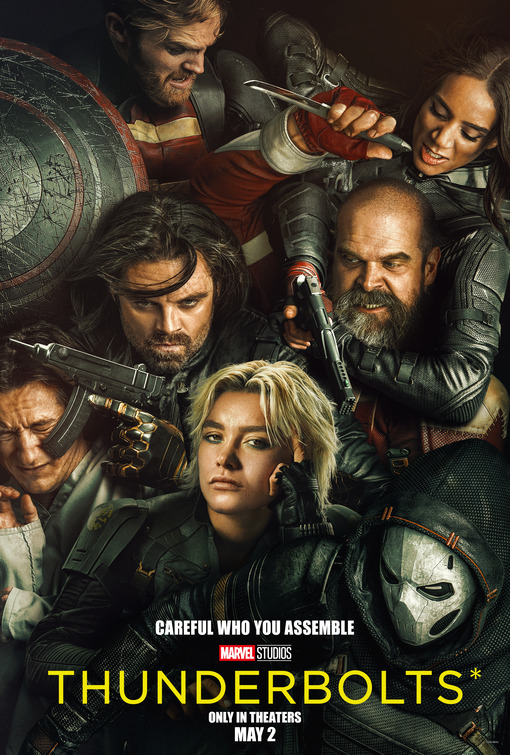
Not a woke trap. Thunderbolts* markets itself openly as a team of broken, traumatized antiheroes grappling with mental health and identity. Florence Pugh leads. The mental health messaging is front and center from the trailer. Nothing is hidden. Conservative viewers who are bothered by therapy-centric storytelling will clock it within the first act. The film is not ideologically deceptive. It is ideologically mixed, and that mix is visible from the start.
Thunderbolts* is the best Marvel film in several years, and the asterisk tells you something about what kind of film it wants to be. The studio insists the punctuation mark carries meaning. It does. It signals uncertainty, incompleteness, a team that does not quite know what it is yet. That uncertainty is the most honest thing in the movie.
This is not a team of heroes. Yelena Belova is a former assassin raised by a government program to feel nothing. Bucky Barnes spent decades as a mind-controlled weapon. John Walker took a super-soldier serum and murdered someone on camera. Red Guardian is a blowhard who only becomes useful when he stops performing. Ghost has been living in constant physical pain. These people do not want to be a team. They are not inspiring. They have body counts and therapy appointments and the basic human problem of not being able to outrun what they've done.
The film works best when it leans into that. Director Jake Schreier comes from the Beef creative team, and his instinct for awkward, searching character work gives the second act a quality that the MCU has not produced in years. The group dynamic is genuinely funny in the way that broken people in a confined space become funny. There is a group therapy sequence that is the best scene Marvel has produced since What We Do in the Shadows proved you can do genuine comedy in a genre format.
Then there is Bob.
Lewis Pullman's Sentry is the reason to see this film. Bob is a man who was given godlike power by a government program and whose mind fractured under the weight of it. He has an alter ego, the Void, that embodies everything he cannot control about himself. Pullman plays both aspects without losing track of either, and his arc — a person discovering that the darkness inside him is not a monster to be suppressed but a part of himself to be integrated — is the most psychologically sophisticated character work in the MCU's recent history.
The problem is that this arc requires the film to believe in its own therapy-centric framing, and sometimes it does, and sometimes it retreats into obligatory superhero conclusion mechanics. The third act, where the team has to stop the Void from destroying New York, is the weakest section of the film. It defaults to what Marvel action sequences look like now: competent, impersonal, fine.
From a traditional values standpoint, Thunderbolts* is genuinely mixed, and the score reflects that. On the woke side: Florence Pugh's Yelena is the undisputed team leader, and the film makes no apologies for it. The mental health framing is consistent with contemporary progressive attitudes toward therapy and trauma processing. Valentina Allegra de Fontaine as villain is a government official who abused her power for personal and institutional gain — the film's politics are broadly anti-establishment.
But the traditional elements are substantial. The film's central argument is that broken people can be redeemed through loyalty and sacrifice rather than through institutional validation. Bob's arc is not resolved by therapy alone. It is resolved by choosing, in a moment of extremity, to protect the people who trusted him. John Walker's limited but genuine redemption comes from action, not confession. Bucky's entire presence in the film is a reminder that men who have done terrible things can spend their remaining days trying to make them right.
The anti-establishment critique cuts both ways. Val de Fontaine is the villain because she used the power of the CIA to eliminate accountability and protect her own interests. This is not specifically a left or right concern. Distrust of government power is American in a way that precedes any contemporary political coalition. The film treats the team's refusal to serve institutional authority as a virtue, not a flaw. That framing plays well for traditional audiences even as its cast of morally compromised antiheroes might seem at odds with conservative taste.
What Thunderbolts* gets right that most Marvel films do not: it takes its characters seriously enough to let them fail before they succeed. These are not people who discover hidden strengths and learn to believe in themselves. They are people who already know their limitations and keep going anyway. There is something genuinely traditional in that — the recognition that virtue is not a feeling but a practice, that character is revealed not in the moment of triumph but in the decision to act despite the weight of everything you've done before.
Formula: Weighted Score = Severity × Authenticity Multiplier × Centrality Multiplier
🔴 Woke Tropes
| Trope | Severity | Authenticity | Centrality | Score |
|---|---|---|---|---|
| Female-Led Team (Unchallenged) | 3 | 1 | 1.8 | 5.4 |
| Mental Health as Central Narrative Theme | 3 | 0.7 | 1.8 | 3.78 |
| Government / Institutional Villain | 2 | 0.7 | 1 | 1.4 |
| Diverse Ensemble Framing | 1 | 1 | 0.5 | 0.5 |
| TOTAL WOKE | 11.1 | |||
🟢 Traditional Tropes
| Trope | Severity | Authenticity | Centrality | Score |
|---|---|---|---|---|
| Redemption Through Action and Sacrifice | 4 | 0.7 | 1.8 | 5.04 |
| Loyalty Over Self-Interest as Highest Value | 4 | 0.7 | 1 | 2.8 |
| Anti-Deep State / Anti-Institutional Authority | 3 | 1 | 1 | 3 |
| Unchecked Power as Corruption (Bob/Sentry) | 3 | 0.7 | 1 | 2.1 |
| TOTAL TRADITIONAL | 12.9 | |||
Score Margin: +2 TRAD
Director: Jake Schreier
CENTER-LEFT. Schreier is associated with the Beef creative team and brings a character-focused, emotionally raw sensibility to the superhero format. No overt political agenda in his prior work, but his thematic interests (trauma, identity, broken families) align with contemporary progressive storytelling priorities.Jake Schreier is best known for his work on the Netflix series Beef (2023), where he collaborated with writer Lee Sung Jin and much of the Thunderbolts* cast. He directed Paper Towns (2015) and has been primarily a TV director. Thunderbolts* is his first major theatrical feature. His instinct is toward intimate character work in large-scale formats, which gives the film its best moments and also exposes its weaknesses in the action sequences, which feel obligatory next to the quieter scenes.
Writer:
Eric Pearson has been a Marvel workhorse since Thor: Ragnarok. Joanna Calo brought emotional depth from her TV work. Lee Sung Jin, creator of Beef, joined for rewrites and his fingerprints are on the film's strongest scenes: the group therapy dynamic, the characters' inability to trust each other, and Bob's arc. The script went through extensive revisions, and the final film shows the seams but also the care.
Adult Viewer Insight
Conservative adults will find more to engage with here than recent Marvel fare. The film's distrust of institutional power is genuine, its redemption arcs are rooted in action and sacrifice rather than progressive identity politics, and Bob's psychological arc is the most interesting thing Marvel has done with a character in half a decade. The therapy framing will grate for those allergic to it, and Yelena's unchallenged leadership is a feminist choice the film does not bother to justify. But the overall ideological balance is closer to MIXED than woke, which puts it above most of what the MCU has produced since Endgame. Pullman's Sentry is reason enough to watch.
Parental Guidance
PG-13. Appropriate for ages 13 and up. Standard Marvel action violence. The more notable content is thematic: trauma, PTSD, government conditioning, and an alter-ego villain that manifests as psychological horror. The film treats mental health with genuine seriousness rather than as a punchline. Mature teenagers and adults will get more out of it. Younger children will be fine with the action and bored by the therapy scenes.
Find Thunderbolts* on Amazon Prime Video, rent, or buy:
▶ Stream or Buy on AmazonAs an Amazon Associate, VirtueVigil earns from qualifying purchases.
Community Discussion 0
Subscribe to comment.
Join the VirtueVigil community to share your perspective on this review.