
Alien
Alien is 47 years old and it still works. That says something about the quality of its construction.
Full analysis below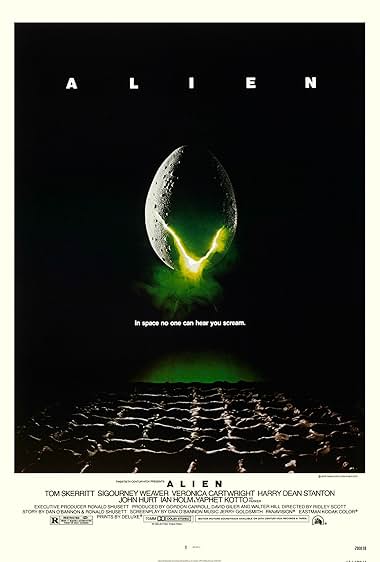
Want to know what's safe to watch? Get our weekly guide to new reviews and woke-free picks. No spam, ever.
Alien (1979) does not qualify as a woke trap under VVWS v1.1. The margin is positive at +9 TRAD, and a woke trap requires a negative margin with woke content hidden past the 50% mark. The film's anti-corporate element is real and the Weyland-Yutani betrayal is genuinely central to the third act. But the overall experience of the film is traditional survival horror: competent individual, existential threat, no institutional rescue. The corporate villain reveal arrives at roughly the 60-percent mark and recontextualizes the crew's situation rather than injecting ideology. Ripley's survival is earned through intelligence and rule-following, not progressive identity. No trap here.
Our Verdict on Alien
Alien is 47 years old and it still works. That says something about the quality of its construction.
Ridley Scott's second feature is a haunted house movie set in space. The premise is almost insultingly simple: seven crew members on a commercial mining vessel respond to what they believe is a distress signal. They find something terrible. It gets on their ship. They die, mostly, trying to stop it.
What makes Alien exceptional is the discipline of its execution. Scott and cinematographer Derek Vanlint build the Nostromo as a real place, grimy and functional and unglamorous, the industrial workplace of people doing a job for wages. The contrast with the alien ship they explore, designed by H.R. Giger with a biomechanical horror aesthetic that still looks unlike anything before or since, is the film's first great achievement. The familiar against the incomprehensible.
Sigourney Weaver's Ellen Ripley is now so famous as a character that it's worth remembering what made her work in 1979. She is not superhuman. She is not exceptional by Hollywood action-hero standards. She is simply the most competent person on the Nostromo: careful, protocol-minded, attentive to detail, and willing to make unpopular decisions when she's right and the captain is wrong. Her survival is earned, not granted. That's a genuinely traditional message about merit.
The film has real woke content that has to be acknowledged. Weyland-Yutani is not a complicated corporate villain. Special Order 937 puts it plain: the Company considers the crew 'expendable' and the alien specimen the priority. The android Ash was placed on the ship specifically to ensure this order was followed. This is straightforward anti-corporate ideology written into the script's skeleton. It's not incidental. The entire reason the crew cannot simply call for rescue is that the Company doesn't want the problem solved, it wants the asset acquired.
Here's what saves Alien's score: the corporate betrayal is structural more than ideological. Someone had to be responsible for why rescue isn't coming. A corporation wanting the alien for its weapons division is a clean story mechanism, not a political lecture. Dan O'Bannon wasn't writing propaganda. He was solving a plotting problem. The film spends far more of its runtime on Ripley's individual competence than on Weyland-Yutani's villainy.
The last act, Ripley alone on the ship with the xenomorph, is the film's thesis statement. Nobody saves her. No institution rescues her. She faces the thing herself, with improvised tools and personal nerve, and she lives because she's smarter and calmer than the situation. That is a deeply traditional message about individual character as the only reliable resource in an indifferent universe.
Jerry Goldsmith's score, despite the famous production clashes with Scott over its use, remains remarkable. The alien's theme is genuinely unnerving. The film's pacing, 117 minutes that feel tighter than most 90-minute films, reflects Scott's confidence in atmosphere over spectacle.
Alien is not a perfect TRAD film. The corporate villain is real. But its core survival narrative and its central character arc belong to a traditional framework: the right person, doing the right things, surviving on merit. That framework, not the Weyland-Yutani stuff, is what makes the film endure.
Woke Tropes & Content Analysis
Formula: Weighted Score = Severity × Authenticity Multiplier × Centrality Multiplier
🔴 Woke Tropes
| Trope | Severity | Authenticity | Centrality | Score |
|---|---|---|---|---|
| Corporate greed as institutional villain | 4 | High | High | 5.04 |
| Working class crew as corporate expendables | 2 | High | Low | 0.7 |
| Institutional authority as unreliable protector | 2 | Moderate | Moderate | 2 |
| TOTAL WOKE | 7.7 | |||
🟢 Traditional Tropes
| Trope | Severity | Authenticity | Centrality | Score |
|---|---|---|---|---|
| Individual competence determines survival | 4 | High | High | 5.04 |
| Protocol and discipline as survival tools | 3 | High | Moderate | 2.1 |
| Personal courage in the absence of institutional rescue | 4 | High | High | 5.04 |
| Self-reliance as survival imperative | 3 | High | Moderate | 2.1 |
| Clear moral hierarchy: the alien is unambiguous evil | 3 | High | Moderate | 2.1 |
| TOTAL TRADITIONAL | 16.4 | |||
Score Margin: +9 TRAD
Director: Ridley Scott
MIXED. Scott's career splits cleanly between masculine, traditional genre filmmaking and occasional woke-adjacent projects. His traditional column: Gladiator, Black Hawk Down, The Martian, Kingdom of Heaven, The Duellists. His woke column: Thelma & Louise, The Last Duel. Alien belongs firmly in the traditional column. Scott at this point in his career was a pure visual craftsman, not an ideological filmmaker. He was hired to make a scary movie in space and he made the scariest movie in space.Ridley Scott was 41 when Alien released and it was only his second feature film. The Duellists (1977) had announced his visual abilities. Alien established his commercial viability and his ability to build dread through production design and atmosphere. Scott has spoken extensively about the film's origins: he was drawn to the script because of the visual potential and the haunted house structure. He is on record saying he wanted to make a film that would leave the audience feeling genuinely scared, not just startled. He succeeded. What matters for VVWS purposes is that Scott in 1979 was not injecting ideology. He was solving craft problems: how do you make something terrifying? The answer involved production designer H.R. Giger, biomechanical design, and a set that felt genuinely alien rather than fake. The ideology that exists in Alien comes from Dan O'Bannon's script, not Scott's direction.
Writer: Dan O'Bannon
Dan O'Bannon and Ronald Shusett wrote Alien over several years, originally as a screenplay titled Memory. O'Bannon drew on multiple inspirations including A.E. van Vogt's story series, It! The Terror from Beyond Space, and his own experiences developing Dark Star with John Carpenter. His genius in Alien was in creating a perfect horror machine: an enclosed space, a dwindling crew, an unkillable threat, and a betrayal from within. The corporate villain, Weyland-Yutani's Special Order 937, exists in the script primarily as a structural device. Someone had to be responsible for setting events in motion. A corporation made more sense than random bad luck. O'Bannon was not writing a treatise on capitalism. He was writing a haunted house story where the house turns out to be rigged against you.
Content Breakdown
Adult Viewer Insight
What Alien actually understands is that dread is more powerful than shock. Scott holds back the xenomorph for most of the film's runtime, letting the audience's imagination do work that no special effect could match. By the time the creature is fully revealed, the audience has already constructed something worse in their heads. This is a lesson contemporary horror has largely forgotten: restraint creates more fear than revelation. For adult viewers, Alien also offers a meditation on the difference between institutional authority and individual judgment. Dallas has command authority. Ripley has competence and is right. The film makes no apology for that distinction. In the real world, we frequently encounter people with authority who are less competent than the people below them. Alien validates the instinct to trust your own judgment over rank when the evidence supports it. That is a conservative argument about individual discernment, not a progressive argument about dismantling hierarchy. The Weyland-Yutani corporation is the film's darkest element for adult viewers because it's the most realistic. The alien is science fiction. Corporations prioritizing asset acquisition over worker safety is not. O'Bannon understood that the most genuinely frightening villain in the story might not be the creature.
Parental Guidance
Alien carries an R rating for science fiction violence, creature horror, and brief nudity. The violence is primarily monster-attack horror rather than gore, but several deaths are genuinely disturbing: the chest-burst scene remains one of cinema's most viscerally upsetting moments. The xenomorph is graphically threatening throughout. The film's horror is sustained and psychological rather than jump-scare based, which makes it more intense rather than less. Strong language throughout. One brief nude scene. No sexual content beyond that. The film's themes of individual competence, duty to protocol, and personal courage are traditional, but the content is absolutely adult horror. Not appropriate for viewers under 15 regardless of the values content.
Is Alien Safe for Kids?
R for sci-fi violence/gore and language. The chestburster scene is cinema's most famous shock. Sustained tension as the crew is hunted. Alien design is sexualized. Language moderate. Brief nudity. Recommended for ages 16+. Scott's masterpiece earns its scares through patience and craft.
Find Alien on Amazon Prime Video, rent, or buy:
▶ Stream or Buy on AmazonAs an Amazon Associate, VirtueVigil earns from qualifying purchases.


Community Discussion 0
Subscribe to comment.
Join the VirtueVigil community to share your perspective on this review.