
Juror #2
Clint Eastwood made Juror #2 at 94 years old. Warner Bros. gave it 50 theaters. Critics gave it 93% on Rotten Tomatoes. That tension tells you almost everything you need to know about where Hollywood is and where Eastwood has always been.
Full analysis below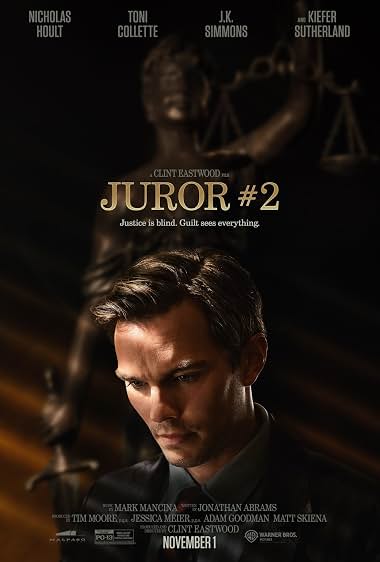
Want to know what's safe to watch? Get our weekly guide to new reviews and woke-free picks. No spam, ever.
Juror #2 is not a woke trap. Clint Eastwood's filmography is among the most transparent signals in American cinema. When Eastwood puts his name on a film, you know roughly what you're getting: personal responsibility, moral weight, consequences for bad choices. Juror #2 delivers exactly that. The systemic justice critique present in the story is not an attack on the legal system as inherently broken. It is a depiction of what happens when one man's moral cowardice threatens to send an innocent person to prison. The critique points inward, not outward. That is a traditional argument, not a progressive one. No bait-and-switch. No late-act pivot. The film's +10 TRAD margin reflects a story that takes individual conscience seriously and punishes evasion of it.
Our Verdict on Juror #2
Clint Eastwood made Juror #2 at 94 years old. Warner Bros. gave it 50 theaters. Critics gave it 93% on Rotten Tomatoes. That tension tells you almost everything you need to know about where Hollywood is and where Eastwood has always been.
Justin Kemp is a recovering alcoholic with a pregnant wife, a carefully managed life, and a secret. While driving drunk one rainy night, he struck and killed a woman on a bridge. He didn't know it. He kept going. Now he's been called to jury duty on the murder trial of a man charged with killing that same woman on that same bridge on that same night. And somewhere around the second day of testimony, Justin realizes: the man on trial may be innocent. And his silence is the reason an innocent man might go to prison.
Eastwood doesn't rush that setup. He doesn't need to. The moral vice tightens slowly, one piece of evidence at a time. Nicholas Hoult plays Kemp's mounting dread with the kind of precise physical restraint that reminds you he's one of the better actors of his generation when he has material worth the effort. Every jury deliberation scene is a small torture chamber where Kemp has to argue for outcomes while hiding the reason he knows what he knows.
Toni Collette plays Faith Killebrew, a prosecutor whose political future depends on securing this conviction. The film is smart enough not to make her a villain. She is doing her job. The evidence she has assembled against the defendant is genuine evidence. It points to a real crime. She just doesn't know that it points to the wrong man. That's not prosecutorial misconduct. That's the system working with incomplete information, which is the only information the system ever has.
J.K. Simmons as Harold Morrison is the film's conscience made human. Morrison is a retired cop who believes in the process. When other jurors start waffling, he holds the line. When Kemp tries to steer deliberations away from conviction, Morrison pushes back with the patience of a man who has spent thirty years watching the system actually work when people let it. His scenes with Hoult are the film's best.
The question Juror #2 asks isn't really about the justice system. It's about what you owe to the truth when the truth will destroy you. Eastwood has been asking that question his whole career, just with different genres around it. In Unforgiven it was about violence and what it costs a man's soul. In Gran Torino it was about legacy and what you leave behind. In American Sniper it was about the bill that comes due for making war. Here it's about the moment when a man has to decide whether his comfortable life is worth more than another person's freedom.
Eastwood's direction is exactly what it always is in his late period: invisible. No showboating, no style for its own sake, total focus on the performances. The Savannah locations give the film a swampy heat that makes the courtroom's sterile fluorescence feel oppressive by contrast. Mark Mancina's score knows when to disappear.
Warner Bros.' decision to bury this film is one of the more cynical studio choices in recent memory. A 93% critics score on a Clint Eastwood legal thriller, and they gave it fewer screens than a mid-budget horror film. The implication, never stated but hard to ignore, is that a film about personal accountability from a director who spoke at the RNC wasn't something the studio wanted prominently displayed. The streaming release on Max let the film find its audience eventually. But this deserved a proper theatrical run.
Woke Tropes & Content Analysis
Formula: Weighted Score = Severity × Authenticity Multiplier × Centrality Multiplier
🔴 Woke Tropes
| Trope | Severity | Authenticity | Centrality | Score |
|---|---|---|---|---|
| Systemic justice critique: innocent man faces wrongful conviction | 2 | Moderate | High | 3.6 |
| Prosecutorial ambition as institutional corruption signal | 2 | Moderate | Moderate | 2 |
| Moral ambiguity used to complicate clear-cut wrongdoing | 1 | High | Low | 0.35 |
| TOTAL WOKE | 5.9 | |||
🟢 Traditional Tropes
| Trope | Severity | Authenticity | Centrality | Score |
|---|---|---|---|---|
| Personal moral responsibility as the film's entire engine | 5 | High | High | 6.3 |
| Truth demands a cost and the cost must be paid | 4 | High | High | 5.04 |
| Rule of law as the bedrock beneath human fallibility | 3 | High | Moderate | 2.1 |
| Moral cowardice has consequences that cannot be avoided indefinitely | 3 | High | Moderate | 2.1 |
| TOTAL TRADITIONAL | 15.5 | |||
Score Margin: +10 TRAD
Director: Clint Eastwood
CENTER-RIGHT. Eastwood is one of the clearest conservative signals in American cinema. A self-described libertarian who has spoken at the Republican National Convention, his filmography consistently returns to themes of individual responsibility, masculine duty, and the moral cost of violence. American Sniper, Gran Torino, Million Dollar Baby, Unforgiven, and now Juror #2 all orbit the same thematic core: what does a man owe to the truth, to his community, and to his own conscience? Eastwood at 94 directing this film is itself a statement.Clint Eastwood has directed 40 feature films over six decades. His later career, from Mystic River through Gran Torino, American Sniper, Sully, Richard Jewell, and Cry Macho, has been defined by moral seriousness and a consistent distrust of institutions when they fail the individual. Juror #2 is his first film for Warner Bros. in nearly a decade, and the studio's decision to limit its theatrical release to roughly 50 screens while fast-tracking it to Max infuriated critics and Eastwood himself. The film's 93% critics score on Rotten Tomatoes suggests a serious work that deserved the wide release it was denied. Eastwood reportedly considered Juror #2 one of the best films of his career. Looking at the final product, that assessment is not vanity. This is controlled, precise filmmaking from a director who has spent 60 years learning how to make a scene matter.
Content Breakdown
Adult Viewer Insight
Juror #2 is an Eastwood film in the deepest sense: the moral weight is not distributed evenly or fairly. Justin Kemp does not get to choose between right and easy. He gets to choose between right and comfortable. His pregnancy, his sobriety, his new life, all of it is real and worth protecting. None of it changes what he knows. That is the film's most traditional quality and its most demanding ask of the audience. It refuses to provide the protagonist with an escape clause. There is no twist that lets him off the hook. There is only what he owes to another man's life, and the question of whether he'll pay it. Conservative audiences who have grown tired of films that reward moral evasion and celebrate self-justification will find Juror #2 genuinely bracing.
Parental Guidance
Rated PG-13 for thematic elements and language. Juror #2 is a mature legal thriller that earns strong consideration for family viewing with teenagers old enough to engage with moral complexity. The central dilemma is one that high school students can discuss productively: what do we owe to the truth when the truth is costly? The film contains no gratuitous violence, minimal sexual content, and moderate language. Its darkness is entirely moral rather than graphic. Eastwood trusts the audience to feel the weight of the situation without visual manipulation. For parents willing to engage with the subject matter afterward, this is exactly the kind of film that generates meaningful conversation.
Is Juror #2 Safe for Kids?
[object Object]
Find Juror #2 on Amazon Prime Video, rent, or buy:
▶ Stream or Buy on AmazonAs an Amazon Associate, VirtueVigil earns from qualifying purchases.

Community Discussion 0
Subscribe to comment.
Join the VirtueVigil community to share your perspective on this review.