
Ocean's Eleven
Ocean's Eleven is not a film about anything in particular. That is almost its highest compliment.
Full analysis below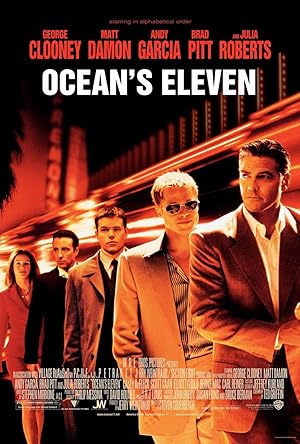
Want to know what's safe to watch? Get our weekly guide to new reviews and woke-free picks. No spam, ever.
Ocean's Eleven is not a woke trap. The margin is +8.4 TRAD, so the verdict is TRADITIONAL LEAN with no negative woke margin. A woke trap requires an actual negative margin and ideological content hidden past the 50% mark. Ocean's Eleven's woke-adjacent signals, primarily the glorification of criminal protagonists and a light anti-establishment tilt, are present from frame one and are clearly genre conventions rather than ideological injections. The film is not trying to make a political statement. It is trying to entertain you for 116 minutes with very attractive people doing very clever things in Las Vegas. It succeeds completely.
Our Verdict on Ocean's Eleven
Ocean's Eleven is not a film about anything in particular. That is almost its highest compliment.
Danny Ocean walks out of a New Jersey prison on the film's first frame and immediately begins planning to rob three Las Vegas casinos simultaneously. His motivation is partly money and partly Tess, his ex-wife who is now in a relationship with Terry Benedict, the casinos' owner. The film does not spend much time on the emotional dimension of this. It has work to do.
Steven Soderbergh assembles eleven characters in about forty minutes of screen time and somehow makes you care about all of them. Not deeply, but enough. Rusty Ryan is Danny's partner and the film's other center of gravity. Linus Caldwell is the kid who wants to prove himself. Reuben Tishkoff is the money and the grievance. The Malloy brothers are the muscle. Basher Tarr is the explosives expert with a working-class English chip on his shoulder. The film does not give most of these people backstories. It gives them traits, and it trusts the cast to make traits into people.
The heist itself is genuinely well-constructed. Ted Griffin's screenplay layers misdirection carefully enough that a first viewing cannot fully follow what is actually happening, and a second viewing reveals how cleanly it was assembled. The reveal works not because it is surprising but because all the pieces were already there and you missed them. That is the right kind of heist movie surprise.
Andy Garcia's Benedict is the film's most undervalued element. He is not a cartoonish villain. He is a man who built something significant, who runs his operation with real competence, and who loses because the team he is facing is simply better at this specific thing than he is. His final confrontation with Danny is cold and precise. He offers Tess a choice that makes clear exactly what kind of man he is without melodrama.
From a values standpoint, Ocean's Eleven occupies the heist film's traditional moral position: the protagonists are criminals, and we root for them anyway. This genre convention has been a fixture of American entertainment since at least the 1930s. The question is always what the film does with it. Ocean's Eleven makes no attempt to justify the theft politically or to present Benedict as deserving of it for systemic reasons. He is simply the obstacle, and Danny is the protagonist, and the entertainment comes from watching the protagonist win. The anti-establishment tilt is a genre convention, not an ideological statement.
What the film does genuinely celebrate, and what earns it its TRADITIONAL LEAN verdict, is male competence, loyalty, and the pleasure of a group of skilled people executing a complex plan together. Each member of the team has something real to contribute. The plan works because of trust, specialization, and the willingness of every person to do their job correctly under pressure. These are genuinely traditional values expressed through a criminal premise. The criminality is the genre; the values are the film.
Soderbergh shoots it with the kind of relaxed confidence that the material requires. David Holmes's score is one of the great heist soundtracks: breezy, jazzy, precise. Every technical element serves the film's primary goal, which is to make you feel like you are in the coolest room in the building. It succeeds for 116 minutes without a wasted shot.
The sequels diminished. Ocean's Twelve is self-indulgent. Ocean's Thirteen is a partial recovery. None of them has the original's combination of ensemble chemistry, structural elegance, and sheer effortless watchability. The first film is a closed system: it knows exactly what it wants to do and does it completely.
Woke Tropes & Content Analysis
Formula: Weighted Score = Severity × Authenticity Multiplier × Centrality Multiplier
🔴 Woke Tropes
| Trope | Severity | Authenticity | Centrality | Score |
|---|---|---|---|---|
| Protagonist criminals glorified as entertainment heroes | 3 | High | High | 3.78 |
| Anti-establishment tilt: sticking it to concentrated power | 2 | Moderate | High | 2 |
| Law enforcement presented as irrelevant obstacle to heroes | 2 | Moderate | Low | 1 |
| TOTAL WOKE | 6.8 | |||
🟢 Traditional Tropes
| Trope | Severity | Authenticity | Centrality | Score |
|---|---|---|---|---|
| Male competence and specialized expertise celebrated | 4 | High | High | 5.04 |
| Male loyalty and brotherhood as operational foundation | 4 | High | High | 5.04 |
| Intellectual planning valued over brute force | 3 | High | Moderate | 2.1 |
| Personal code and honor within the criminal fraternity | 3 | Moderate | Moderate | 3 |
| TOTAL TRADITIONAL | 15.2 | |||
Score Margin: +8 TRAD
Director: Steven Soderbergh
MIXED LEANING WOKE. Soderbergh is one of the most genuinely varied directors in American cinema, and his political tendencies surface unevenly across his work. Traffic (2000) is a systemic critique of the drug war with clear progressive sympathies. Erin Brockovich (2000) is a populist anti-corporate film. The Informant! (2009) deconstructs American whistleblowing mythology. Contagion (2011) is a procedural with technocratic trust-the-institutions messaging. His personal politics are clearly left of center. Ocean's Eleven is Soderbergh in pure genre mode, however. He is making a studio entertainment with A-list movie stars and a $85 million budget, and the only agenda is elegance. No social commentary intrudes. The politics of the heist film as a form, rooting for criminals against institutions, are genre conventions rather than Soderbergh impositions. When he has something to say politically, he says it explicitly. Ocean's Eleven has nothing to say politically. It just wants to show you how the trick was done.Steven Soderbergh won the Best Director Oscar for Traffic (2000) in the same year he was nominated for Erin Brockovich, a rare double nomination. He then immediately made Ocean's Eleven, a film that has nothing in common with either of those except technical excellence. Soderbergh is the rare filmmaker who operates in genuine genre range: he makes experimental art films, Hollywood entertainments, procedural dramas, and heist comedies with equal technical competence. His visual style adapts to the material rather than imposing itself on it. For Ocean's Eleven he shot on film in anamorphic widescreen with DP Peter Andrews (his own pseudonym when he serves as his own cinematographer) using saturated Vegas neon and cool blue surveillance aesthetics to give the film its distinctive look. He cut the film himself under another pseudonym. He is a genuine craftsman.
Content Breakdown
Adult Viewer Insight
What Ocean's Eleven gets right about how competence actually works is the ensemble structure. Danny does not do everything. He cannot. He knows what he can do and he builds a team around what he cannot. The vault has a specific kind of security. He finds the specific person who understands that kind of security. The SWAT-team logistics require a specific kind of coordination. He finds people who do that. This is how functional organizations actually work: not a lone genius but a correctly assembled team of specialists who trust each other's expertise. The film portrays this with genuine respect for each team member's function. Nobody's role is wasted. That specificity is part of what makes the heist feel real rather than magical.
Parental Guidance
Rated PG-13. Appropriate for teenagers 13 and up. The content is mild by modern standards: no significant violence, no explicit sexual content, moderate language. The main consideration is the genre premise of rooting for criminals, which is worth a brief conversation with younger teenagers. The film's actual moral landscape is more traditional than its criminal protagonists suggest: it rewards loyalty, competence, trust, and good planning, and it punishes betrayal and overconfidence.
Is Ocean's Eleven Safe for Kids?
[object Object]
Find Ocean's Eleven on Amazon Prime Video, rent, or buy:
▶ Stream or Buy on AmazonAs an Amazon Associate, VirtueVigil earns from qualifying purchases.


Community Discussion 0
Subscribe to comment.
Join the VirtueVigil community to share your perspective on this review.