Rogue One: A Star Wars Story
Rogue One is the best Disney-era Star Wars film. It's also the most honest one. It ends with every hero dead, and it earns that ending completely.
Full analysis below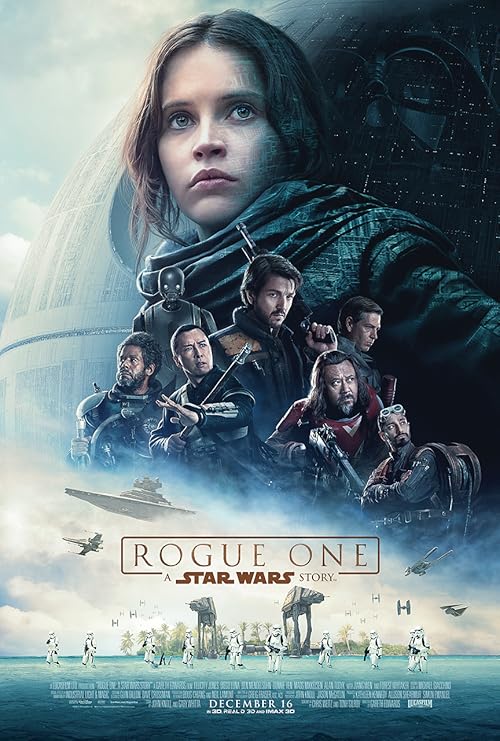
Want to know what's safe to watch? Get our weekly guide to new reviews and woke-free picks. No spam, ever.
Rogue One is not a woke trap. A woke trap requires a negative margin with progressive content deliberately concealed past the 50% runtime point. Rogue One's margin is +13 TRAD. More importantly, the film's woke signals are fully visible from the first frame: Jyn Erso is clearly the female lead, and the ensemble's diversity is established in the trailer and opening act. Nothing is hidden. The film's structural conservatism, which is about sacrifice, duty, and dying for something larger than yourself, grows more prominent as the film progresses. The Scarif sequence in the final act is one of the most powerful expressions of military sacrifice in Disney-era blockbuster filmmaking. If anything, Rogue One gets more traditional as it goes, not less.
Our Verdict on Rogue One: A Star Wars Story
Rogue One is the best Disney-era Star Wars film. It's also the most honest one. It ends with every hero dead, and it earns that ending completely.
The premise is deceptively simple: the original Star Wars opens with the Rebel Alliance in possession of stolen Death Star plans. Rogue One is the story of how they got them. It's a prequel with a predetermined ending. Everyone who matters dies. The audience knows this going in and the film knows the audience knows it. That shared knowledge creates a specific kind of dread that most blockbusters can't produce: not 'will they survive' but 'how will they spend the time they have.'
Jyn Erso is the daughter of the Death Star's chief engineer. Her father, Galen, was coerced into building it but secretly designed a flaw into the reactor that can destroy the whole station. His message to the Rebellion: find the flaw, find the plans, and use them. The film's first half is a war film about people who have lost their faith in the Rebellion and need to find a reason to die for it.
Cassian Andor opens the film by executing an informant. Not reluctantly, not after a long moral struggle. He does it quickly and walks away. He has spent years doing things the Rebellion asked of him that he knows are wrong. The film doesn't redeem this by pretending it didn't happen. It uses it to make his eventual choice to go on the suicide mission to Scarif meaningful. He's not going because he's good. He's going because he decided the cause is worth the cost of what he's already done. That's a more complicated motivation than most blockbuster heroes get, and Diego Luna plays it with real conviction.
Chirrut Imwe is the film's spiritual center. He's blind, elderly, and carries no weapon more complex than a quarterstaff. He's also the most dangerous fighter in the ensemble and the character who best understands what the Force actually is. His repeated invocation, 'I am one with the Force and the Force is with me,' is a prayer, not a power-up. He says it while walking through open ground under heavy fire. He says it because his faith is the only thing between him and despair, and his faith holds. The sequence where he walks across the battlefield at Scarif to reach a master switch, praying aloud while soldiers around him are killed, is the most genuinely moving spiritual moment in the Star Wars franchise since Obi-Wan's death in 1977.
The Scarif battle is extraordinary. It's a beach assault modeled on D-Day, not in aesthetic but in emotional logic: a small group of people accept that they will not survive the mission, go anyway, and succeed at the cost of their lives. Jyn gets the plans to the transmitter. The transmission goes out. Darth Vader arrives and destroys most of what's left. The survivors on the beach are killed by the Death Star's weapon. The plans reach the ship at the beginning of A New Hope. Nobody who went to Scarif comes back.
This is a film about dying for something larger than yourself. It's about deciding that what you're giving your life to is worth the cost. That's a traditional value in the oldest sense, and Rogue One expresses it without irony or subversion. The sacrifice is real. It matters. The galaxy gets its chance because these people gave everything.
The film's woke signals are real and worth acknowledging. The female lead was a deliberate diversity choice. The ensemble is visibly international in a way that reflects a corporate mandate, not organic story logic. Cassian's moral grayness pushes into territory that some traditionalists will resist. But the film's structural conservatism outweighs its progressive casting and moral complexity by a significant margin. When the Rogue One crew dies, they die in service of freedom against tyranny. The politics are traditional even if the casting was engineered.
Woke Tropes & Content Analysis
Formula: Weighted Score = Severity × Authenticity Multiplier × Centrality Multiplier
🔴 Woke Tropes
| Trope | Severity | Authenticity | Centrality | Score |
|---|---|---|---|---|
| Female Protagonist Replacing Traditional Male Action Lead | 3 | High | High | 3.78 |
| Diversity-First Ensemble Casting | 2 | Moderate | Moderate | 2 |
| Moral Grayness / Ends-Justify-Means Framing | 2 | Moderate | Moderate | 2 |
| TOTAL WOKE | 7.8 | |||
🟢 Traditional Tropes
| Trope | Severity | Authenticity | Centrality | Score |
|---|---|---|---|---|
| Ultimate Self-Sacrifice for a Greater Good | 5 | High | High | 6.3 |
| Good vs. Evil Moral Clarity | 5 | High | High | 6.3 |
| Military Discipline and Duty to Mission | 4 | High | Moderate | 2.8 |
| Religious Faith as Source of Strength | 3 | High | Moderate | 2.1 |
| Loyalty and Found Family | 3 | High | Moderate | 2.1 |
| War Demands Real and Permanent Sacrifice | 4 | High | Low | 1.4 |
| TOTAL TRADITIONAL | 21.0 | |||
Score Margin: +13 TRAD
Director: Gareth Edwards
MIXED LEANING TRADITIONAL. Edwards is a technical filmmaker first, an ideological filmmaker almost never. His breakout film Monsters (2010) was shot on a $500,000 budget and told a story about two Americans navigating a militarized alien-infected zone on the US-Mexico border. The alien metaphor for immigration was present but not the point. Godzilla (2014) was a pure genre exercise in the tradition of practical effects spectacle, with zero political content. Rogue One reflects Edwards's instincts: he's interested in scale, consequence, and the weight of human beings making impossible choices. The film's traditional themes of sacrifice and duty align with his aesthetic preference for gravity over fun. He's not a propaganda filmmaker.Gareth Edwards made his name with Monsters, a guerrilla-shot science fiction film with two people and digital alien effects. That film demonstrated a specific gift: making large-scale things feel genuinely threatening by grounding them in human-scale stakes. He brought that gift to Godzilla (2014) and then to Rogue One, which is the largest canvas he had worked on. The production famously went through significant reshoots with Tony Gilroy brought in to reshape the final act. What emerged is widely considered the most complete and emotionally satisfying Disney-era Star Wars film, which says something about Edwards's taste even when filtered through a studio intervention. His direction of the Scarif battle sequence, a beach assault that deliberately evokes D-Day in its scale and human cost, is genuinely impressive filmmaking. He understands how to make sacrifice feel real.
Content Breakdown
Adult Viewer Insight
Rogue One asks a question that most blockbusters avoid: what does it feel like to die for a cause you didn't fully believe in until the end? Jyn Erso spends the first half of the film as someone who has stopped caring about the war. The Rebellion failed her. Her father was taken. She survived by not investing in anything. The film's arc is not about her becoming a superhero. It's about her deciding to care again, fully, knowing what it will cost. That decision, made without certainty of success and without expectation of survival, is a genuinely traditional moral act. She chooses the cause over herself. So does Cassian, who has been living with the cost of his choices for years and finally decides the cause is worth what he's already paid. This is not the easy patriotism of a film that promises heroes will survive. It's the harder version: the one where the people who matter most give everything and the victory belongs to others. That version is more honest about what defending real things actually requires.
Parental Guidance
Rated PG-13 for extended sci-fi violence. Rogue One is significantly darker than the original Star Wars trilogy. Every main character dies. The combat sequences are more visceral and war-like than typical Star Wars fare. Cassian's opening execution of an informant is brief but genuinely jarring. The Darth Vader corridor sequence at the end is intensely frightening. For families, the film provides one of the best discussions of sacrifice and duty available in blockbuster form. The question 'why did they do it knowing they would die?' has a clear, traditional answer. Recommended for ages 12 and up.
Is Rogue One: A Star Wars Story Safe for Kids?
[object Object]
Find Rogue One: A Star Wars Story on Amazon Prime Video, rent, or buy:
▶ Stream or Buy on AmazonAs an Amazon Associate, VirtueVigil earns from qualifying purchases.
Community Discussion 0
Subscribe to comment.
Join the VirtueVigil community to share your perspective on this review.