
Knock at the Cabin
Let me tell you the most surprising thing about Knock at the Cabin: it is a film about gay people that arrives at a verdict more theologically conservative than anything Hollywood has produced in a decade.
Full analysis below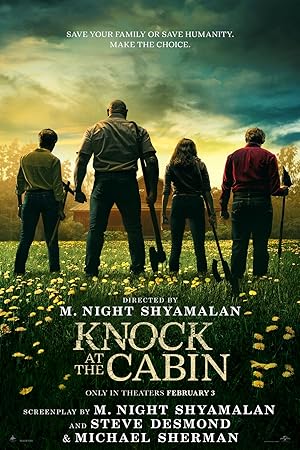
Want to know what's safe to watch? Get our weekly guide to new reviews and woke-free picks. No spam, ever.
Knock at the Cabin is not a woke trap. Its gay protagonists are established in the opening minutes, and the film's LGBTQ+ content is visible from the start. More importantly, the margin is positive at +4 TRAD. The film's theological framework, its genuine engagement with divine sacrifice and apocalyptic consequence, carries enough traditional weight to offset the woke signals. There is no mismatch between the film the trailer advertised and the film that was delivered. Shyamalan's handling of the gay couple is sympathetic but the film does not weaponize that sympathy against traditional audiences. It asks everyone to sit with a genuinely difficult moral question.
Our Verdict on Knock at the Cabin
Let me tell you the most surprising thing about Knock at the Cabin: it is a film about gay people that arrives at a verdict more theologically conservative than anything Hollywood has produced in a decade.
You would not guess this from the premise. A gay couple, Eric and Andrew, are vacationing at a remote Pennsylvania cabin with their adopted daughter Wen. Four strangers arrive armed with homemade weapons and claim they have been sent by visions to deliver a message: the family must choose to sacrifice one of their own. If they refuse, the apocalypse begins. If they comply, it ends.
This is M. Night Shyamalan. The critical instinct is to look for the twist, the reveal that the intruders are delusional, the rational explanation. Shyamalan made a different choice in adapting Paul Tremblay's novel. In the book, the apocalyptic premise is left genuinely ambiguous. In the film, it is real. As each refusal produces a new catastrophe, on television, the scale increasing, the implication becomes impossible to avoid: the universe is structured in a way that demands sacrifice.
That is an Old Testament premise. God demanding something terrible for comprehensible reasons. The chosen family cannot be chosen without the choosing meaning something. Dave Bautista's Leonard, a second-grade teacher who weeps before every act of violence he is required to commit, is not a villain. He is a man who received information he did not want and has accepted the obligation it places on him. He is trying to do the right thing in an impossible situation. This is not the portrait of religious coercion that the premise initially suggests.
The gay couple at the center creates genuine ideological friction. Andrew, played by Ben Aldridge, comes from a background of genuine religious hostility. He was attacked in a hate crime. He looks at the four intruders and sees exactly what his experience has trained him to see: fundamentalist violence targeting his family for what they are. His skepticism of the premise is not irrational. It is the reasonable skepticism of someone who has been harmed by people who also claimed divine mandate.
Eric, Jonathan Groff's character, receives the story's version of grace: a concussion during the intruders' entry produces what may be a genuine vision. He begins to believe. The film's climax turns on whether that belief is real, and what acting on it costs.
For VirtueVigil's VVWS scoring, this film presents a genuine interpretive challenge. The woke signals are real: gay protagonists treated as full heroes, same-sex adoption normalized without comment, LGBTQ+ victimhood woven into Andrew's backstory. These are not subtle. They are front and center in a film that is clearly sympathetic to its gay characters.
But the framework in which those characters are placed is not progressive. The universe of Knock at the Cabin is morally structured in the most traditional possible sense: genuine divine authority exists, it makes genuine demands, and human beings cannot simply refuse those demands without consequence. The sacrifice that ultimately ends the apocalypse is not symbolic. It is real. It matters. The moral weight is distributed to everyone equally, regardless of sexuality or family structure.
Shyamalan is asking whether love, including this love, is capable of sacrifice. The answer the film gives is yes. That is a traditional answer to a traditional question, arrived at through a story about people Hollywood typically uses to ask different questions entirely.
The TRADITIONAL LEAN verdict reflects a real tension in the film. It is not a film without woke content. It is a film in which traditional theological architecture carries more structural weight than the progressive character choices embedded within it.
Woke Tropes & Content Analysis
Formula: Weighted Score = Severity × Authenticity Multiplier × Centrality Multiplier
🔴 Woke Tropes
| Trope | Severity | Authenticity | Centrality | Score |
|---|---|---|---|---|
| Gay couple as protagonists and heroes | 4 | High | High | 5.04 |
| Same-sex adoption normalized without comment | 3 | High | Moderate | 2.1 |
| LGBTQ+ victimhood and homophobia as backstory element | 3 | High | Moderate | 2.1 |
| Multiracial family unit presented as normative | 2 | High | Moderate | 1.4 |
| TOTAL WOKE | 10.6 | |||
🟢 Traditional Tropes
| Trope | Severity | Authenticity | Centrality | Score |
|---|---|---|---|---|
| Sacrifice for others as the highest good | 4 | High | High | 5.04 |
| Genuine theological / divine authority framework | 3 | Moderate | High | 5.4 |
| Parental love and family as ultimate value | 3 | High | High | 3.78 |
| TOTAL TRADITIONAL | 14.2 | |||
Score Margin: +4 TRAD
Director: M. Night Shyamalan
MIXED. Shyamalan is one of Hollywood's most genuinely ideologically complicated filmmakers. His work consistently returns to faith, sacrifice, family, and the question of whether the universe is morally structured. Signs (2002) is essentially a Catholic film about a man reclaiming his faith through catastrophe. The Village (2004) is about a traditional community's right to construct its own social order and protect it from outside contamination. Unbreakable (2000) is about a man discovering his heroic calling and accepting the responsibility it entails. Old (2021) is about parents protecting their children from forces beyond their control. These are not progressive premises. Knock at the Cabin continues this pattern: the universe of the film is one in which genuine divine sacrifice is required, where the moral order is real and demands something from human beings. The gay protagonists are not a woke insertion into a traditional premise. They are characters placed inside a genuinely theological framework and asked the same question anyone in that situation would face: will you sacrifice what you love most for strangers?M. Night Shyamalan is a Philadelphia-based filmmaker born in Pondicherry, India in 1970 who remains one of American cinema's most distinctive working voices. His career has peaks (The Sixth Sense, Unbreakable, Signs), valleys (Lady in the Water, The Happening), and a late-career resurgence (Split, Glass, Knock at the Cabin) that few predicted. He writes and directs his own material, almost entirely, which is rare. He makes films about faith without embarrassment at a time when Hollywood treats faith as either quaint or sinister. His theological instincts are real and consistent across three decades of work. Knock at the Cabin may star a gay couple, but it is a Shyamalan film at its core, which means God, or something that functions like God, is real and demanding and not remotely interested in human comfort.
Content Breakdown
Adult Viewer Insight
Shyamalan's decision to confirm the apocalyptic premise is the most conservative artistic choice in the film and the least discussed. In a cultural moment when Hollywood's default move is to explain away the supernatural and validate the rational skeptic, Shyamalan does the opposite. God, or something that functions exactly like God, is real in this story. It makes demands. Refusing those demands has consequences for innocent people. The film does not treat this as horror in the pejorative sense. It treats it as the terms of existence. For viewers who believe in a morally structured universe, this film's underlying logic is more hospitable than its marketing suggests. For viewers who assumed a film starring a gay couple would deliver a progressive thesis, Knock at the Cabin is genuinely surprising.
Parental Guidance
Rated R for violence and some language. The violence is psychological as much as physical: the central premise, that a family must choose to sacrifice one member, is sustained pressure throughout the runtime. Three deaths among the intruders are depicted on screen. A character dies by suicide off-screen. A child witnesses the events of the film and is visibly traumatized. The gay couple is a central and sympathetic element. For families with strong positions on LGBTQ+ content, this should be factored into viewing decisions. Not appropriate for children or younger teenagers. The theological themes require adult engagement.
Is Knock at the Cabin Safe for Kids?
[object Object]
Find Knock at the Cabin on Amazon Prime Video, rent, or buy:
▶ Stream or Buy on AmazonAs an Amazon Associate, VirtueVigil earns from qualifying purchases.



Community Discussion 0
Subscribe to comment.
Join the VirtueVigil community to share your perspective on this review.